Ferrari Luce: the brand’s first electric car arrives with 1,050 hp, 530 km range and Jony Ive's design signature

Index
On May 25 in Rome, Ferrari presented the Luce, the brand's first 100% electric car in its 78-year history. The presentation took place at the Vela de Calatrava, within the Città dello Sport, and unveiled a Ferrari like never before: a four-door, five-seat sedan with 1,050 hp distributed across four motors, 530 km range, a 122 kWh battery, and 800V architecture. The exterior, interior, and interface design were entrusted to LoveFrom, the studio of Jony Ive and Marc Newson. Priced starting at €550,000, production for 2027 is already reserved.
What is the Ferrari Luce: Maranello's first EV
Maranello took almost eight decades to truly electrify. There were hybrids (SF90, 296), but no catalog Ferrari had dispensed with an internal combustion engine until now. The Luce is not a special series or limited edition; it is a range model, set to coexist with the current V8 and V12 with continuous production starting in 2027. It is also the first four-door Ferrari, the first with five real seats, measuring five meters with a 600-liter trunk: specifications more akin to a Porsche Taycan or a Lucid Air than a classic GT.
Benedetto Vigna, Ferrari's CEO, framed it as proof that a company shows leadership when it embraces technological challenges: the Luce is the result of over 60 new patents. John Elkann, chairman, described the launch as the opening of a chapter that turns a vision into reality.
Exterior Design: the LoveFrom language
It's the first time in Ferrari's history that the exterior design of a street car is not led by the Centro Stile directed by Flavio Manzoni. Maranello delegated it to LoveFrom, the creative collective founded by Ive and Newson in San Francisco.
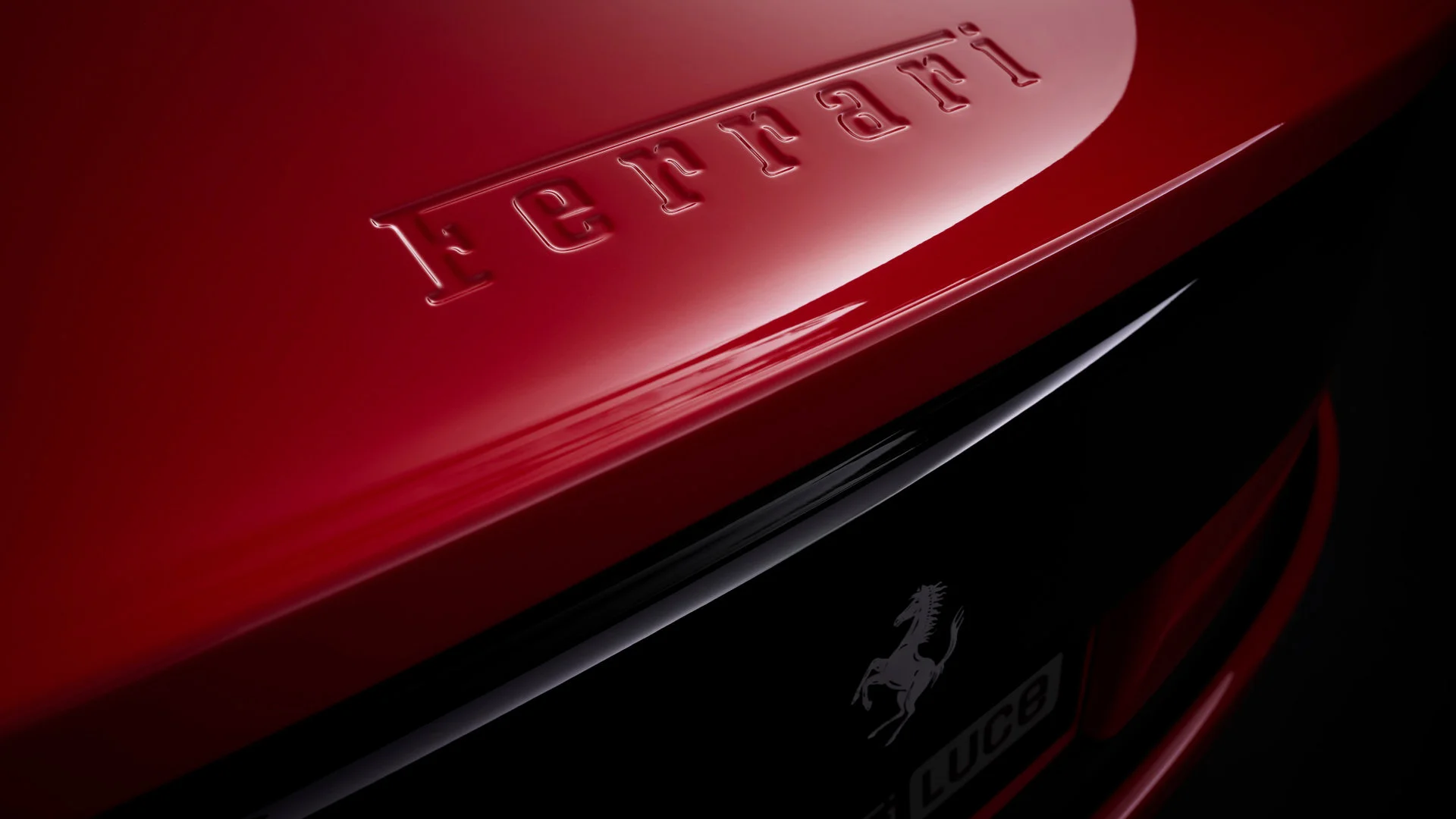
The result is the car's most polarizing feature. The silhouette is a fastback with a descending roofline tapering to a short tail. The most distinctive element is the "glasshouse": a continuous panoramic glass that stretches from the windshield to the rear window, across the roof, with no visible interruptions. The body is entirely aluminum (much of it recycled) with no steel used. At the front, a fine horizontal LED bar serves as lighting; at the back, two double circular halos function as taillights, a deliberate nod to the Testarossa and F40. Ferrari claims it has the lowest drag coefficient of any street car from the brand.
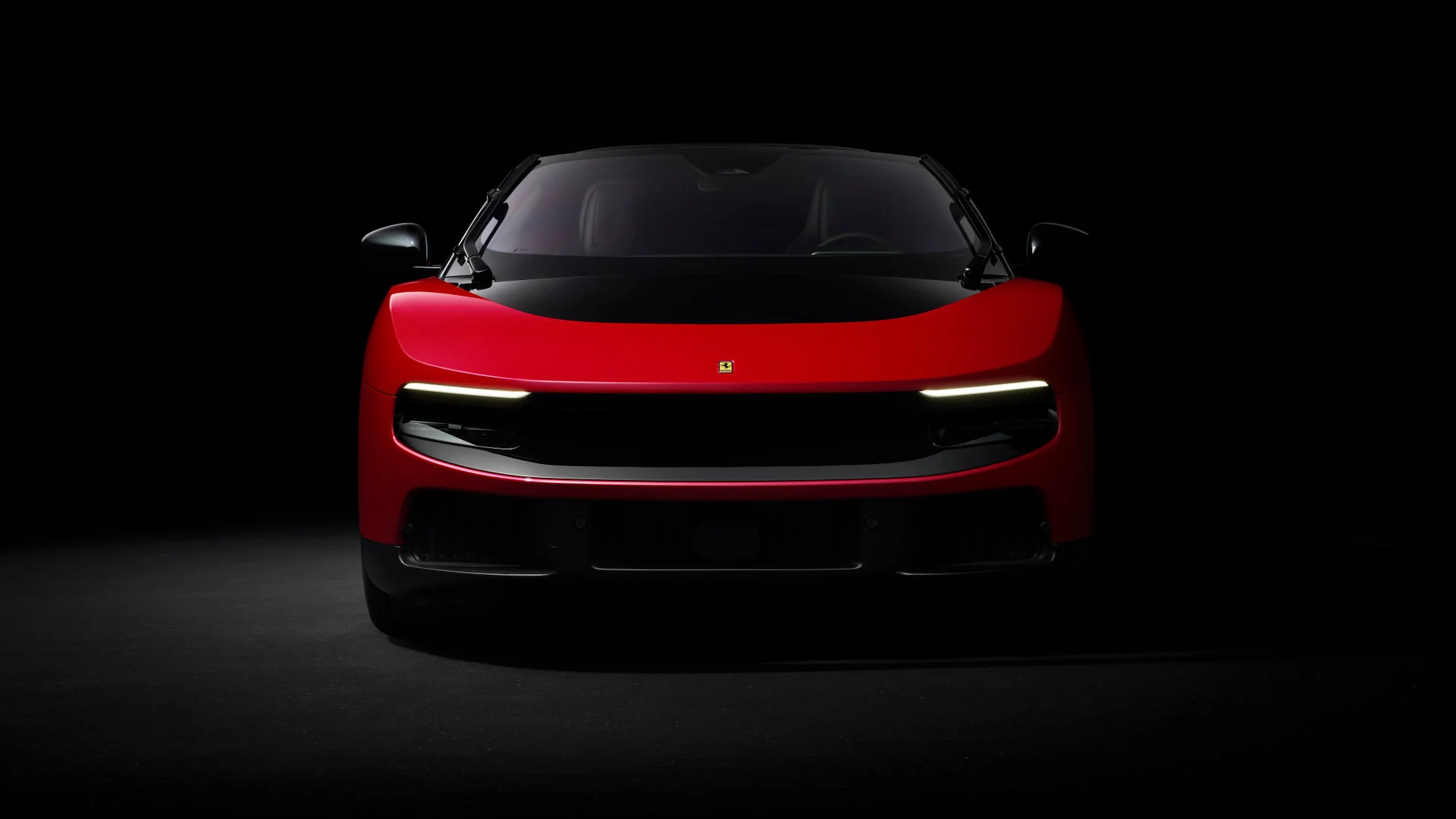
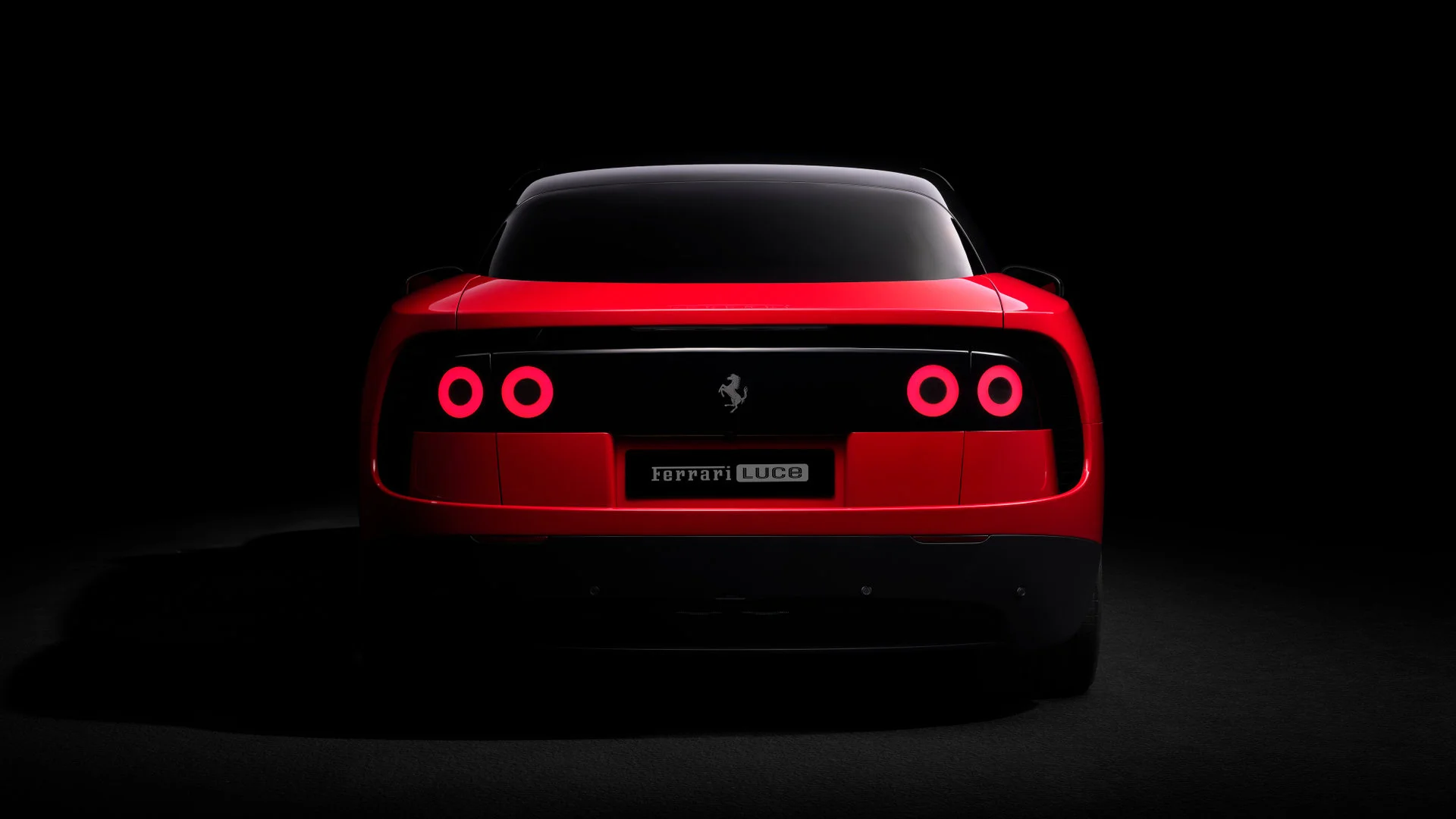
There is an engineering detail that few sites pointed out: the modular architecture. The front axle, battery pack, and rear axle can be independently disassembled. For an electric car priced at €550,000, it’s not an aesthetic whim, but about real maintainability: a collision affecting one axle doesn’t necessitate dismantling the rest, and a battery replacement within the car's life cycle becomes a contained procedure.
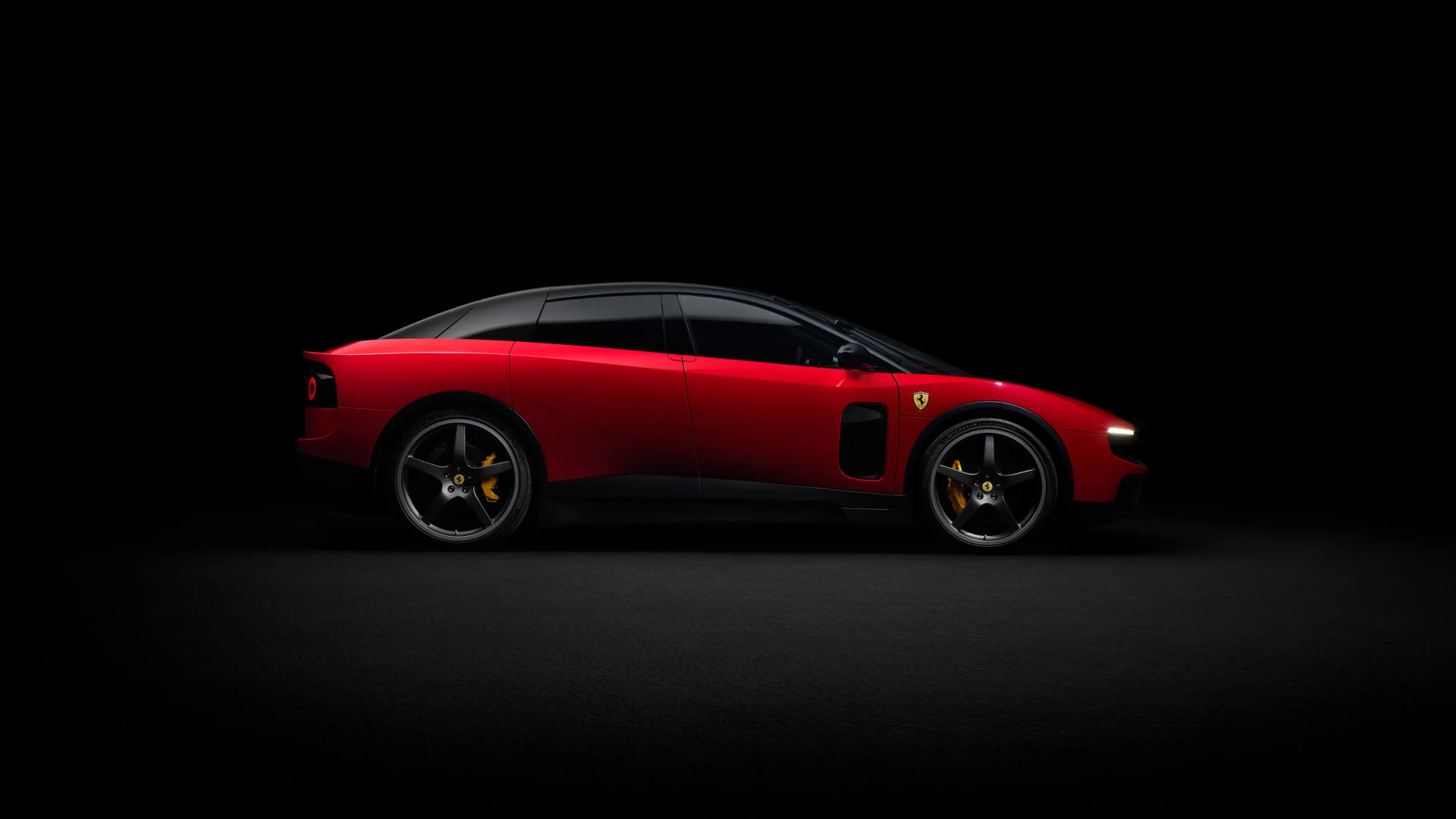
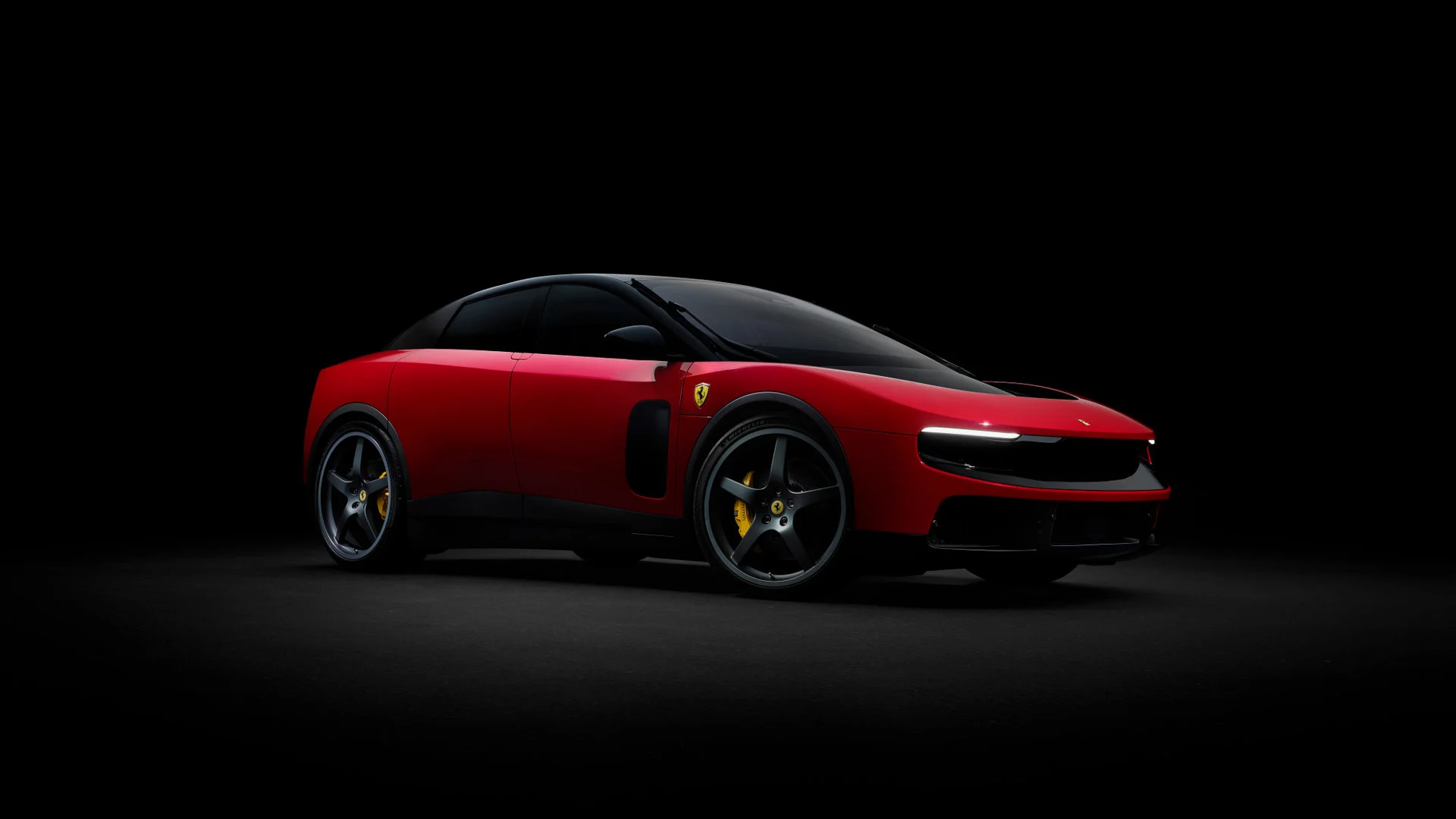
The color palette also breaks conventions: besides the obligatory Rosso Corsa, Ferrari also showcased the Luce in an unusual two-tone light blue (chosen for official exterior renderings). This is deliberate: the Luce doesn't aspire to be recognized as a classic Ferrari from a distance.
Interior: glass, recycled aluminum, and physical buttons
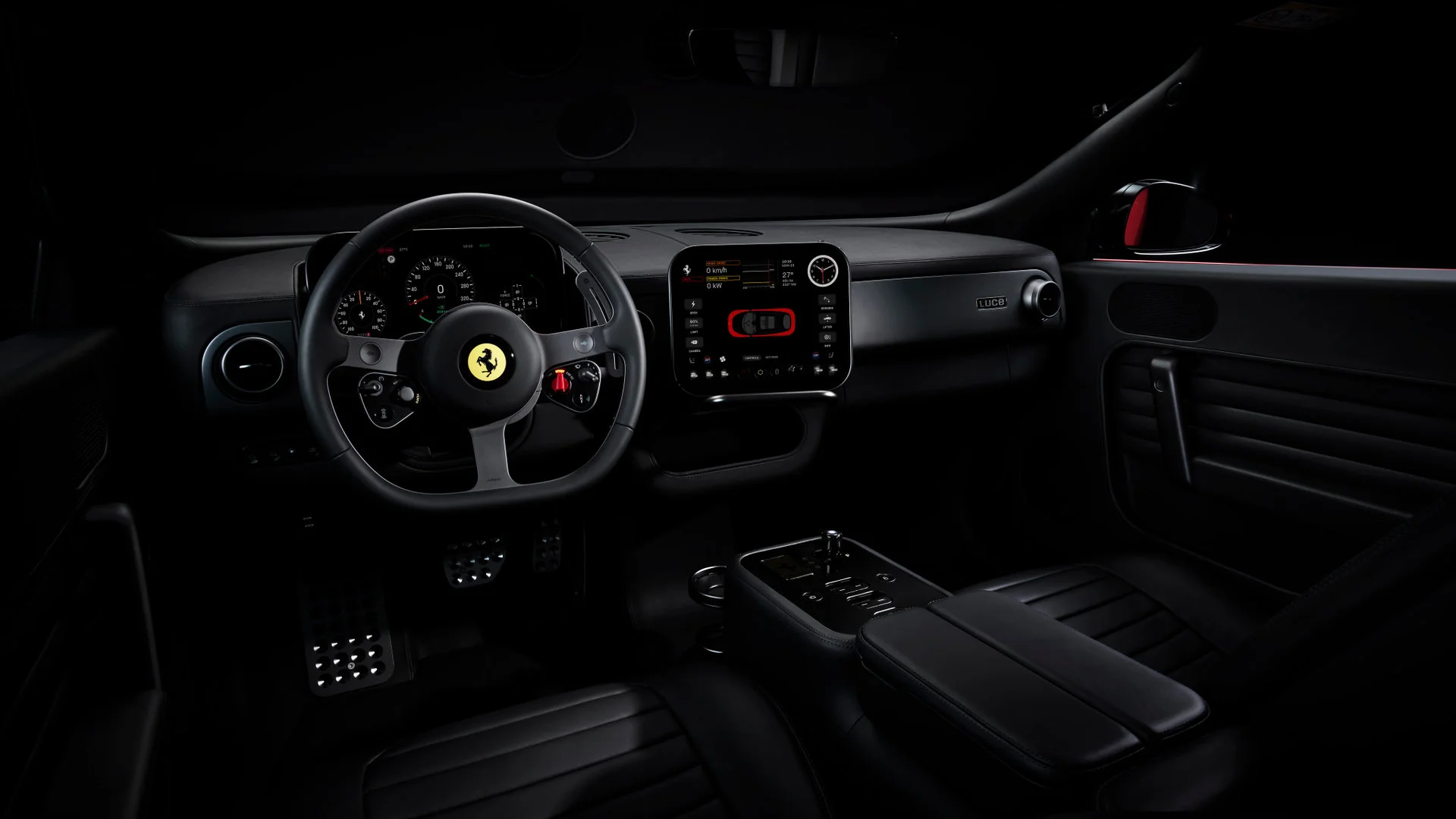
If the exterior divides opinions, the interior is where LoveFrom’s signature becomes most recognizable. Explicitly rejecting the convention set by Tesla and replicated by the Mercedes EQS, Lucid Air, and all premium EVs of having a giant touchscreen replace almost all physical controls, the Luce does exactly the opposite.
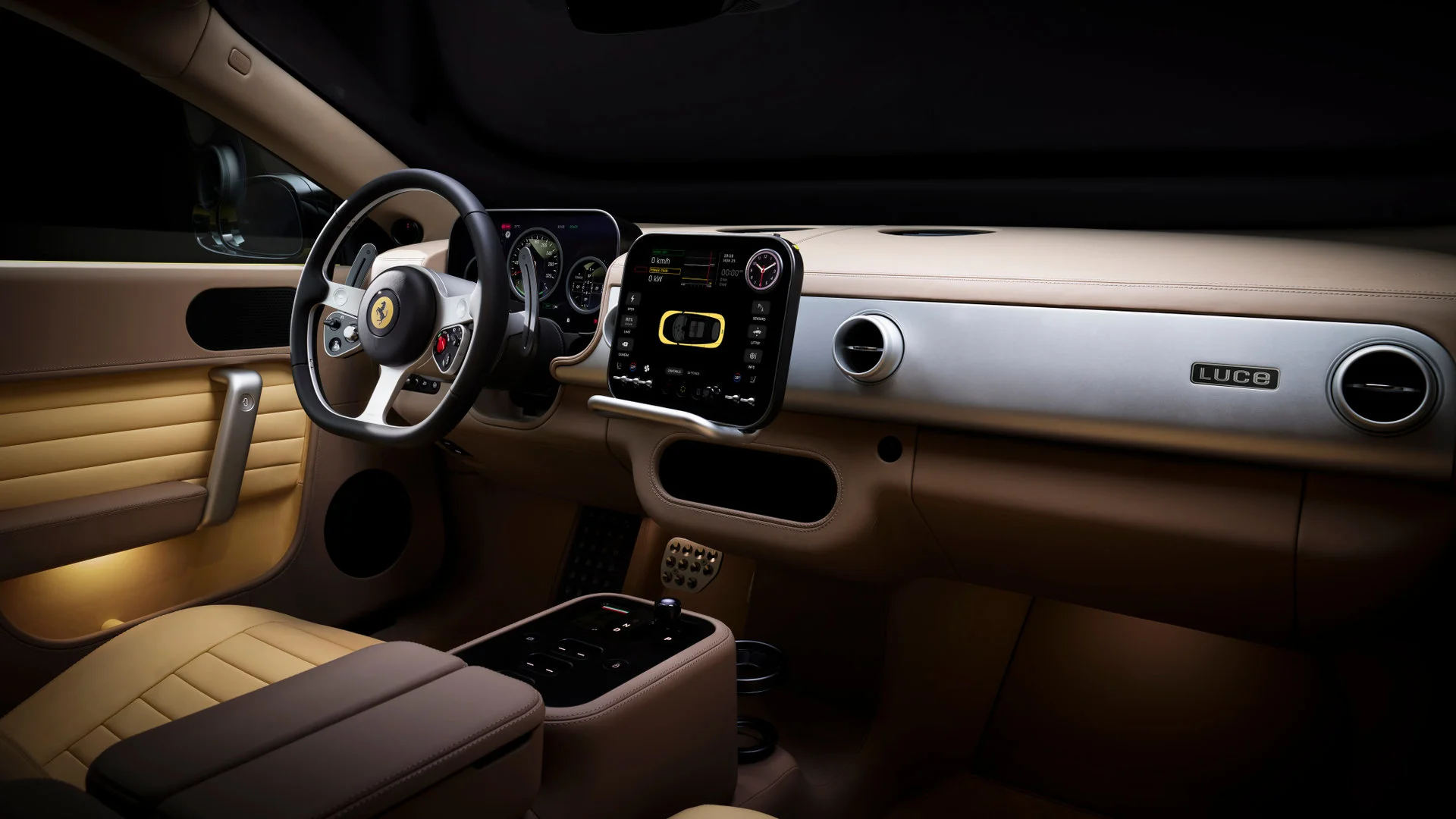
The palette: recycled anodized aluminum, Corning Gorilla Glass, leather. Precision-machined aluminum, tempered Gorilla Glass, and OLED displays from Samsung Display: the recipe closely mirrors that of a premium Apple product, which makes sense since the guiding hand is the same that for twenty years defined how an iPhone feels.
There are four custom-made Samsung OLED screens: 12.9", 12", 10.1", and 6.3". The driver's cluster combines two OLED panels overlaid with mechanical physical needles sandwiched between the two glasses: the needles are real, motor-driven, and move over digital drawings that change according to the driving mode.
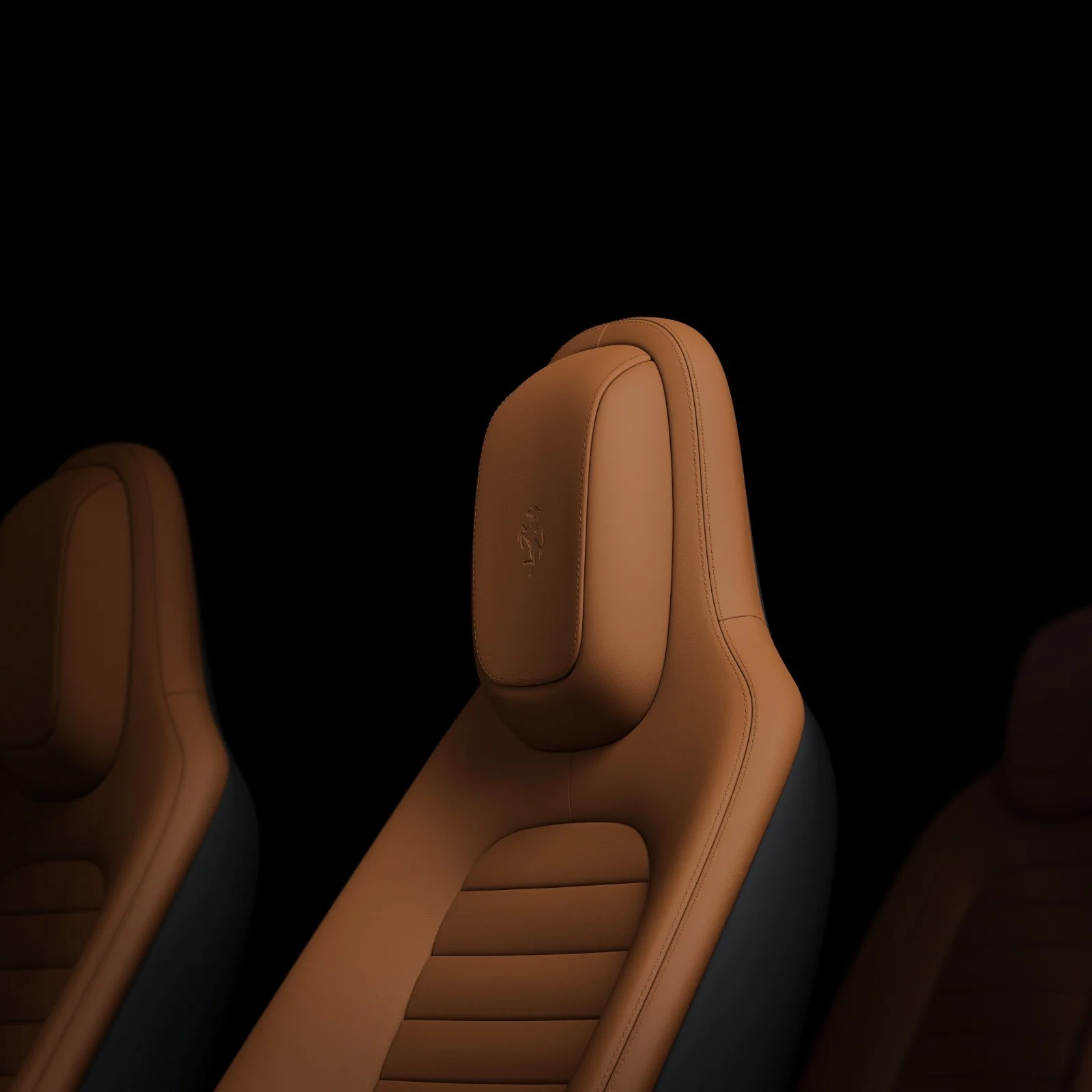
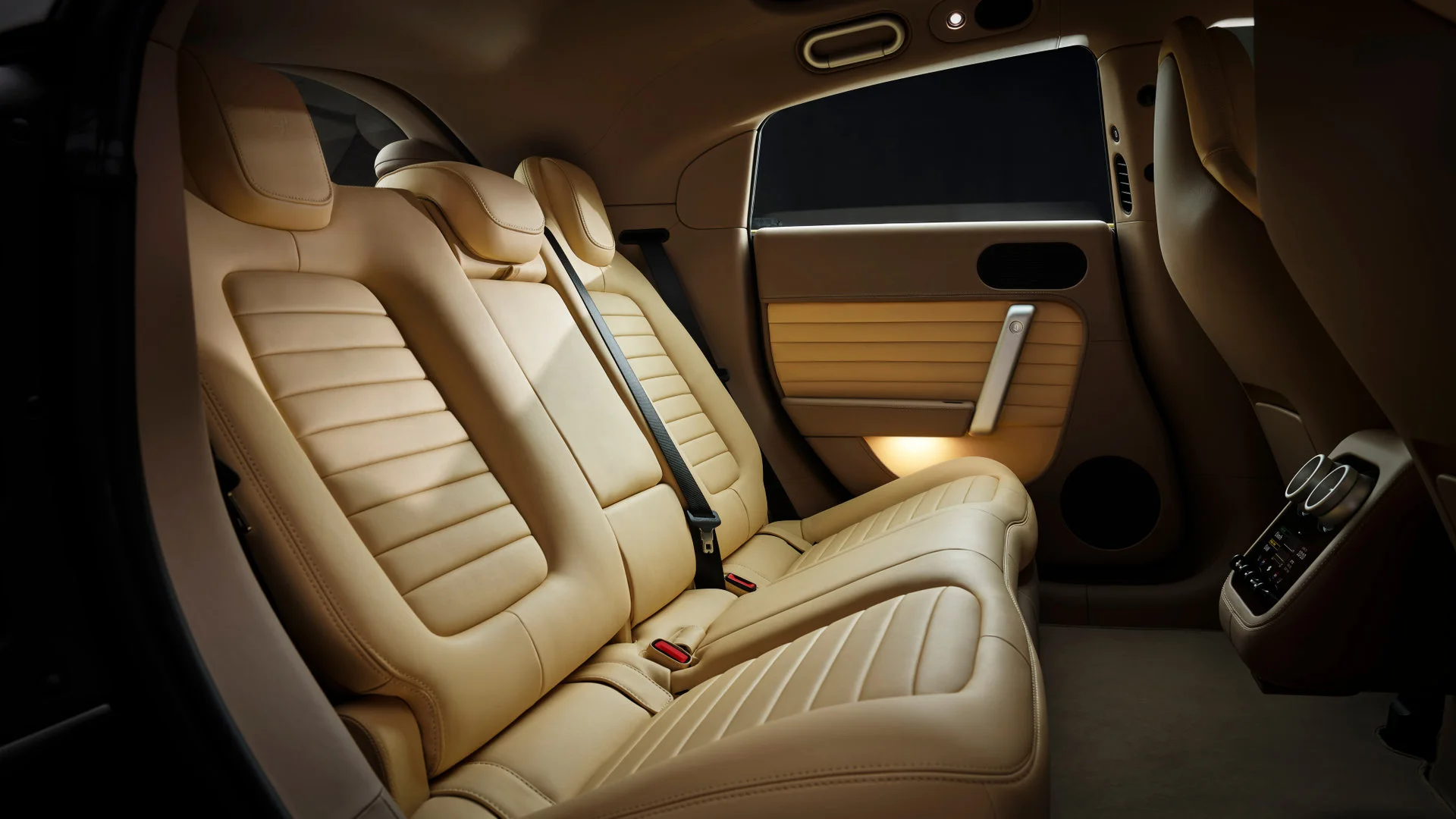
Another functional nod to space: there is no transmission tunnel. The floor is flat since there’s no gearbox or longitudinal axle, so the fifth passenger can occupy the rear center seat without contortions. In a Ferrari, this is historic. The audio system is called Ferrari Audio Signature: 21 speakers, 24 channels, 3,000 W amplification.
Steering Wheel, multigraph, and Jony Ive’s signature
The steering wheel features three spokes, flat bottomed, without the button-cluster saturation of the SF90 or 296. There’s a red manettino on the right with classic positions (Ice, Wet, Dry, Sport, ESC Off) and a left selector for power mode (Range, Tour, Perfo). The center has the prancing horse on a yellow background, nothing more.
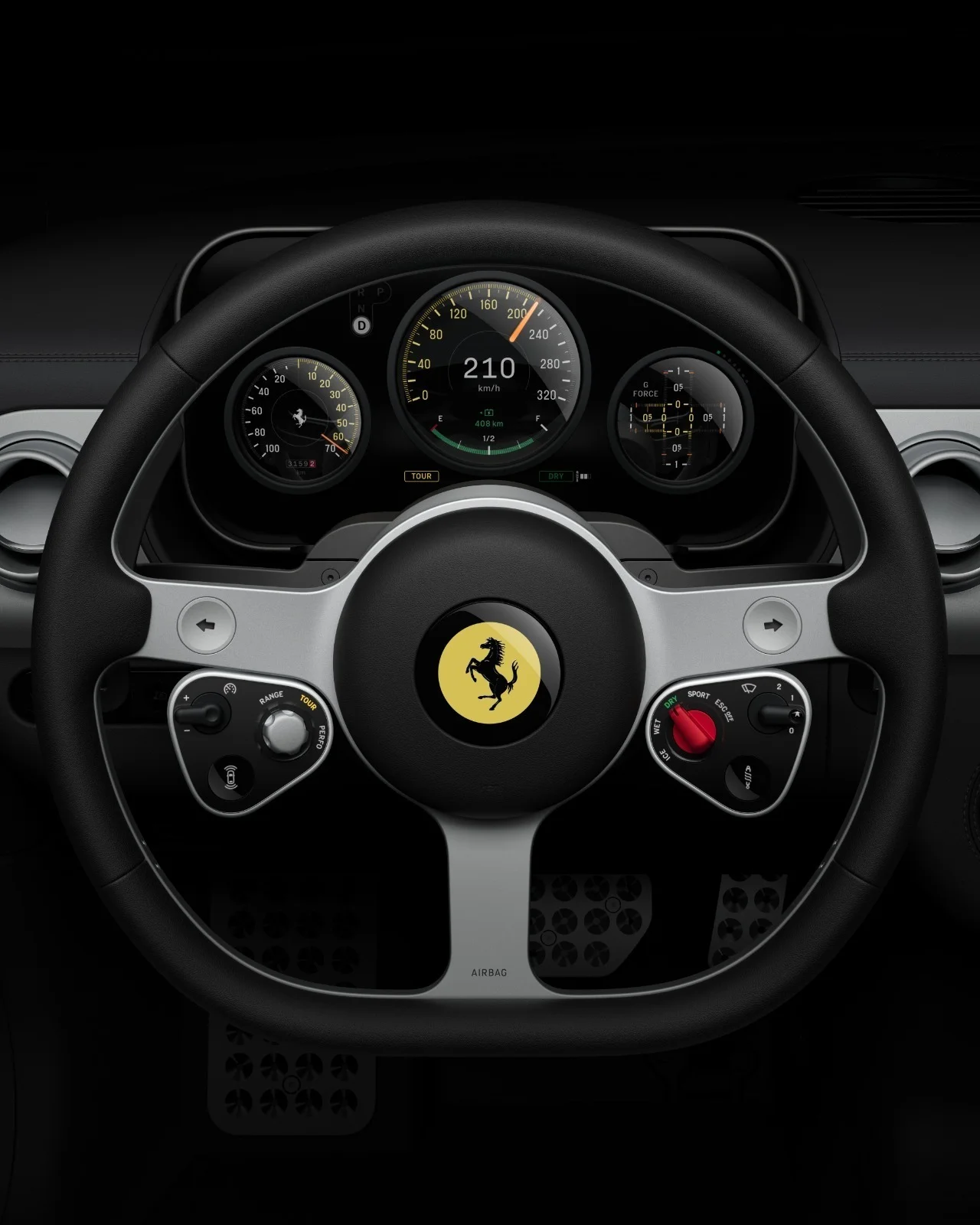
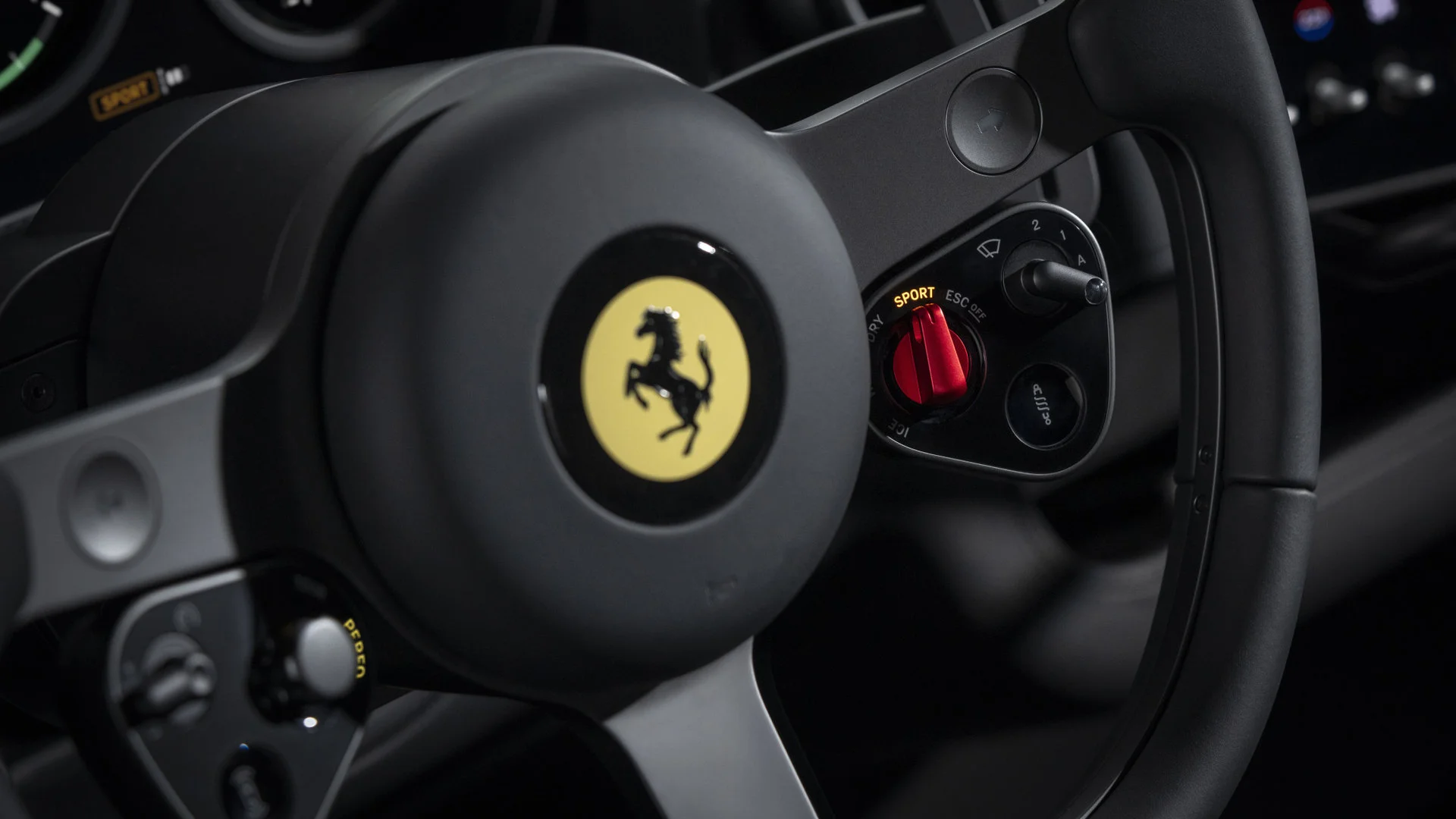
The most commented detail of the cabin is the paddles behind the steering wheel. In a combustion Ferrari, they control gear changes. In the Luce, there are no gears: Ferrari renamed them Torque Shift Engagement. The right controls five levels of power delivery, the left five levels of regenerative brake. Entering a turn, the driver modulates with the left how much negative torque to apply; exiting, with the right, how much power to unleash. It’s not gear shift simulation (Porsche and Hyundai have done that); it’s dynamic control impossible in a combustion car.
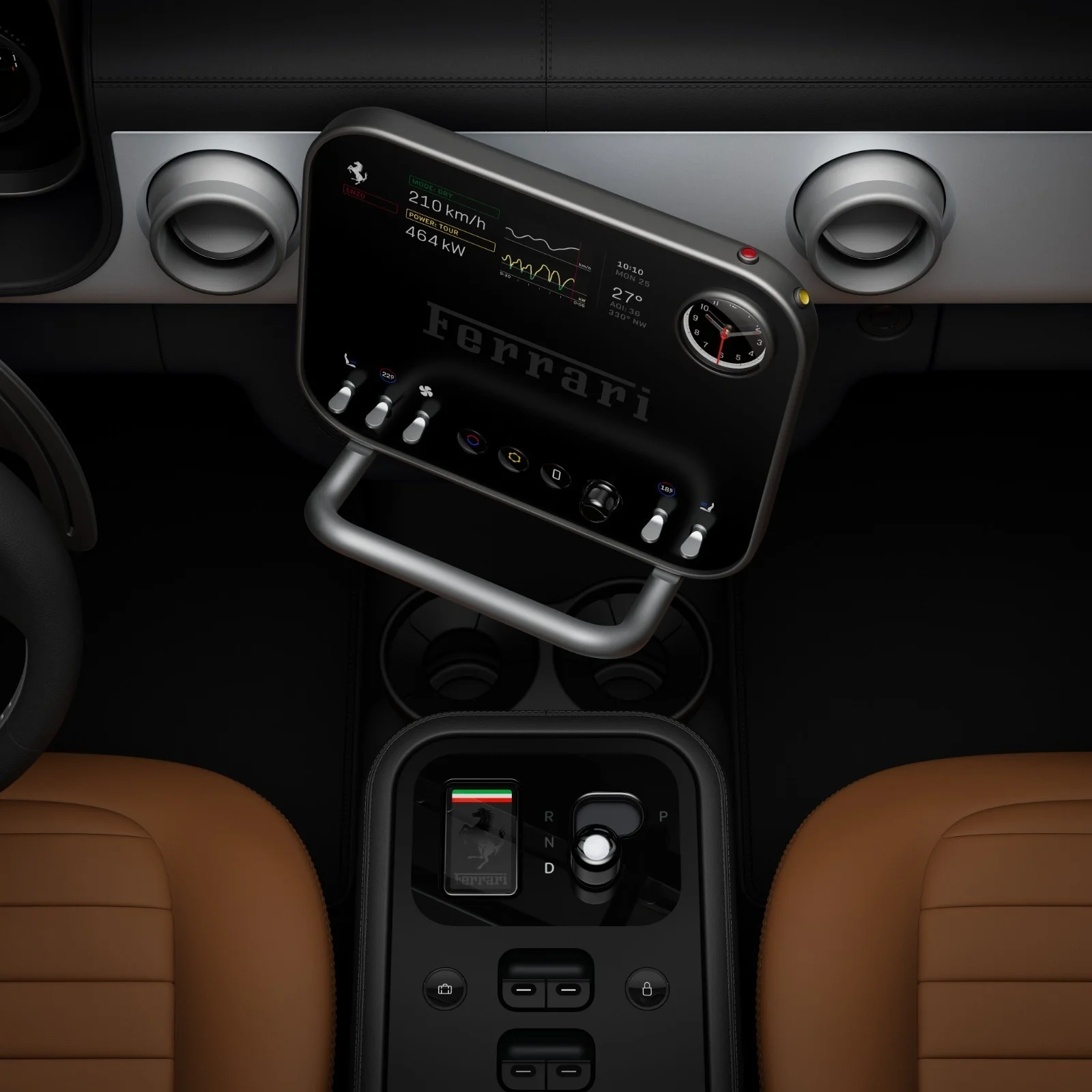
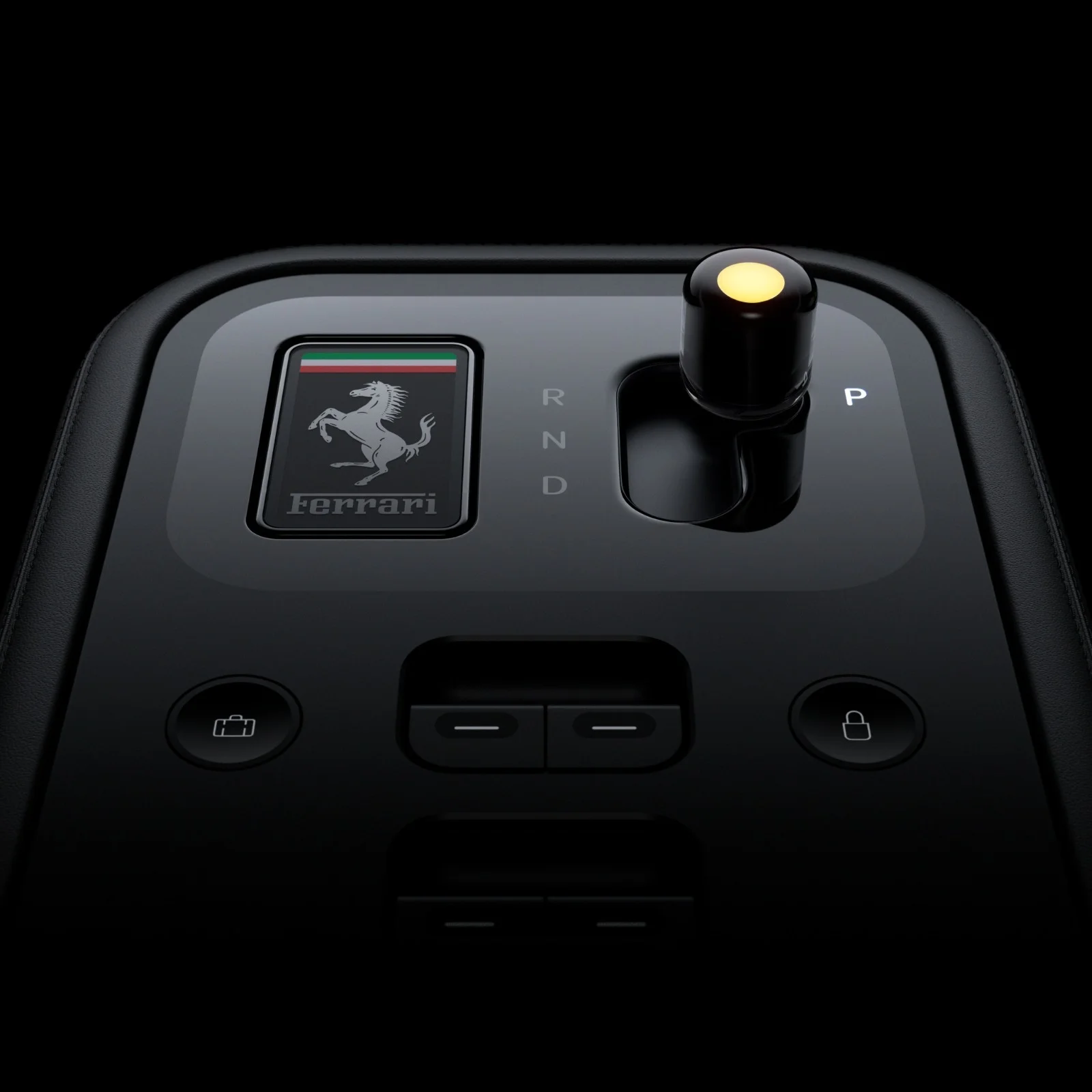
In the central console, there’s a panel Ferrari calls "multigraph": an OLED screen surrounded by an anodized aluminum analog needle that changes function according to context (clock, stopwatch, compass, or launch control). The needle is real, motor-driven; the graphics behind change. This is one of Newson’s most characteristic design gestures, rooted in watchmaking.
The Luce key deserves a separate mention. It is made of Corning Gorilla Glass with a bistable E Ink display. When inserted into its dock, the display changes from yellow to black, the gear selector lights up, and a light choreography starts throughout the cabin. This is exactly the ceremonial detail Ive championed throughout his career. The final gesture, in sync: a physical lever on the ceiling to activate Launch mode.
Powertrain: 4 motors, 800V, and structural battery
The Luce is equipped with four permanent magnet synchronous motors with radial flux, derived from the F80. One per wheel: the rear ones spin at 25,500 rpm with 620 kW combined, and the fronts reach 30,000 rpm with 210 kW combined. Total: 1,050 hp (772 kW) and 990 Nm of torque.
Each motor is individually controlled by a Vehicle Control Unit (VCU) that updates the torque targets per wheel 200 times per second. Paired with the active suspension derived from the F80 and the independent rear-wheel steering, the Luce injects or withdraws power wheel-by-wheel in real-time: a level of control impossible in a combustion car.
The battery has a nominal 122 kWh, 210 cells in series, NMC chemistry co-developed with SK On and assembled in Maranello. It operates at 800V (same league as the Porsche Taycan or Lucid Air) and supports fast charging up to 350 kW: it recovers about 70 kWh in 20 minutes, equivalent to 10-80% during a coffee stop.
The most interesting fact isn’t the capacity: it’s the integration. The pack acts as a structural element of the chassis, contributing 20% to flexural rigidity and 40% to torsional; the body-in-white plus battery set weighs 10% less than the category average, according to Ferrari. The center of gravity is 95 mm lower than in the Purosangue: the brand claims the dynamic behavior is equivalent to driving a car 400 kg lighter. This is a manufacturer’s claim (the press will verify it), but the low center of gravity is objective and will be noticeable.
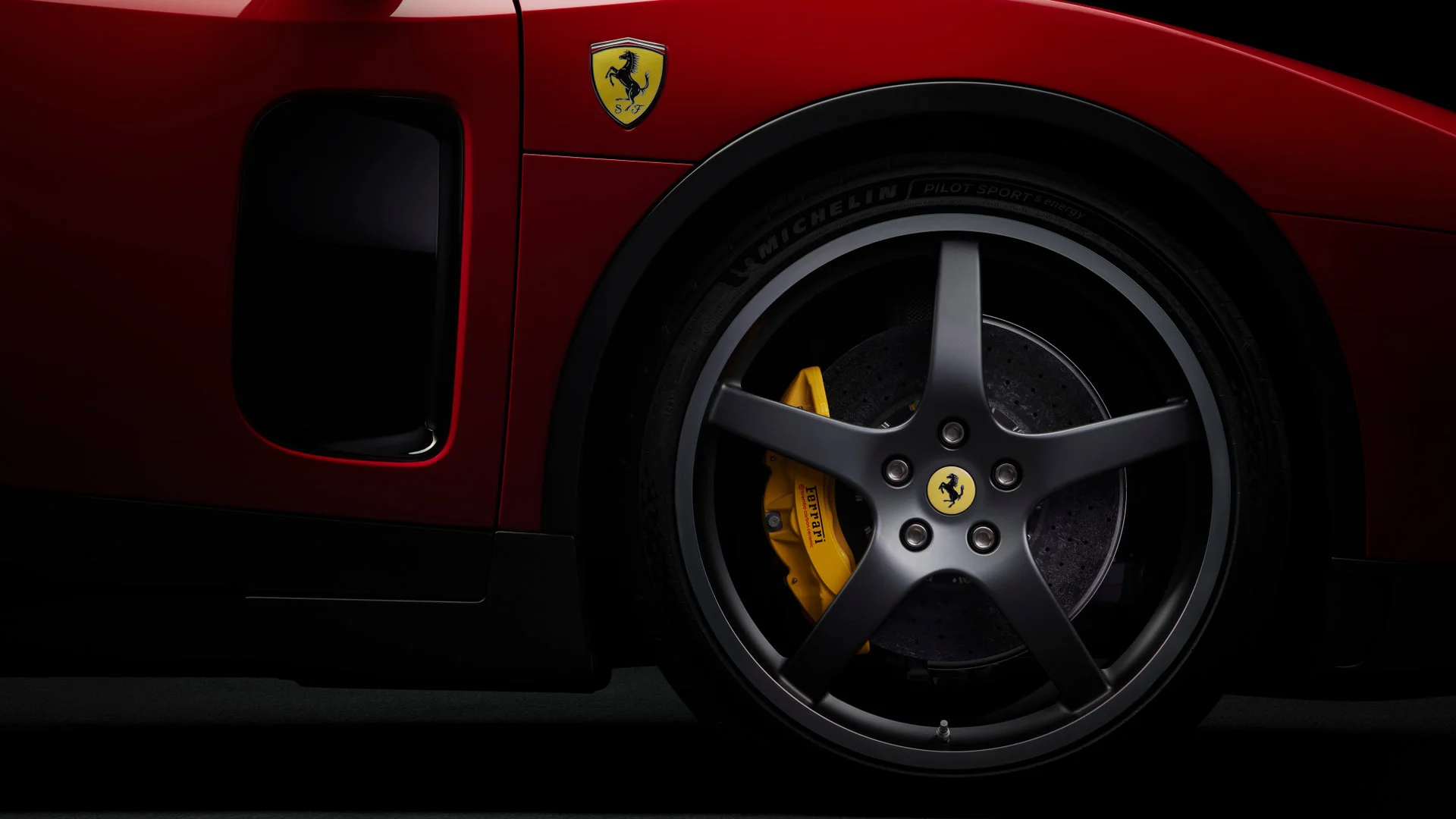
The tires are Michelin Pilot Sport S energy. Ferrari mentions over 60 new patents and 120,000 hours of R&D dedicated to the electric powertrain. The package numbers: 0-100 km/h in 2.5 seconds, 0-200 in 6.8, top speed above 310 km/h (electronically limited), range greater than 530 km in WLTP-equivalent cycle, curb weight 2,260 kg with 47:53 distribution.
Sound: the accelerometer replacing the V12
The entire industry, from Porsche to BMW, has addressed the lack of combustion engine sound by synthesizing fake noise through speakers. Ferrari rejects that path. The Luce features a precision accelerometer mounted at the center of the rear axle that captures the real vibrations of motors, gears, and rotating components. The raw signal is filtered, equalized, and amplified before being sent to the 21 internal speakers and external speakers. Ferrari compares it to an electric guitar amplifier: the string vibrates for real, the amplifier makes it audible, but the sound originates from real physical movement. There are five presets from the e-Manettino and it can be muted. It’s not a simulated V12: it's an acoustic signature derived from the Luce’s own physics, one of the most coherent proposals any manufacturer has made for sound in a performance EV so far.
Price, availability, and Maranello's gamble
The Luce starts at €550,000 (around $640,000 USD at the current exchange rate). Reservations opened on the day of the presentation and, according to Ferrari, production assigned for 2027 is already sold out. It’s not a limited edition: it coexists with the current V8 and V12 and is manufactured continuously. Ferrari maintains its goal for 20% of its production to be electric by 2030, a figure already cut down from a previously more ambitious target. The Luce isn’t aimed at the traditional Maranello customer: it targets the new buyer, possibly a first-time Ferrari owner, possibly in markets like China where luxury EVs have more cultural acceptance.
The financial market reception on announcement day was lukewarm: Ferrari shares fell as much as 8% during the Milan stock session before moderating losses around 6%, indicating that investors didn’t unanimously view the launch as a success. This interpretation, along with the discussion that the car's design generated on social media since the curtain lifted, merits separate analysis.
Conclusion: a Ferrari that breaks its own rules
The Luce isn’t designed to be a Ferrari for the traditional Ferrari enthusiast, and that seems deliberate. What defines it isn’t the raw data of 1,050 hp or the 530 km range (Lucid Air and Porsche Taycan are in that zone). What defines it is the design decision: rejecting the dominant touchscreen, retaining mechanical needles and physical buttons, capturing the real sound of the motors instead of synthesizing it, and delegating the aesthetic direction to an external studio for the first time in its history.
That LoveFrom’s bet will define whether the Luce ages well. Cars designed around massive touchscreens begin to look outdated when the screen falls two generations behind; cars with physical interfaces and noble materials tend to endure better. The open question is not whether the Luce works technically —the 60 patents and F80 heritage suggest the engineering is covered—. The question is whether the new customer Ferrari targets will pay Maranello's premium for a car unlike any previous Ferrari, and if the traditional customer accepts the V12 coexisting with a five-seat electric sedan in the same catalog.
Luce
Primer auto 100% eléctrico de Ferrari. Sedán de 4 puertas y 5 asientos con 1.050 cv distribuidos en 4 motores, batería de 122 kWh a 800V y autonomía superior a 530 km. Diseño firmado por LoveFrom (Jony Ive y Marc Newson). Modelo de gama con producción 2027 ya agotada por reservas.
✓ Pros
- Más de 60 patentes nuevas y arquitectura modular que permite desmontar ejes y batería de forma independiente.
- Batería como elemento estructural del chasis: +20% rigidez flexional y +40% torsional.
- Sonido derivado de vibraciones físicas reales del powertrain, sin síntesis artificial.
- Interfaz física con manettino, agujas mecánicas y botones reales en lugar de pantalla táctil dominante.
✕ Cons
- Diseño exterior polarizante, alejado del lenguaje visual clásico de la marca.
- Peso considerable: 2.260 kg, casi 200 kg más que el Purosangue con V12.
- Recepción del mercado financiero tibia: caída de hasta 8% en la acción de Ferrari el día del anuncio.
Information based on official specs. The author has not had physical access to the product for this report.
Comments (0)
No comments yet. Be the first!