ASUS Debuts RGB Stripe Pixel OLED at CES 2026: Three New ROG Monitors Solve Text Issue

Index
At CES 2026, ASUS unveiled three new OLED monitors in their ROG line, featuring a panel innovation more significant than refresh rate or HDR: RGB Stripe Pixel OLED technology. It addresses the last argument keeping OLEDs from serious productive use – color fringing on text edges – and simultaneously appears in Samsung Display's QD-OLED and LG Display's Tandem WOLED.
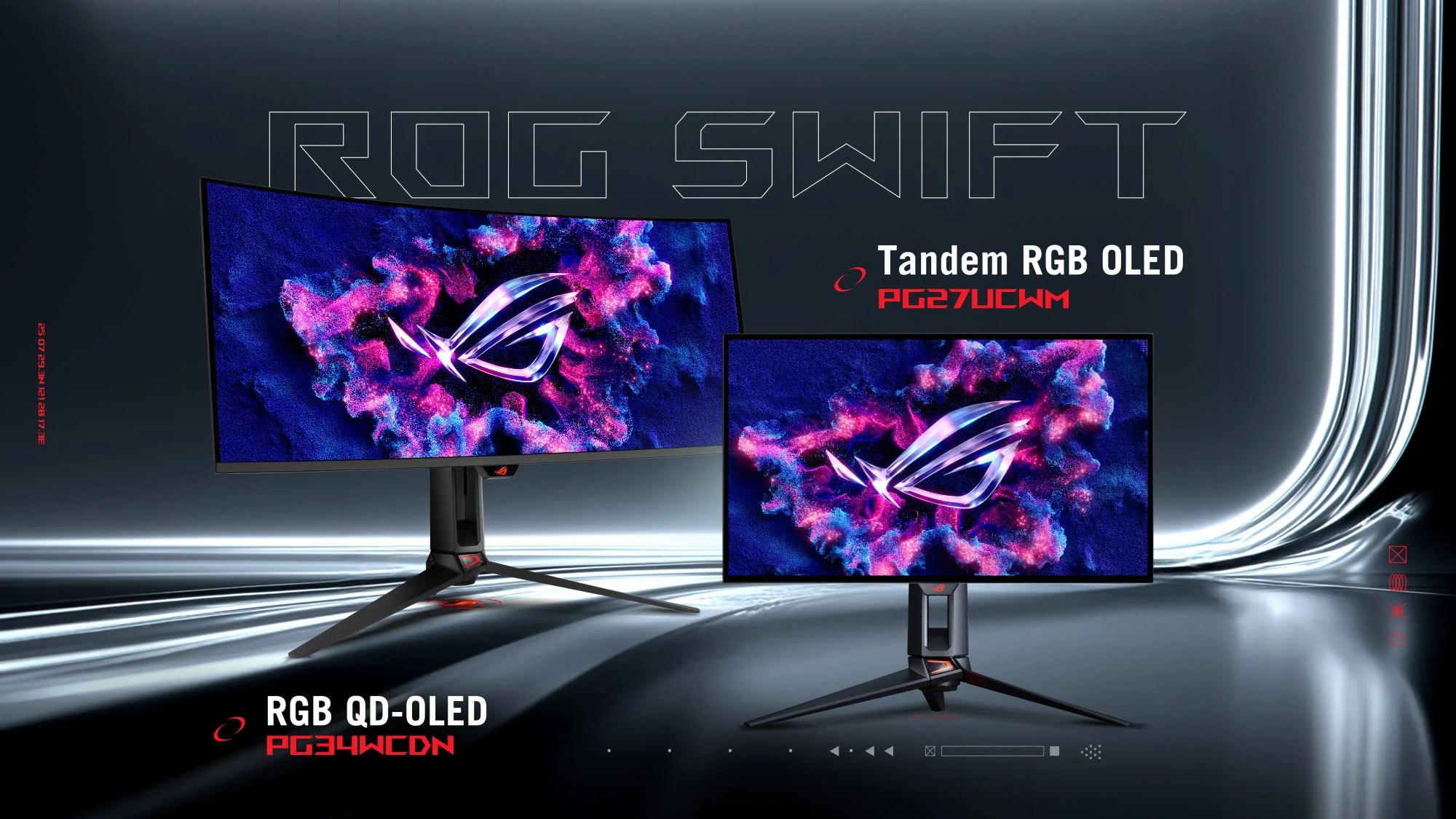
The lineup spans two panels, two formats, and three price tiers: the flagship ultrawide ROG Swift OLED PG34WCDN at 360Hz, the cut-down twin ROG Strix OLED XG34WCDMS at 280Hz, and the ROG Swift OLED PG27UCWM, a 27" 4K dual-mode designed equally for gaming and work.
What is RGB Stripe Pixel OLED and Why It Matters
In a traditional OLED, the red, green, and blue subpixels that make up each pixel are not arranged in a line but in non-standard patterns: triangular in QD-OLED, RGWB in WOLED (with an extra white subpixel). These layouts yield excellent color and brightness results but disrupt the rendering logic for operating systems. Windows with ClearType assumes a vertical R/G/B subpixel stripe order for subpixel rendering – the technique that enhances text sharpness by leveraging the panel's physical configuration. When the panel doesn't adhere to this order, color fringing (a purplish or yellowish halo on text edges) appears, and the text looks blurry at normal monitor distances.
RGB Stripe Pixel OLED reorganizes the subpixels into contiguous vertical R/G/B stripes, identical in distribution to those of an IPS or VA. The OS rendering realigns with the panel, and the text appears crisp as on a high-quality LCD, without sacrificing OLED's contrast, color gamut, or response time.
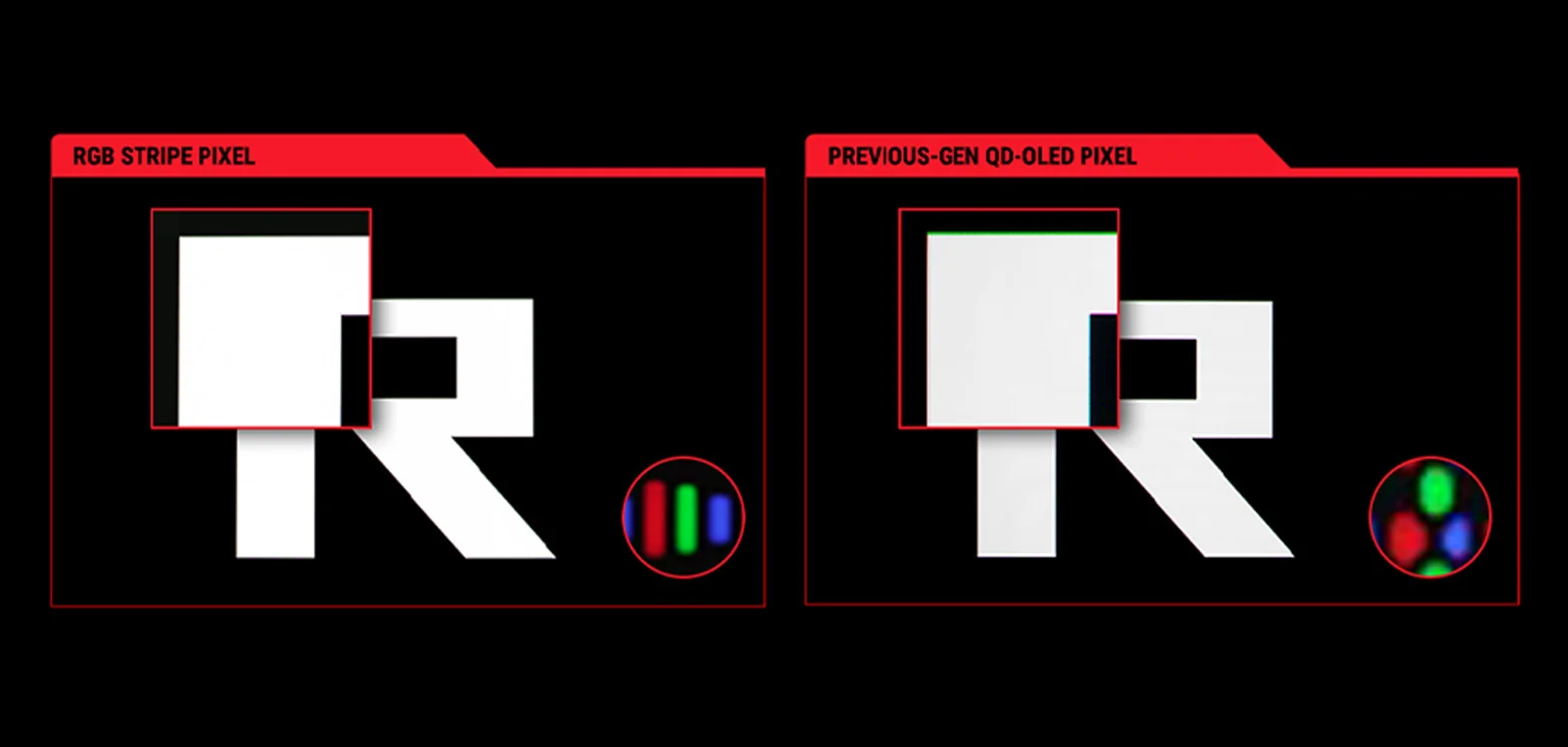
This is not a proprietary technology of ASUS. Samsung Display introduces the layout (calling it "V-stripe") in their 5th generation QD-OLED, and LG Display follows suit in their 4th generation Tandem WOLED, also removing the white subpixel from RGWB. ASUS is among the first to release commercial products with both panels, but throughout 2026, we will see similar changes from MSI, Dell/Alienware, and other brands sharing suppliers.
ROG Swift OLED PG34WCDN: The 360Hz Flagship
The PG34WCDN is the model ASUS positions as the "world's first RGB OLED gaming monitor." It is a 34" 1800R curved ultrawide with a WQHD 3440×1440 resolution, native 360Hz, and 0.03ms GtG response time on the 5th generation QD-OLED from Samsung Display.
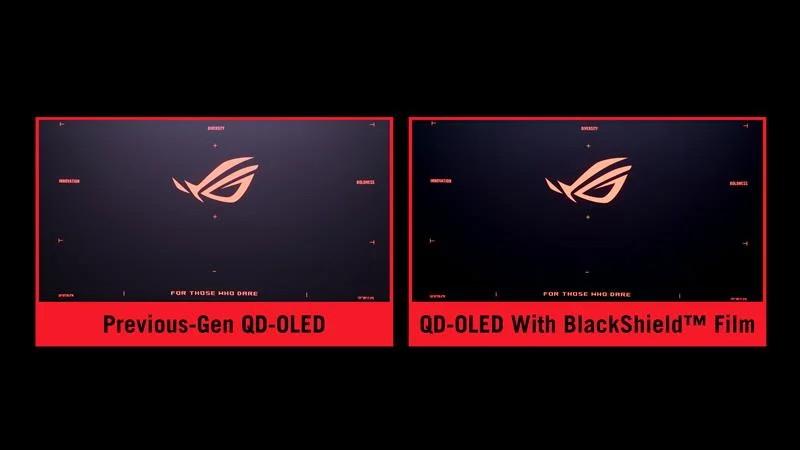
The less publicized but most relevant feature for long-term use is the BlackShield film, a layer ASUS applies over the panel to increase the surface hardness from 2H to 3H. The difference is noticeable in daily cleaning, living with dust, pens, or a potential accident with cleaner without a real risk of marking the panel – QD-OLEDs have been notoriously more fragile than WOLEDs in this respect. The film also boosts perceived blacks by 40% in lit environments, where classic QD-OLED tended towards a purplish black.
The HDR certifications are comprehensive: VESA DisplayHDR 500 True Black, 1300 nit peak, 99% DCI-P3, 10-bit native, Delta E < 2, and Dolby Vision support. Connectivity is also flagship: DisplayPort 2.1a UHBR20 with 80Gbps full bandwidth (necessary for 360Hz at 10-bit without compression), HDMI 2.1, and USB-C with 90W Power Delivery. This means you can plug in a MacBook Pro M4 or any USB-C laptop, charging, displaying, and working with a single cable.
Completing the package is OLED Care Pro with the Neo Proximity Sensor, which turns off the panel when you step away from the desk. It's one of the few real anti burn-in implementations that work without you needing to set timers or remember anything.
ROG Strix OLED XG34WCDMS: The Same Panel, Less Cost
The XG34WCDMS shares the 5th gen QD-OLED base panel with the flagship – same BlackShield film, same RGB Stripe subpixel, same 0.03ms, same 99% DCI-P3, same DisplayHDR 500 True Black certification. What changes is where ASUS decided to save: 280Hz instead of 360Hz, DisplayPort 1.4 with DSC instead of DP 2.1a UHBR20, USB-C with 15W instead of 90W, and a more compact stand.
The difference between 280Hz and 360Hz isn't noticeable outside of serious competitive metrics, and DP 1.4 with DSC is sufficient to run WQHD at 280Hz with HDR without visible compromise. The USB-C cut, however, defines the decision: if you were planning to use this monitor with a MacBook or any USB-C laptop as an all-in-one dock, 15W doesn't charge anything. Connectivity for display, yes, real charging, no. If you need that function, the PG34WCDN is the only option of the ultrawide trio; otherwise, the XG34WCDMS offers the same panel at a Strix price.
ROG Swift OLED PG27UCWM: The Interesting Outlier
The PG27UCWM is the most distinct model in the trio and possibly the most useful package. It's a 27" (actual 26.5") 4K 3840×2160 native panel, yielding a pixel density of approximately 166 PPI – high by OLED standards, where the average is between 110 and 140 PPI.
The panel is 4th generation Tandem WOLED from LG Display, not QD-OLED from Samsung. This generation is the first to adopt a pure RGB Stripe, removing the white subpixel that OLEDs carried from their origin. The result, according to LG Display, is 27% more color volume at high luminance: classic WOLEDs lost saturation when nits increased as the white subpixel stepped in to compensate brightness. Instead of the QD-OLED's BlackShield film, this model comes with a TrueBlack Glossy coating, a different solution for the same objective (reduce reflections without losing black depth).
The most useful package feature is the dual mode: with a shortcut, the monitor switches between 4K@240Hz and 1080p@480Hz. For cinematic AAA games where resolution matters, 4K@240Hz; for competitive shooters where you want all possible frames, 1080p@480Hz with identical 0.03ms response time. Complete connectivity: DP 2.1a UHBR20, USB-C 90W PD, HDMI 2.1.
This is the first 27" 4K OLED genuinely comfortable for text, code, and creator workflow, besides being a gaming powerhouse. If you have to choose a single monitor for mixed use, this is the one looking most to the future.
Availability
ASUS targets the first half of 2026 for market rollout, with the PG34WCDN already having reviews available and the XG34WCDMS and PG27UCWM slated for Q1-Q2. No official prices were announced.
Conclusion
The conversation around OLED monitors in 2026 has shifted. Until now, it has been about nits, refresh rate, and burn-in, and that discussion is practically closed: 1300-nit peak, true 360Hz, and OLED Care Pro with Neo Proximity Sensor are already high-end standards. This year's upgrade-defining difference is the subpixel, and ASUS was first out the gate with three models covering the spectrum well.
If you want ultrawide without compromise, the PG34WCDN is the flagship. If you want the same panel at a reasonable price without full USB-C dock functionality, the XG34WCDMS. If you need a single monitor for competitive gaming, cinematic AAA, and all-day screen work, the PG27UCWM is the most versatile of the trio.
The one left out of the party is the PG32UCDM Gen 3, announced in parallel. It gets the BlackShield film but retains the triangular subpixel from the old QD-OLED. If you were considering it, it's worth waiting for the version adopting RGB Stripe – it will come.
Information based on official specs. The author has not had physical access to the product for this report.
Comments (0)
No comments yet. Be the first!
You might also like

540Hz at $1,099: ROG Swift OLED PG27AQWP-W, the world's fastest OLED monitor.
The ROG Swift OLED PG27AQWP-W arrives at $1,099 with native 540Hz at QHD, 4th gen Tandem WOLED panel, and translucent design. A technical analysis with the caveats the rest of the media doesn't mention.
29 April 2026

UltraGear evo is LG's bet on 5K gaming with integrated AI: these are the three models
LG inaugurates UltraGear evo at CES 2026 with three 5K monitors, dedicated AI processor, and a significant asterisk on the most expensive model. Analysis of the 39GX950B, 27GM950B, and 52G930B.
about 21 hours ago
