540Hz at $1,099: ROG Swift OLED PG27AQWP-W, the world's fastest OLED monitor

Index
ASUS unveiled it at Gamescom 2025 and released it in November of the same year. Since then, the ROG Swift OLED PG27AQWP-W holds the official title of "world's fastest OLED gaming monitor": native 540Hz at QHD, the first 4th generation Tandem WOLED panel by LG Display, unprecedented translucent design, and an MSRP of $1,099 USD / €1,099. In January 2026, it earned the Taiwan Excellence Award, and ComputerBase rated it as the best monitor tested in their lab to date.
The framing ASUS imposed on the coverage—"the world's fastest OLED"—is technically correct but doesn't tell the whole story. The product is genuinely flagship; it also has caveats that the Spanish-speaking press largely overlooks.
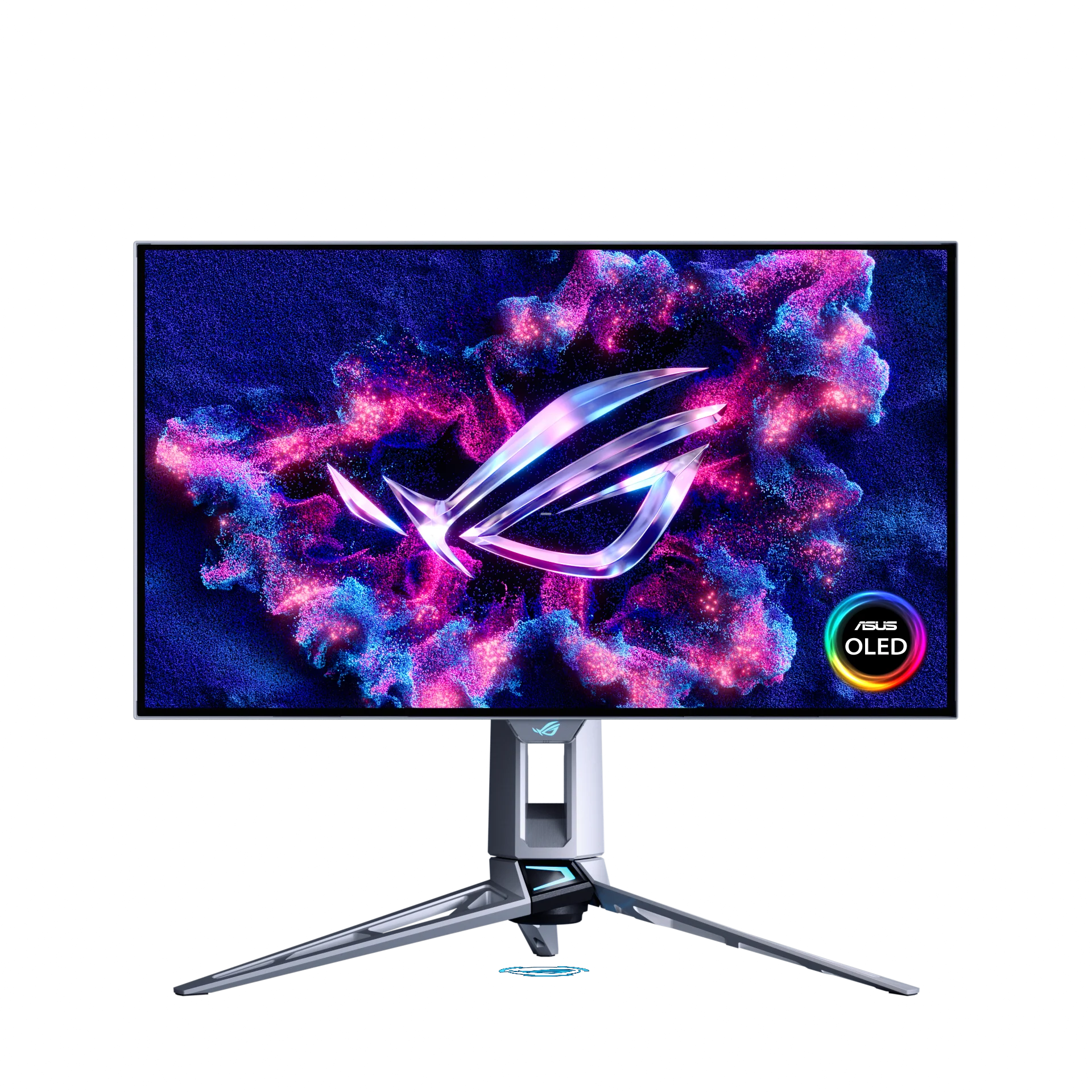

What it is and where it fits in the ASUS lineup
It's a 27" (26.5" actual) QHD 2560×1440 monitor with a 4th-generation Tandem WOLED panel from LG Display. Within the ASUS lineup, it stands as the flagship esports model for the 2025-2026 season: above the Strix XG27AQWMG ($599), its cut-down twin at 280Hz sharing the same base panel; and below the ultrawide PG34WCDN from CES 2026, targeting a different use case.
The final "W" in the name identifies the silver/white edition. It's one of the few flagship gaming monitors breaking away from the category's standard black.
4th gen Tandem WOLED and the promise of durability
The technical shift that defines the product is in the panel. Tandem WOLED stacks four OLED layers instead of the two found in traditional WOLED, which translates to 15% more peak brightness, 25% more color volume, and 60% more lifespan than the previous generation. TFTCentral and RTINGS confirm HDR peaks up to 1500 nits in small windows—enough to compete head-to-head with QD-OLED in HDR, which classic WOLED couldn't do due to brightness limitations.
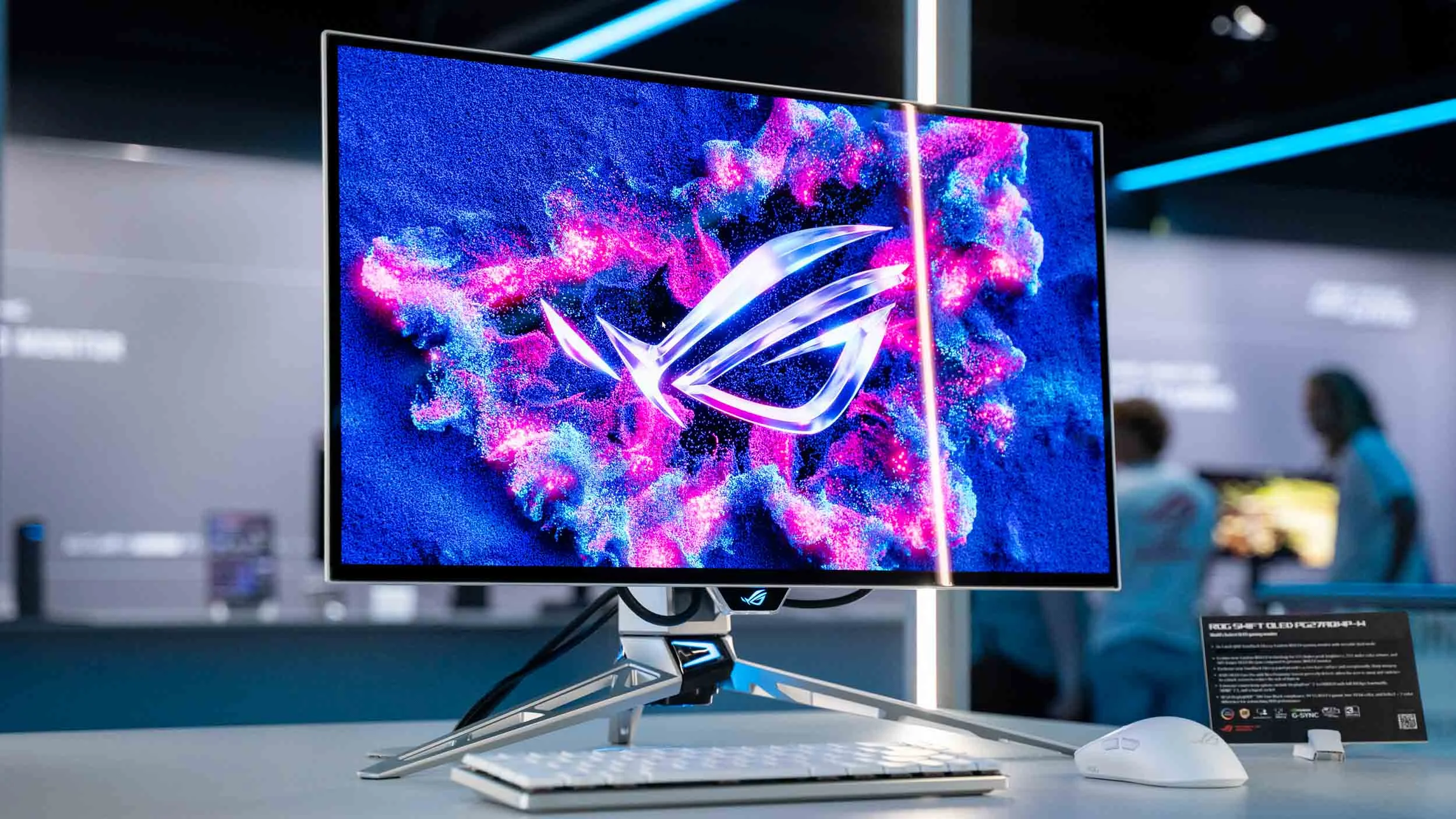

The panel retains the RGWB sub-pixel structure with the characteristic white subpixel of WOLED, mitigated by the "Clear Pixel Edge" algorithm designed to reduce color fringing on text edges. It's a software solution, not hardware: effective, but not the same as the pure RGB Stripe of the panel's RGB variant, headed for the PG27UCWM announced at CES 2026 (we cover that news here).
The durability promise is reinforced with the OLED Care Pro package: pixel orbiter, perimeter dimming, pixel clean, and the Neo Proximity Sensor that turns off the panel when the user steps away. Added to a custom internal heatsink and a 3-year warranty with burn-in coverage, ASUS backs the investment at a level that wasn't standard two years ago.
Native 540Hz and the dilemma of dual mode 720Hz
540Hz in native QHD is the figure that justifies "world's fastest": surpassing the 500Hz QD-OLEDs that arrived months earlier by a small yet real margin. Coupled with the 0.02ms GtG and 0.1ms input lag measured by TechSpot, the numbers compete at the absolute ceiling of the market.
The asterisk lies in the dual mode. With a shortcut, the monitor switches to 720Hz but the resolution drops to 1280×720—real HD, not Full HD; the labeling initially caused confusion. According to PCWorld's measurements, the leap from 540Hz to 720Hz isn't noticeable to most, and 720p on a 27" panel looks blurry due to scaling. TechSpot outright recommends against using it. The less advertised but practically more useful feature is ELMB (Extreme Low Motion Blur): inserts black frames, delivering clarity equivalent to 540Hz at 270Hz operation.
Design: translucent panel, hollow base, silver white
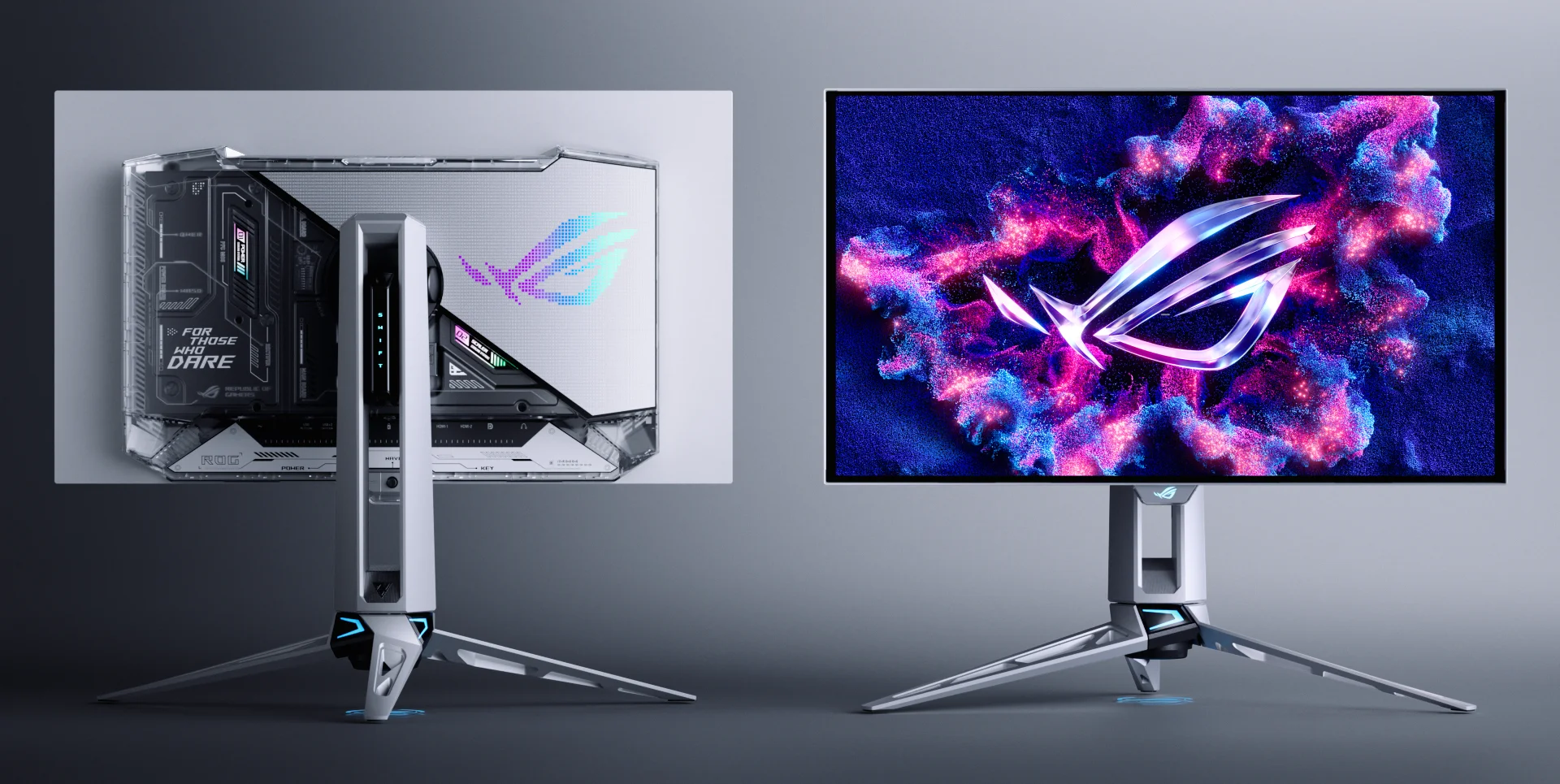
This is where the product visually distinguishes itself from the rest of the market. The rear casing features a central transparent section that reveals internal components—including secondary OLED panels with animations—and is completed with a metallic silver finish, cast aluminum base, and a "hollow-style" arm justified by ASUS as a sustainable decision without losing stability.
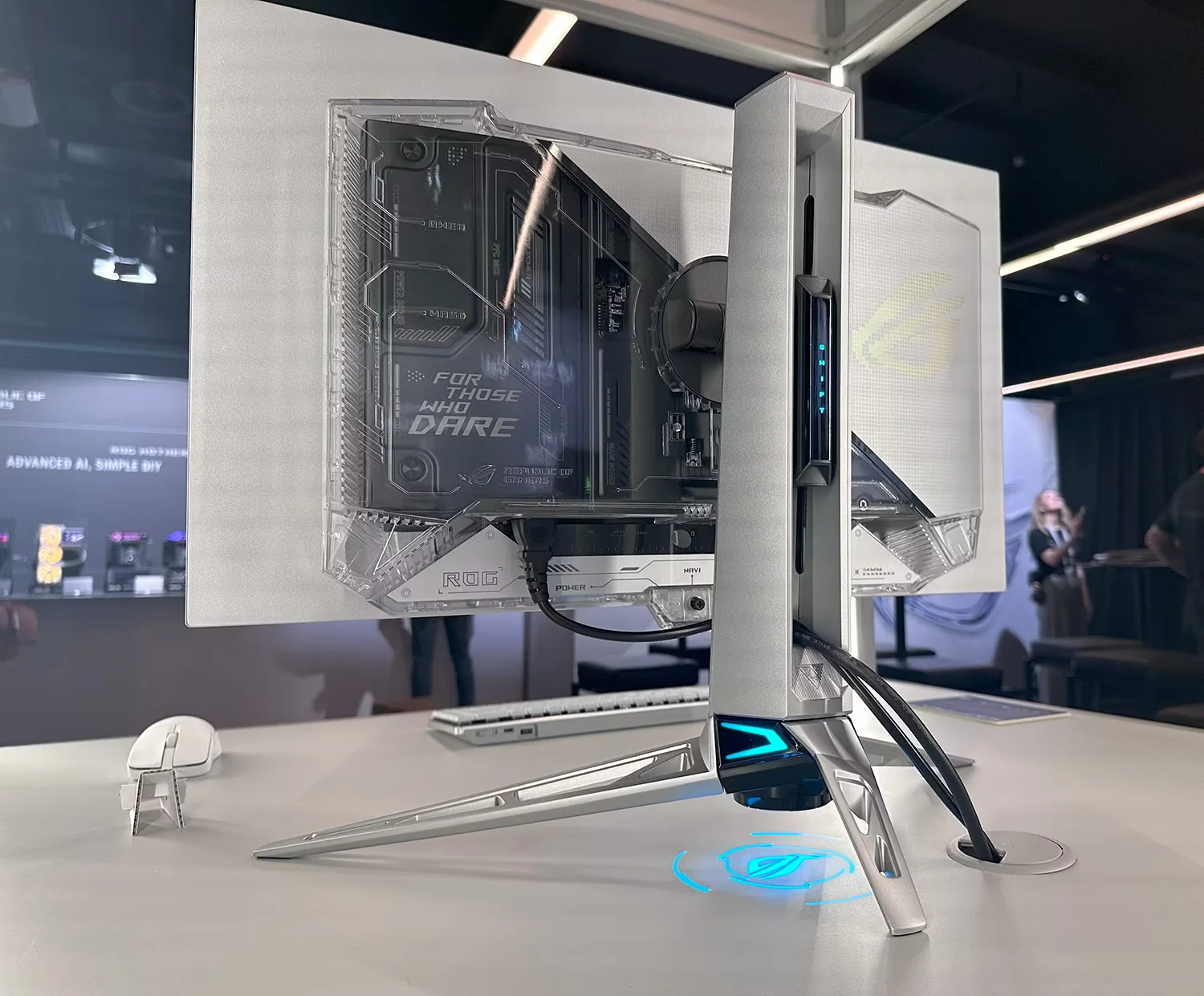
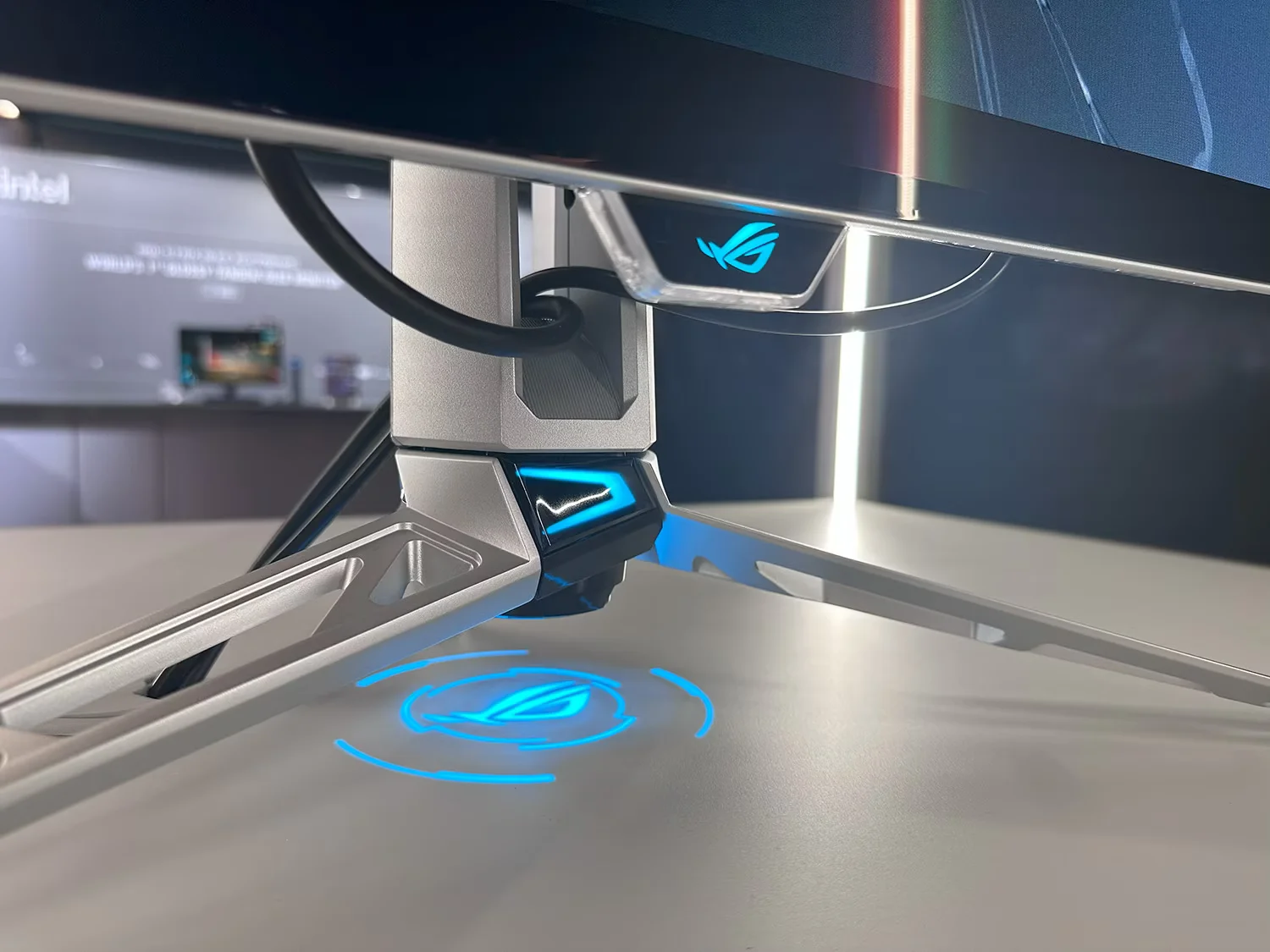
The base includes a logo projector with interchangeable lenses, the bezels are 8mm on the sides/top and 11mm on the bottom, and it maintains VESA mount compatibility. The lighting changed from the traditional ROG red to blue.
HDR, color, and factory calibration
Certifications are full flagship: VESA DisplayHDR 500 True Black, 99.5% DCI-P3, native 10-bit, factory calibration with Delta E < 2. The static contrast measured is 1.5 million to 1, which in HDR translates to bright highlights against perfect blacks without halos or blooming.
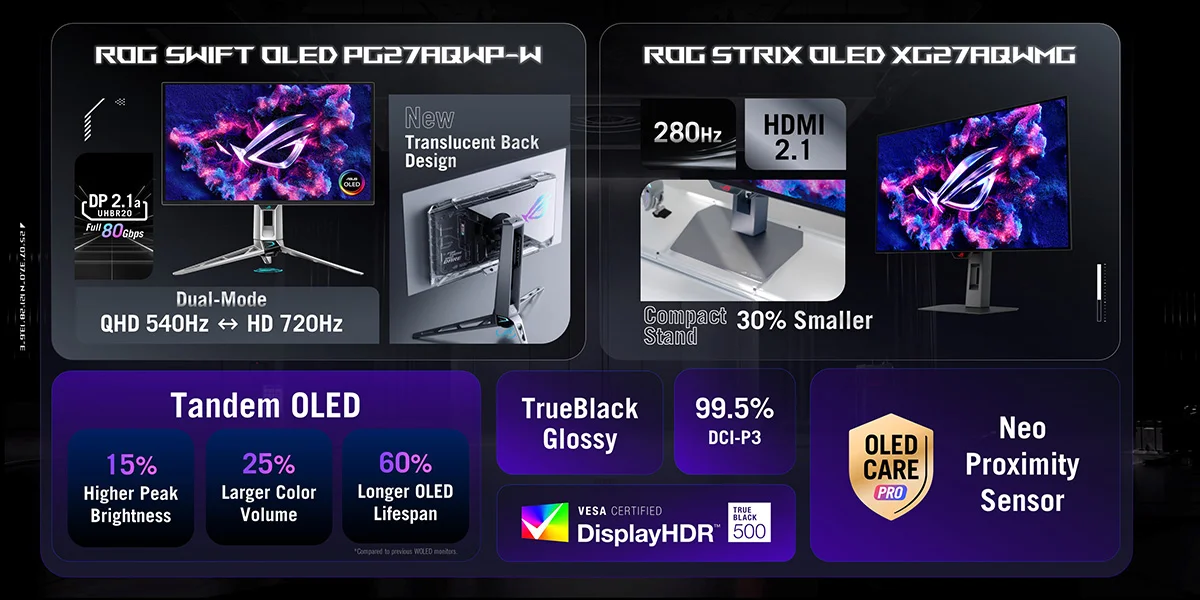
The TrueBlack Glossy coating provides a zero-haze surface for maximum sharpness and reduces reflections by 38% compared to previous generation WOLED glossy. In practice, the panel can be used in well-lit environments without sacrificing the characteristic OLED black depth.
How it compares to the direct competition
Among 27" OLEDs priced between $599 and $1,099, options cover different philosophies: maximum speed, price-performance balance, or resolution over refresh rate. The table summarizes the PG27AQWP-W's direct competitors in the current market.
The PG27AQWP-W wins in refresh rate and peak HDR. MSI offers 95% of its motion clarity with USB-C for $350 less. Alienware redefines the decision: if 240Hz is enough for you, you gain 4K and 166 PPI for $200 less. And the XG27AQWMG, its twin from ASUS, shares the panel and BlackShield film at $500 less, sacrificing only refresh and premium connectivity.
Connectivity and important asterisks
DisplayPort 2.1a UHBR20 with 80Gbps of bandwidth, needed for 540Hz QHD at 10-bit without DSC. Dual HDMI 2.1 with VRR support for consoles. USB hub with three USB-A 3.2 Gen 1 ports plus USB-B upstream. Adaptive-Sync, G-Sync compatible, and FreeSync Premium Pro.
The most relevant asterisk: no USB-C. For pure esports, it's irrelevant, but if you planned to use it with a MacBook or USB-C laptop as an all-in-one dock, it's not an option. In its price tier, it's a notable omission, especially when the CES 2026 flagship PG34WCDN does include it with 90W PD. There's also no KVM or PIP/PBP: ASUS made it clear this monitor is focused exclusively on gaming.
What honest reviews are highlighting
Three points that Spanish-speaking coverage largely misses.
Horizontal line artifact. TechSpot detected a subtle pattern of horizontal lines on this specific panel that doesn’t appear on the 280Hz sibling. It's hard to see—only noticed when compared side by side with QD-OLED and IPS—but it exists.
Dirty screen effect on dark grays slightly more pronounced than on the XG27AQWMG, according to the same review.
Price-competitive reality. PCWorld and TechSpot agree: the motion clarity difference between 500Hz and 540Hz is practically imperceptible. If you opt for the MSI 272QP X50, you save $350 and get USB-C, sacrificing peak HDR and the likely unused 720Hz mode.
Conclusion: buy this or wait for the PG27UCWM
The PG27AQWP-W is genuinely the flagship esports OLED of its generation. For a specific profile—a serious competitive gamer playing at 1440p, not needing USB-C or perfect text for productive use—it has no practical rival today.
For mixed gaming + work use, the decision shifts. The PG27UCWM announced at CES 2026 offers the pure RGB Stripe variant of the 4th-generation Tandem WOLED, 90W PD USB-C, and a dual mode 4K@240Hz / 1080p@480Hz. It's arriving Q1-Q2 2026. It doesn't replace the PG27AQWP-W—they are products for different users—but it does eliminate it as an option if you're looking for a single 27" monitor equally suited for esports and all-day programming.
At $1,099, the PG27AQWP-W is exactly what ASUS claims: the world's fastest OLED. The question the buyer must answer is not if it works but if pure speed is the only critical factor in their decision.
ROG Swift OLED PG27AQWP-W
ASUS flagship esports OLED with native 540Hz at QHD, first 4th Gen Tandem WOLED panel by LG Display, and unique translucent design. The fastest monitor in the world with concrete caveats: no USB-C, questionable 720Hz dual mode, and $350 cheaper QD-OLED competition.
Pros
- Native 540Hz at QHD, first OLED panel to achieve it, surpasses 500Hz QD-OLEDs.
- 4th gen Tandem WOLED with 1500 nits peak HDR, directly competes with QD-OLED in HDR.
- TrueBlack Glossy reduces reflections by 38% compared to previous generation WOLED glossy.
- Translucent design with unique transparent rear section and silver finish in its class.
- Factory calibration included with Delta E < 2, 99.5% DCI-P3 and native 10-bit.
- OLED Care Pro with Neo Proximity Sensor that auto-turns off the panel when absence is detected.
- 3-year warranty with burn-in coverage included, exceptional in the flagship tier.
Cons
- No USB-C, limiting for mixed use with MacBook or modern laptops as an all-in-one dock.
- Dual 720Hz mode drops resolution to 720p, questionable trade-off according to TechSpot and PCWorld.
- Subtle horizontal line artifact detected by TechSpot on this specific panel, absent in the 280Hz sibling.
- Dirty screen effect on dark grays more pronounced than in the XG27AQWMG.
- 500Hz QD-OLED like the MSI 272QP X50 ($749) offers virtually equivalent motion clarity for $350 less and includes USB-C.
- No KVM or PIP/PBP, exclusive gaming focus without productive use features.
- RGWB sub-pixel with white subpixel mitigated by software (Clear Pixel Edge); hardware removal in the next panel generation.
Author
Alexis PaezInformación basada en specs oficiales y reviews técnicas independientes (TFTCentral, TechSpot, RTINGS, Tom's Hardware, PCWorld, ComputerBase, KitGuru). El autor no tuvo acceso físico al producto para este reporte.
Comments
Share article
You might also like

ASUS Debuts RGB Stripe Pixel OLED at CES 2026: Three New ROG Monitors Solve the Text Problem
ASUS introduced three new ROG monitors at CES 2026 featuring RGB Stripe Pixel OLED, the new panel technology that finally solves color fringing in text and makes OLED a no-compromise option for gaming and productivity.