DJI Lito X1 and Lito 1: two beginner drones with front LiDAR and omnidirectional sensing

Index
DJI did not settle for adding two more drones to its catalog. With the launch of the Lito series on April 23, it brought down to the €419 tier a technology that justified twice the price eighteen months ago: front LiDAR and omnidirectional obstacle sensing in a sub-249-gram drone. The series debuts with two models, the Lito 1 and the Lito X1, both aimed at creators who are just getting started in aerial photography but want tools they will not outgrow in six months. It is available now in Europe, the United Kingdom, and international markets — the United States is left out because FCC authorization is still pending, the same situation as the Osmo Pocket 4.
What the Lito series is and where it fits in DJI’s lineup
Until this launch, DJI had an obvious gap in its consumer catalog. Below it, the Mini 4K delivered on the promise of a “first drone for under $250,” but with a 1/2.3-inch sensor, no obstacle sensing, and O2 transmission. Above it, the Mini 5 Pro stretched the line to around $935 with a 1-inch sensor, a 225-degree rotating gimbal, and O4 Plus with nearly 20 kilometers of range. Between the two there was a $400 to $500 space where no DJI drone offered modern safety features at a reasonable price.
The Lito series fits exactly into that gap. The Lito 1 starts at €339 and the Lito X1 at €419. The first targets users who have never flown and want the cheapest option with decent obstacle sensing; the second is for creators who know what they are going to film and need tools that will not slow down their workflow.
The interesting question is not “does it replace the Mini 4K?”, but “what does the Lito series do that the Mini line could not do?” The short answer: bring to the entry tier a safety system that, until two years ago, was exclusive to high-end drones. The long answer takes up the rest of this article.
As for the name, DJI did not explain where “Lito” comes from. The hypothesis circulating among specialist media — picked up by HotHardware — is that it is an abbreviation of “little one.” That makes sense coming from a company with products called Mini, Mavic, Avata, and Neo. What DJI did confirm is the structure: the Lito 1 is the accessible version, and the Lito X1 is the premium version of the same concept.
Design and configurations
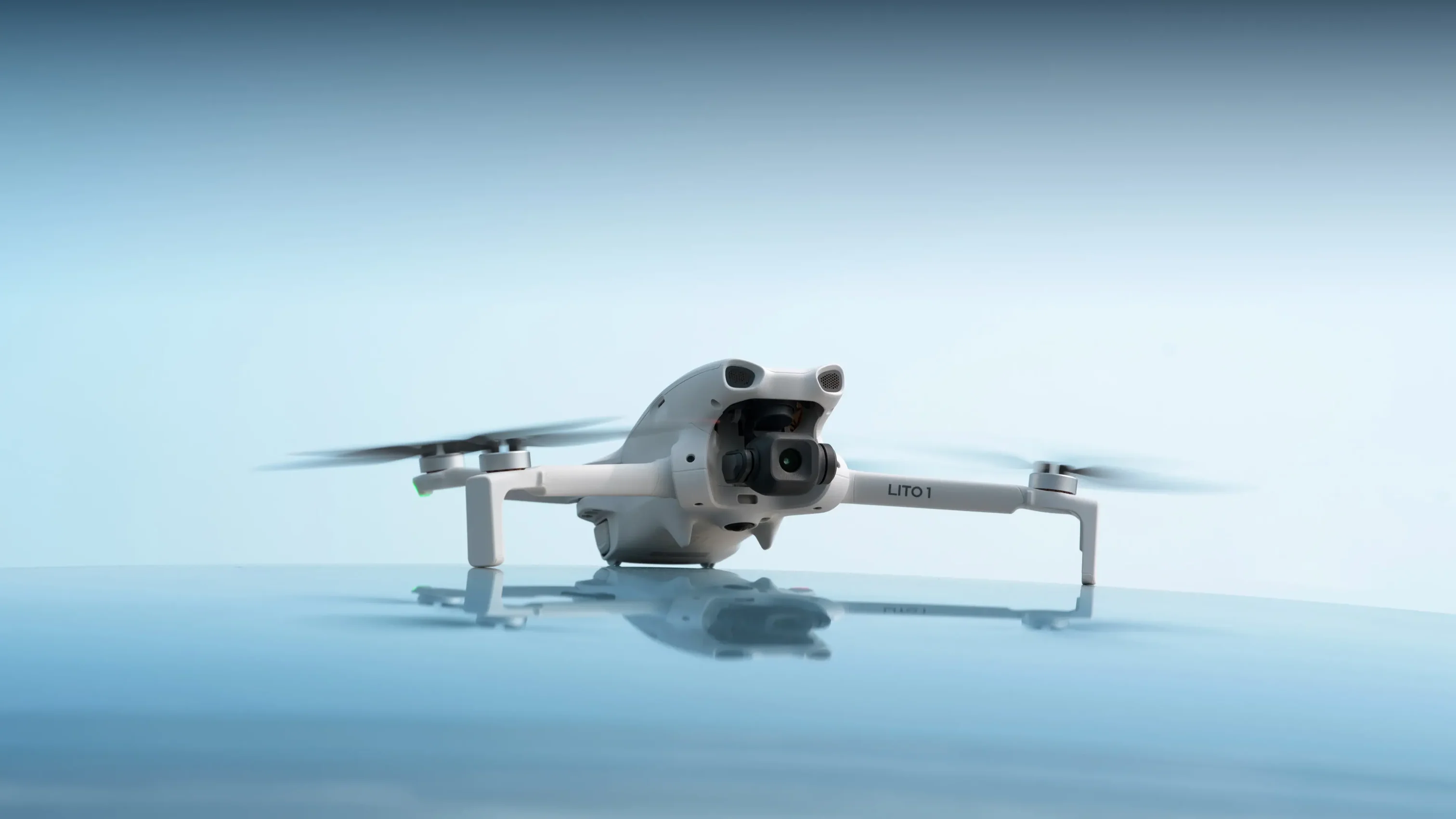
Both drones follow the sub-249-gram format with foldable arms that DJI established with the Mini series years ago. That weight is not decorative: in Europe, it qualifies them for class C0 (or UK0 in the United Kingdom), which allows flying almost anywhere, including over people not gathered in crowds, without formal training. In LATAM, regulations vary by country, but weight remains the factor that determines whether a drone falls into the most permissive recreational category or one with additional paperwork.
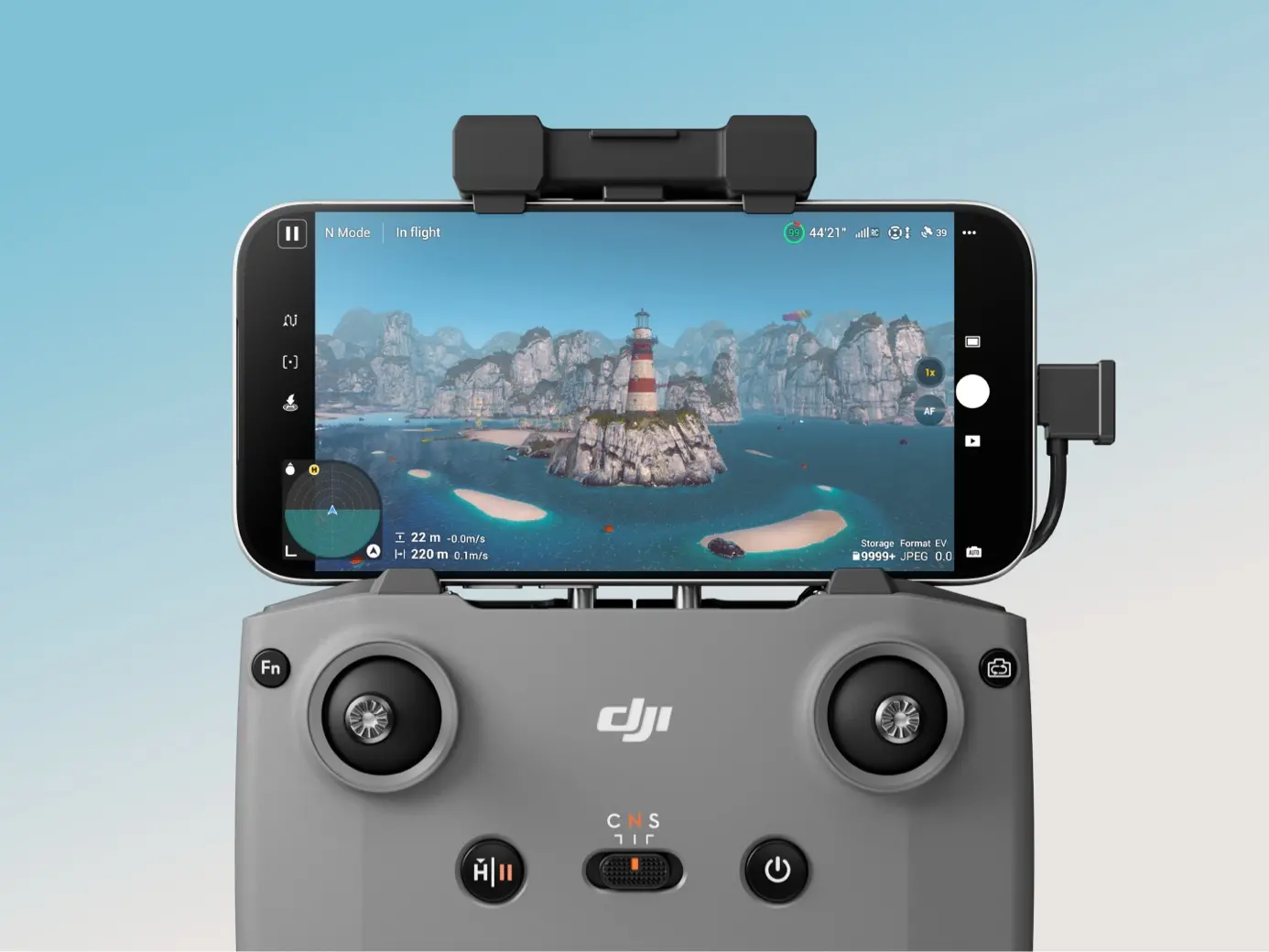
DJI offers two configurations for each model. The standard version includes the drone, one battery, and the DJI RC-N3 controller, which requires connecting a smartphone for live view and telemetry. It is the cheapest option, but it carries the friction of having to plug in your phone every time you fly. The Lito 1 Fly More Combo keeps the RC-N3 but adds two extra batteries, a triple charging dock, and a carrying bag, for €479. The Lito X1 bundle is more interesting: it swaps the RC-N3 for the RC 2, a controller with an integrated 5.5-inch display that removes the smartphone from the equation. It costs €679, placing it €200 above the Lito 1 Combo with a substantial upgrade in user experience.
In some markets, the Intelligent Flight Battery Plus is also available, a higher-capacity battery that extends flight time but pushes the drone above 249 grams, changing its regulatory category. It is a decision worth evaluating carefully: gaining flight minutes in exchange for losing the regulatory flexibility of the sub-249 class may not be worth it.
Camera: the leap that justifies the 80-euro difference
The Lito 1 uses a 1/2-inch CMOS sensor with an f/1.8 aperture and a 79-degree field of view. It captures photos up to 8K and video in 4K at 60 fps, with slow motion in 4K at 100 fps and a 2.7K vertical mode for Reels and TikTok. It is a competent camera to get started.

The Lito X1 moves up to a 1/1.3-inch sensor with an f/1.7 aperture and an 82.1-degree field of view. The figure that looks like a minor detail but defines the real difference is the minimum focus distance: 1 meter on the X1 versus 4 meters on the Lito 1. Four meters is a brutal floor. It means any shot close to a subject, any cinemagraph over a defined object, any creative low-angle shot is outside the entry model’s possibilities. The X1 at 1 meter plays in another league.
On top of that, the X1 exclusively adds 10-bit D-Log M, with up to 14 stops of dynamic range for HDR recording. This is the first time DJI has brought D-Log M down to an entry-level drone — until now, it belonged to the Mini 4 Pro, the Air 3, and higher models. For creators who want serious color grading in post-production, that difference alone can justify the extra €80.
A clarification for those who read Spanish-language coverage: Hipertextual reported that the Lito 1 uses a 1/1.2-inch sensor and that both drones support 10-bit D-Log M. Both claims are incorrect according to DJI’s official press release distributed via PRNewswire. The Lito 1 uses a 1/2-inch sensor (notably smaller than the X1’s), and D-Log M is exclusive to the premium model. The clarification matters because both data points can change a purchase decision.
Safety: omnidirectional for everyone, LiDAR as the differentiator
Both the Lito 1 and the Lito X1 include omnidirectional obstacle sensing with sensitivity down to 5 lux, allowing them to operate in low-light conditions better than any Mini 4K. The system combines stereoscopic cameras in every direction — front, rear, sides, top, and bottom — and, when it detects an obstacle, stops the drone before impact.
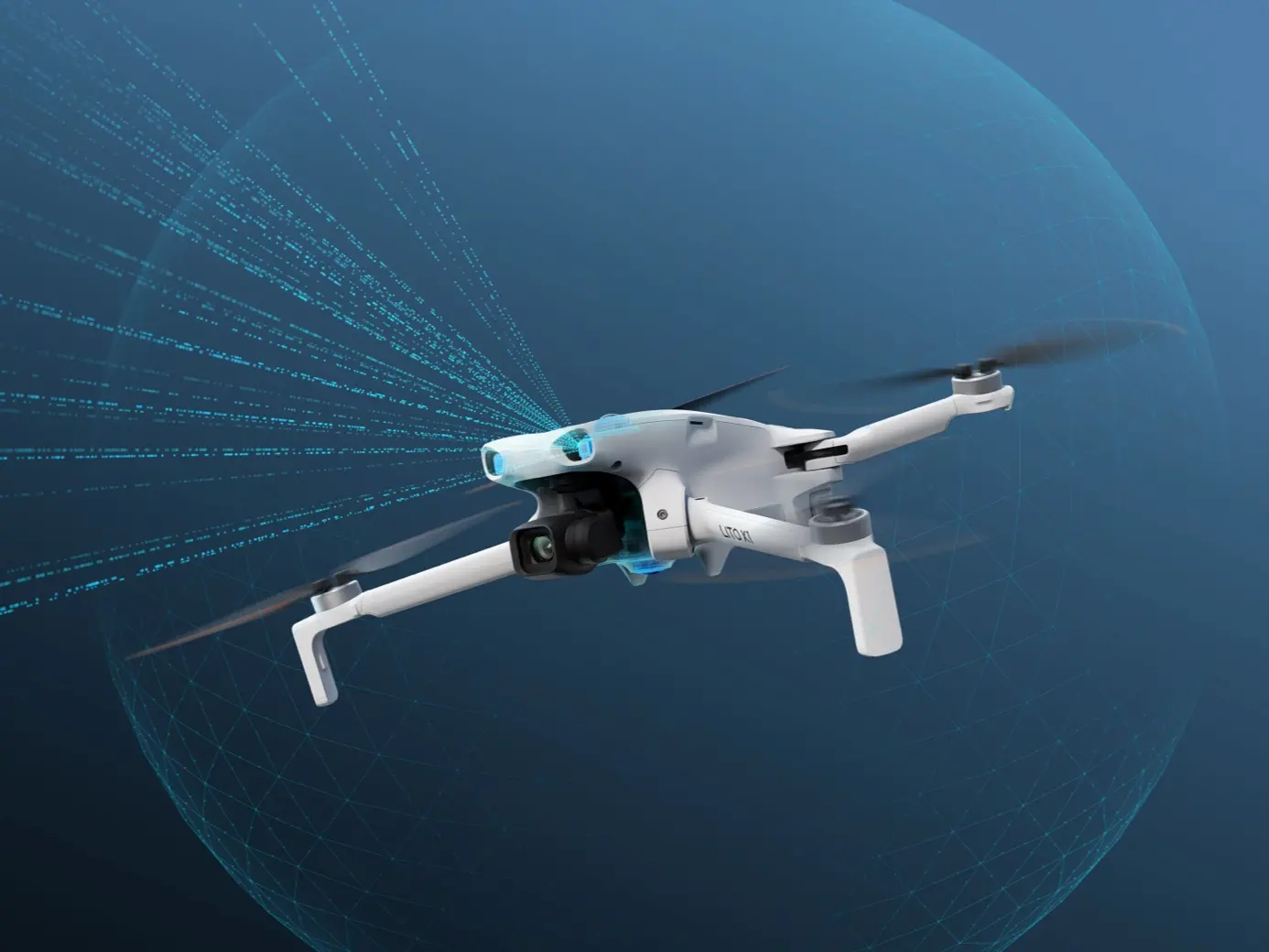
The Lito X1 adds a front LiDAR sensor to that: the same technology DJI debuted in the Neo 2 and Mini 5 Pro in late 2025. LiDAR does not compete with stereoscopic vision; it complements it. The classic problem with pure stereoscopic systems is detecting thin obstacles in low light — bare branches, power lines, thin cables — because the algorithm needs visible texture to triangulate. LiDAR solves that case because it measures distance with laser pulses, not visual triangulation.
That scenario — a thin obstacle in low light — is exactly where a novice pilot is most likely to crash the drone. DJI bringing LiDAR down to a €419 product implies a concrete reduction in the accident rate during the first month of use, which ultimately matters for DJI Care Refresh insurance economics and for the brand’s perception as a “reliable” manufacturer for beginners.
Battery life and resistance
DJI claims up to 36 minutes of flight time with the standard battery, a figure that reviewers who tested pre-production units temper to 25–30 minutes in real-world use. That is reasonable: claimed battery life is measured in controlled conditions, with no wind and a conservative flight profile. In practice, when filming, we are talking about four or five batteries for a serious morning session.
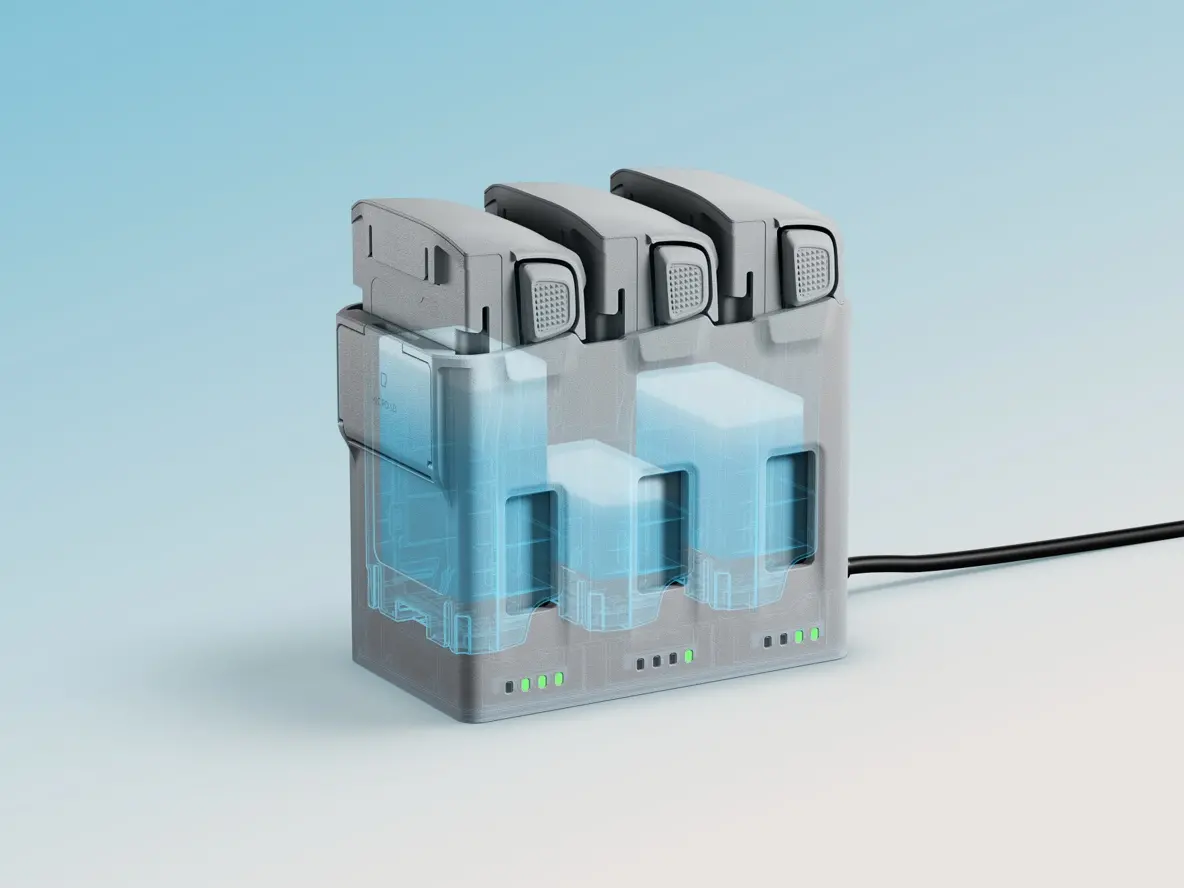
With the Intelligent Flight Battery Plus, available in some markets, the ceiling rises to 52 minutes per battery, but as mentioned earlier, that takes the drone out of the sub-249-gram range. Wind resistance is rated at 10.7 m/s — about 38 km/h — a decent number for a drone of this weight, but not one that should be taken as an invitation to fly in marginal conditions.
Transmission and workflow
Both models use DJI O4 transmission with a range of up to 15 kilometers, a notable improvement over the Mini 4K’s O2. In practice, in LATAM most pilots fly within visual line of sight, so those 15 km matter more for link robustness in areas with interference — cities, beaches with many Wi-Fi networks — than for raw range.
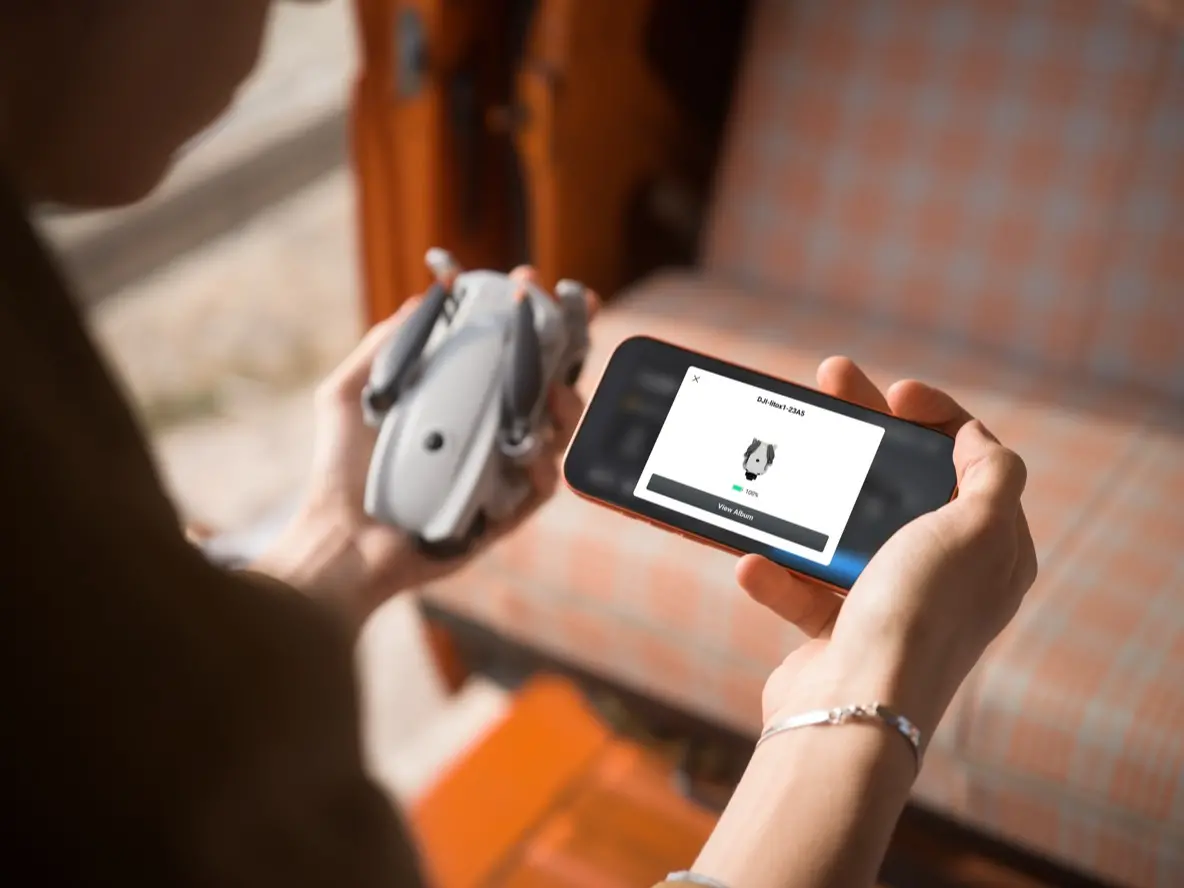

QuickTransfer, the direct wireless transfer to a smartphone, runs over Wi-Fi 6 at speeds of up to 50 MB/s. It is fast and eliminates the need to remove the microSD card to move footage to a phone in the field. Where the models do differ is internal storage: the Lito X1 includes 42 GB onboard, while the Lito 1 relies exclusively on microSD.
That difference looks secondary on a specs sheet, but it adds up in real-world use for three reasons. First, microSD cards get lost, fail, and become corrupted — having internal storage as a backup prevents losing an entire session. Second, internal storage write speeds usually exceed those of cheap microSD cards, which matters for high-bitrate 4K HDR. And third, it simplifies the workflow when filming from multiple locations and you do not want to depend on having formatted cards available.
Both drones also incorporate ActiveTrack for automatic subject tracking at speeds of up to 12 m/s, along with the pro-line legacy modes: QuickShots, MasterShots, Hyperlapse, and Panorama. These are the cinematic modes that became popular with the Air 2S and Mavic 3, now available in the entry tier.
Price, availability, and why it is not coming to the United States
Orders opened on April 23, 2026, through store.dji.com and authorized retailers in Europe, the United Kingdom, and international markets. The United States is not on the list: FCC authorization is still pending, just as happened with the Osmo Pocket 4. The block affects a significant portion of DJI’s new 2026 catalog and has no public resolution date.
For LATAM, this has a concrete impact. Traditionally, a lot of stock entered the region through importers who bought in the United States and resold in Argentina, Mexico, Chile, or Colombia. Without a US channel, imports shift to Europe or Asia, which typically adds between 10 and 25% in extra margin to the final price, depending on the country and customs structure.
A clarification about Spanish-language coverage: Hipertextual reported the Lito 1 price as €399, a figure that does not match DJI’s official release or coverage from DroneXL, T3, and TechRadar. The confirmed price is €339 for the standard Lito 1.
DJI Care Refresh is already available for both models, with one- and two-year plans covering accidental damage — including flyaways, collisions, and water damage. For a drone in the hands of a pilot just starting out, Care Refresh will probably pay for itself with the first scare.
Conclusion: the portfolio play
DJI did not invent anything new with the Lito series. What it did was execute a very aggressive tier drop: features that eighteen months ago justified budgets above a thousand dollars — front LiDAR, 10-bit D-Log M, O4 transmission, omnidirectional sensing with low-light sensitivity — now appear in a €419 drone. That drop has a technical name: industrial economies of scale sustained by three years of iteration on the same camera and sensor module.
The Lito X1 is worth the extra €80 over the Lito 1 for three reasons that rarely appear together in coverage: the 1-meter minimum focus distance enables a universe of shots the Lito 1 simply cannot capture, 10-bit D-Log M allows serious color grading in post, and the 42 GB of internal storage is a concrete safety net when a microSD card fails at the worst possible moment. If the idea is to film seriously, the Lito 1 falls short in six months. The X1 lasts for years.
The Lito 1, by contrast, makes sense for a very specific profile: someone who has never flown, wants the cheapest option with modern safety features, and probably will not produce content for third parties. That same user will probably end up selling the Lito 1 once they discover they cannot get close to their subjects because of the 4-meter focus limitation, and will buy an X1 in the end.
What DJI’s move makes clear, between the lines, is that the Mini 4K is effectively obsolete. The company has not officially discontinued it, but a drone with no obstacle avoidance, no LiDAR, O2, and a 1/2.3-inch sensor has no way to compete against the Lito 1 for a hundred dollars more. The next logical step is for DJI to quietly remove it from the catalog at some point in the second quarter.
DJI Lito 1
Entry-level drone from DJI’s Lito series. Sub-249 grams, 1/2-inch CMOS sensor with 48 MP, omnidirectional obstacle sensing with 5-lux sensitivity, 36-minute battery life, and O4 transmission with a range of up to 15 kilometers.
Pros
- Omnidirectional obstacle sensing at an entry-level price.
- Sub-249 grams for regulatory flexibility when flying.
- 36 minutes of battery life with the standard battery.
- 4K video at 60 fps and 4K slow motion at 100 fps.
- Inherited cinematic modes: QuickShots, MasterShots, Hyperlapse, and Panorama.
Cons
- No front LiDAR (exclusive to the Lito X1).
- 4-meter minimum focus distance, limiting close-up shots.
- No internal storage; relies exclusively on microSD.
- No D-Log M or HDR, with very limited color-grading options.
- Not available in the United States due to pending FCC authorization.
DJI Lito X1
Premium model in DJI’s Lito series. Sub-249 grams, 1/1.3-inch CMOS sensor with 48 MP, f/1.7 aperture, 10-bit D-Log M with 14 stops, front LiDAR in addition to omnidirectional sensing, and 42 GB of internal storage.
Pros
- Front LiDAR complements omnidirectional sensing for greater precision.
- 1/1.3-inch sensor with a brighter f/1.7 aperture.
- 10-bit D-Log M with 14 stops of dynamic range for serious color grading.
- 42 GB of internal storage as a backup to microSD.
- 1-meter minimum focus distance that enables close-up shots.
Cons
- Not available in the United States due to pending FCC authorization.
- 1/1.3-inch sensor is below the Mini 5 Pro’s 1-inch sensor.
- No rotating gimbal for native vertical capture (requires 2.7K vertical mode).
- Battery Plus extends battery life to 52 minutes but takes the drone out of the sub-249g class.
- The Fly More Combo with RC 2 raises the price to 579 euros.
Author
Alexis PaezReport based on official announcements and verified public sources at the time of publishing.
Comments
Share article
You might also like


Which Pixel 11 to buy: which of the four is right for you and which configuration to choose
The Pixel 11, the Pro, the Pro XL, or the foldable: which one makes sense depending on your use, what really changes between them, and which RAM and storage configuration to choose.

Pixel 11: 30x zoom and fast wireless charging come to the base model, but it misses out on HiLight
The Pixel 11 inherits the Pro models’ 5x telephoto and 30x Super Zoom for $899. Full specs, price, sale date, and what it gives up versus the Pro models.

Camera Looks, Creator Suite, and Magic Capture: what actually helps people filming with the Pixel 11
Film simulations, teleprompter, project folders, and Magic Capture. What each Pixel 11 camera feature solves and where the asterisks are.