Googlebook: what’s confirmed, what leaked, and what Google held back from the announcement

Index
On May 12, 2026, during The Android Show: I/O Edition, Google introduced a new line of laptops built around Gemini. Five manufacturers, a new operating system, and zero official hardware specs.
Googlebook is not a renamed Chromebook or a continuation of the Pixelbook line. It is a new category —that’s how Google presented it— designed to compete at the high end, where MacBook Air, Surface Laptop, and Copilot+ PCs dominate today. The bet is aggressive, but the announcement left as many questions as answers.
One platform, five manufacturers
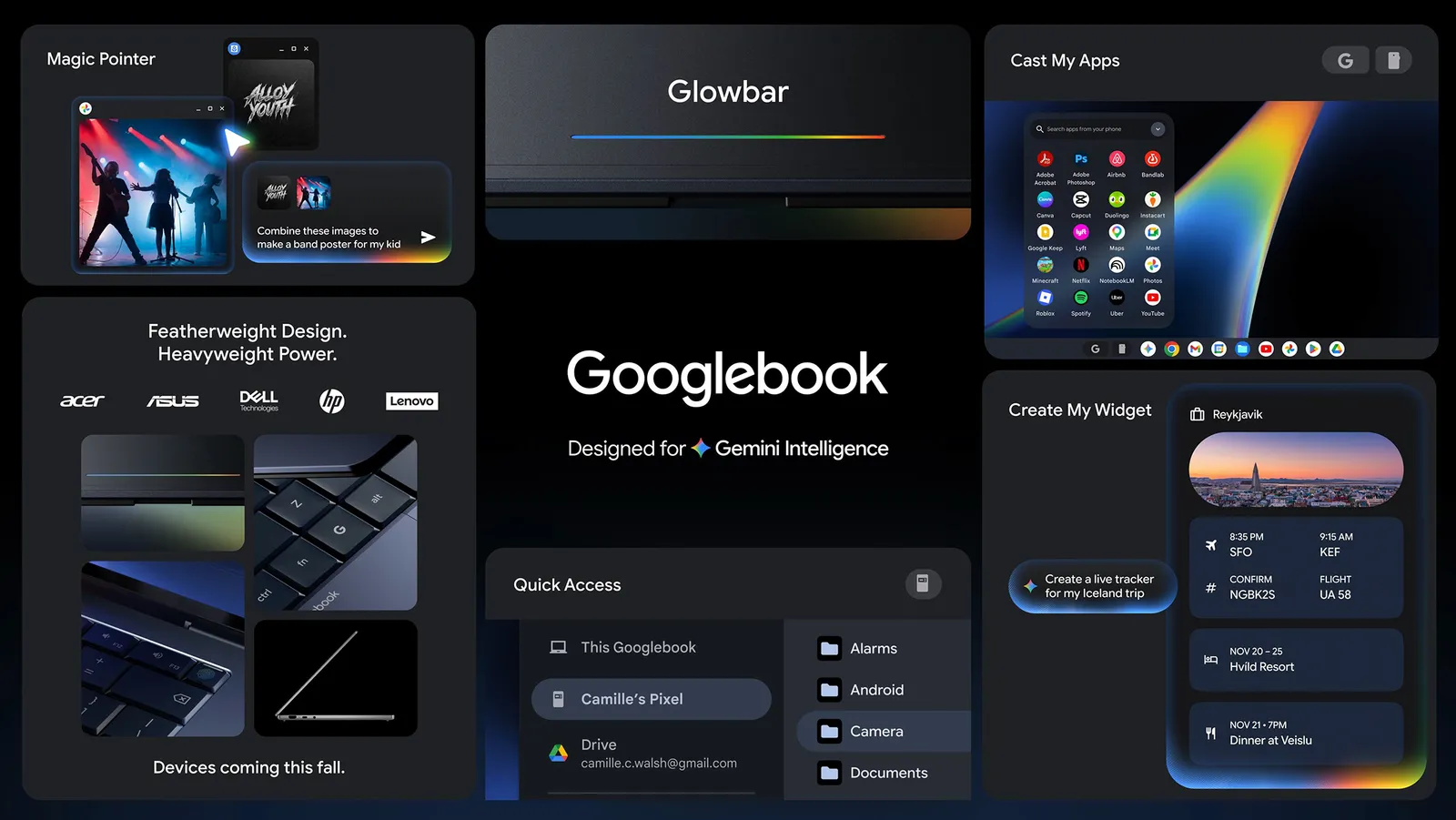
Googlebook is not a device: it is a hardware program with partners. The five confirmed partners are Acer, ASUS, Dell, HP, and Lenovo —the heavyweights of the PC ecosystem. Each one will make its own version. The first wave arrives between September and November 2026, with no exact date yet.
Under the hood, two architectures will coexist from day one: Intel —likely with its 18A-process Core 300 "Wildcat Lake" chips, with a 40 TOPS NPU— and Qualcomm ARM. MediaTek is being discussed as a third supplier. There will be x86 Googlebooks and ARM Googlebooks in parallel, with all that implies for software compatibility.
A new operating system (codename Aluminium)
The most radical piece of the announcement. Google is merging Android with ChromeOS into a single platform, internally codenamed Aluminium. The promise: take Android’s massive app ecosystem, phone integration, and ChromeOS’s enterprise management and sandboxing security, then package it all as a premium laptop OS.
It is a direct answer to Apple’s proprietary integration: phone-laptop continuity. If it ships the way Google is pitching it, Googlebooks will have integration with Android devices equivalent —or superior— to what macOS has with the iPhone.
The five flagship features
What Google showed working on stage:
-
Magic Pointer. It replaces the traditional cursor. Shake it and Gemini activates, suggesting contextual actions based on what you are pointing at. If you point to a date in an email, it offers to schedule the meeting. If you select two images, it combines them. The stated tools are ask, compare, and combine.
-
Create My Widget. You ask for a widget via prompt, and Gemini builds it by searching the internet and connecting to your Google apps. Google’s demo showed an Iceland travel widget that combined flight, hotel, and dinner reservations into a single live block.
-
Glowbar. An RGB LED strip with a rainbow gradient located on the lid, above the keyboard, or on both sides depending on the OEM. It is the Googlebook’s new visual signature —the equivalent of the original glowing Apple logo on MacBook. Whether it will have a practical function (notifications, Gemini status) or is purely branding is still unclear.
-
Cast My Apps. Direct mirroring of Android apps to the Googlebook, without needing to install the desktop equivalent.
Quick Access. A unified file manager across the laptop, Pixel phone, and Google Drive in a single view.
All the intelligence runs locally with Gemini Nano and optimized versions of Gemini Pro, without requiring a connection. It is a direct answer to Apple Intelligence and Microsoft Copilot+.
What Google did NOT reveal
Here comes the uncomfortable part. In the keynote, Google showed five features, five partners, several renders, and exactly zero hardware specs. There is no:
- Confirmed price in any configuration
- Screen sizes
- RAM or storage capacities
- Battery life
- Specific models by OEM
- Exact on-sale date
The only pricing reference comes from Alexander Kuscher, Senior Director at Google, who told Wired that Googlebooks will sit in "the most premium segment of the laptop market," above Chromebook Plus models that top out at USD 699. Unofficial estimates point to a starting price of USD 999, in MacBook Air and Surface Laptop territory, but until an OEM publishes firm pricing, it is only speculation.
What’s next
Upcoming milestones to watch: Computex (Taipei, June 2026), where ASUS and Acer are likely to show their first physical models. IFA (Berlin, September 2026) for HP, Dell, and Lenovo. And Google’s own hardware event.
Only once we have firm specs and real prices will we be able to assess whether Googlebook delivers on what it promised or ends up being another Pixelbook with more marketing. Google’s strategy is clear —merge the OS, move upmarket, add OEMs— but the outcome depends almost entirely on five manufacturers that still have not shown their cards.
For now, one thing is confirmed: Google has decided that ChromeOS alone is not enough to compete at the high end.
Author
Alexis PaezComments
Share article
You might also like

Pixel 10 and Gemini: the duo Google plans to dominate 2025 with
Everything we know about the Google Pixel 10 and 10 Pro ahead of the Made by Google event. Tensor G5 chip, 16 GB of RAM, and full Gemini integration.

Pixel Fold 2, Watch 4, and Buds 2a: Google's next ecosystem
Everything about the refresh of the Google ecosystem: a slimmer Pixel Fold 2 with Tensor G4, Pixel Watch 4 with 3,000 nits of brightness, and the new Buds 2a.