LG Sound Suite: the first modular home theater with Dolby Atmos FlexConnect

Index
At CES 2026, LG did something unusual for a brand of its size: instead of introducing yet another closed soundbar, it launched an ecosystem. Sound Suite is what the brand calls a modular home theater: four components purchased separately and combined into six official bundles, all connected by a new technology called Dolby Atmos FlexConnect. The proposition promises to free users from the mandatory symmetry of traditional surround systems and build real Atmos in living rooms that are not a brand’s test lab. The technology works, but the first generation comes with conditions.
What Sound Suite is and why it changes the game
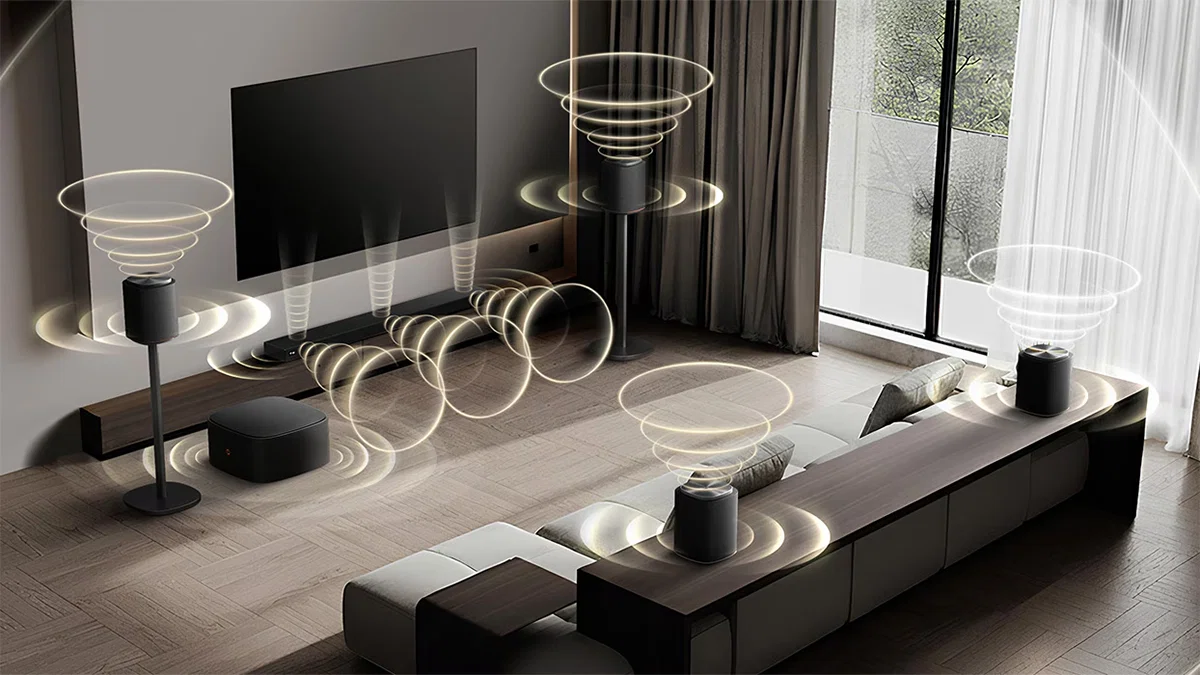
Until now, buying a serious home theater meant choosing one of two paths. One: an all-in-one soundbar like those offered by Samsung or Sonos, where the manufacturer decides how many speakers are included and how they are distributed. Two: a separate system with a receiver, cables through the walls, and the need to place speakers in symmetrical positions so Atmos sounds the way it should. Sound Suite proposes a third way.
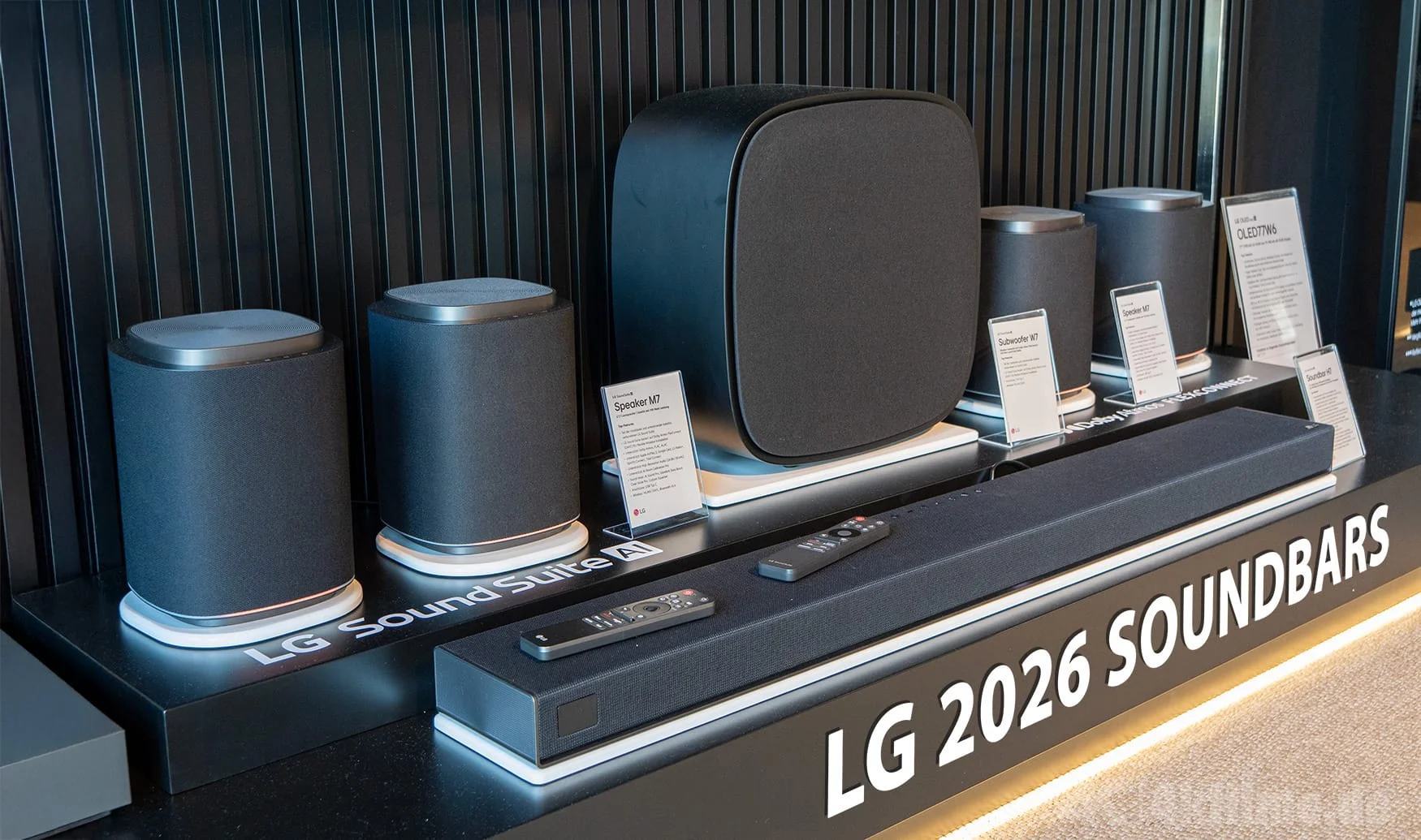
The ecosystem consists of four pieces that can work on their own or in combination: the H7 soundbar, the W7 subwoofer, and two models of wireless satellite speakers, the M7 and M5. LG sells six official bundles with their own names — from the Stereo Suite 5 (the soundbar plus two M5 speakers) to the Immersive Quad Suite 7 Pro (the soundbar, the sub, and four M7 speakers) — but you can also build your own combinations with up to five speakers.
What makes all this work is Dolby Atmos FlexConnect, a technology Dolby introduced in 2023 but that is only now arriving in a complete soundbar system. The idea is elegant: each speaker has built-in microphones that detect the position of the others, and the system automatically calibrates output to compensate for differences in distance and height. If one speaker ended up 50 cm from the wall and the other 1.5 m away, FlexConnect notices and adjusts. If you moved the sub to make room for a guest, you recalibrate and you’re done. For anyone with a living room full of asymmetric furniture, this is huge.
The four components in the ecosystem
H7: the soundbar and the system’s brain
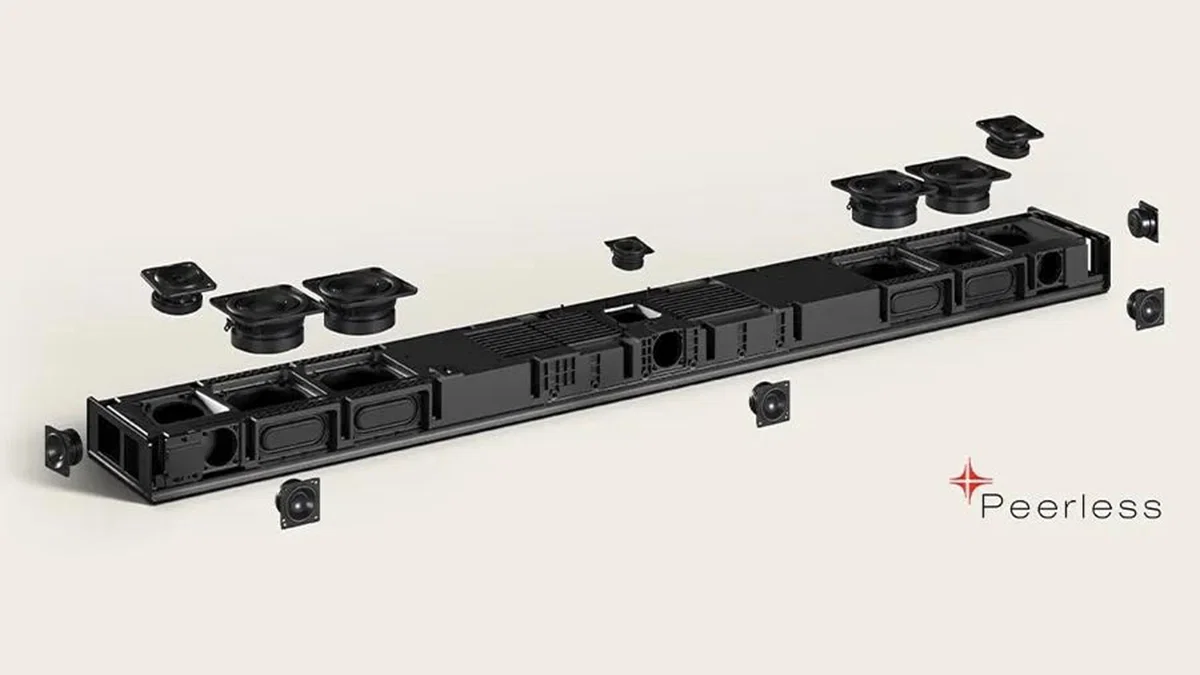
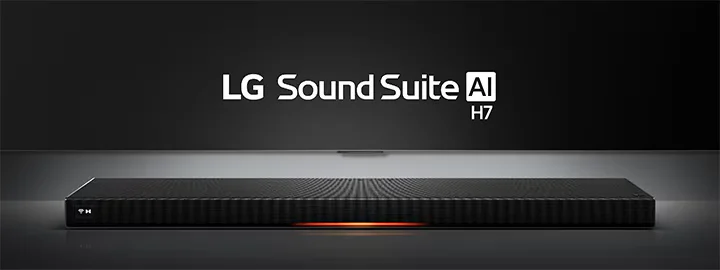
This is the centerpiece. The H7 measures just over 1.2 meters, with 12 full-range drivers from Danish firm Peerless arranged in front, side, and up-firing positions, plus four woofers and eight passive radiators for bass. Total power: 500W. Inside, it houses LG’s Alpha 11 Gen 3 processor — the same one found in its high-end OLED TVs — and that chip coordinates the entire FlexConnect system. It connects via HDMI eARC and supports WiFi, Bluetooth, AirPlay 2, Google Cast, and Spotify/Tidal Connect. Price: USD 999.
W7: the wireless subwoofer
An 8-inch woofer with Bass Reflex and 220W that reaches down to 25.9 Hz, enough to fill medium-sized living rooms with real physical presence. It weighs 8.8 kg and can be installed either vertically or horizontally, useful flexibility for low furniture or corners. Price: USD 599.
The satellites: M7 and M5
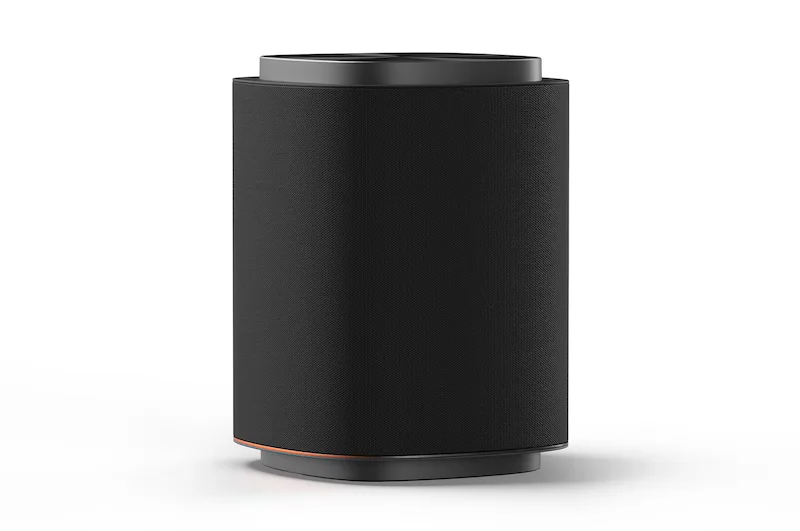
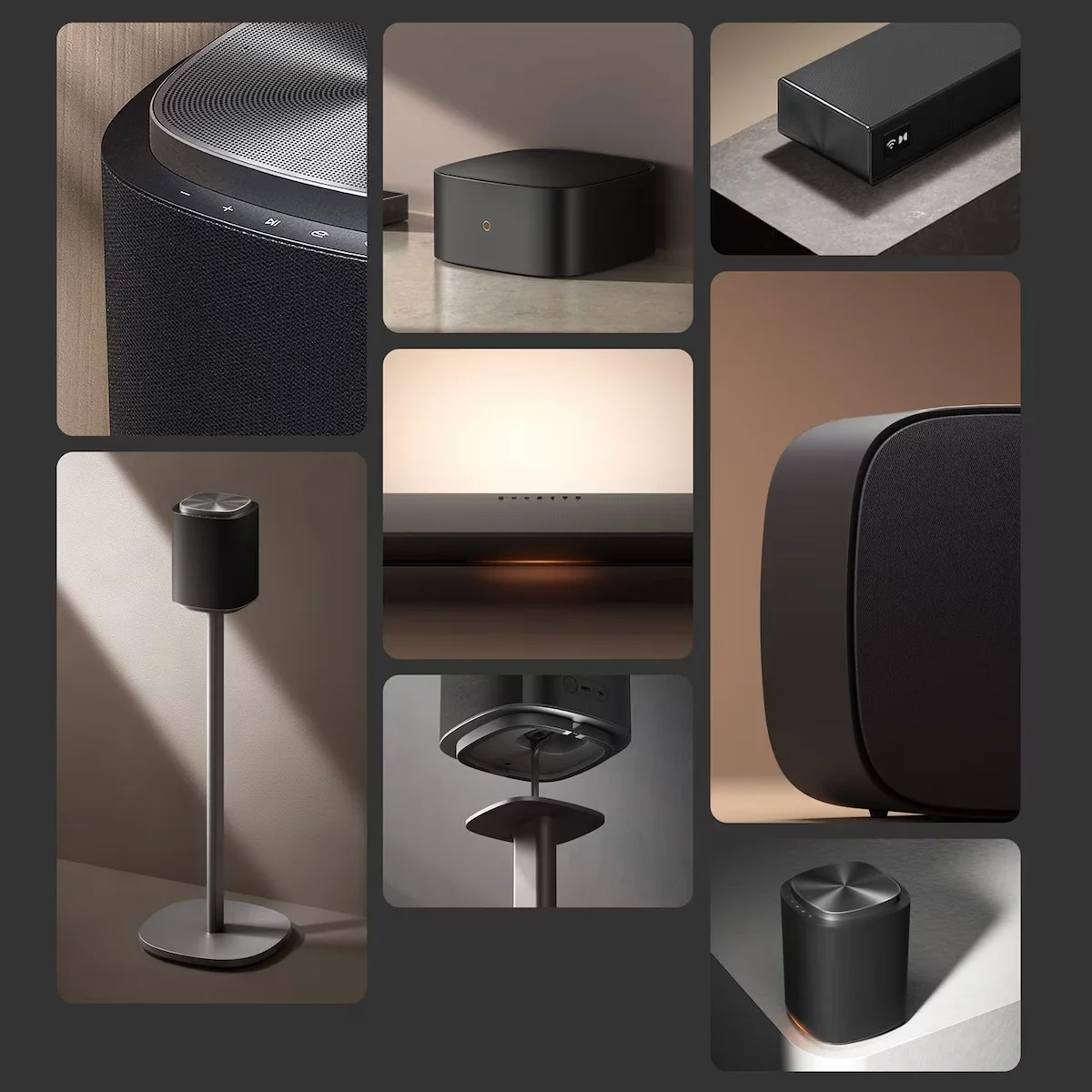
The M7 speakers are the premium models in the lineup. Each is a 2.1.1 system with 100W: two front full-range drivers, one up-firing driver for height effects, and a 4-inch Peerless woofer. They have a rear USB-C input for direct sources and work both as system satellites and standalone speakers — two loose M7 units in a room behave like a Sonos stereo pair, with good detail and decent bass for music. Price: USD 399 each.
The M5 speakers are the smaller, more affordable version: 1.1.1 configuration, 60W, 3-inch woofer, and two tweeters (16 mm front, 20 mm up-firing). Same streaming connectivity, less power. USD 249 each.
The bundles: from Suite 7 to Quad Suite 7 Pro
LG builds six official combinations of the ecosystem, but three are the ones most relevant to users looking for the top end:
The one most international outlets are analyzing is the Quad Suite 7 Pro, which reaches a 13.1.7-channel configuration. That is the setup where LG demonstrates how far the system can go. One downside: buying the bundle does not include any discount — you pay the exact sum of the individual pieces. Engadget and What Hi-Fi? pointed this out as an odd decision for a newly launched premium system.
How the Quad Suite 7 Pro sounds
Tests from Engadget, Xataka, and RTINGS agree on the good part: lateral directionality is excellent. In the opening sequence of Drive to Survive on Netflix, cars seem to move literally around the couch — an effect a closed soundbar cannot replicate. The W7’s bass is deep and forceful, reinforced by the woofers built into each M7. And the Alpha 11 Gen 3’s real-time processing lifts mids when there is dialogue, lowers bass in quiet scenes, reinforces directionality in explosions — all automatically.
Where the system falters is the height channel. Xataka tested the helicopter scene over Mexico City’s Zócalo square in Spectre — a classic Atmos test — and reported that the overhead sensation is not perceived with the same intensity as in systems with dedicated ceiling speakers. The up-firing drivers create more of a diffuse layer than a directional effect. In the same test, occasional micro-dropouts were reported in that channel, possibly attributable to early firmware.
For live sports, Engadget directly recommends disabling the rear speakers: the audio mixes poorly with the soundbar and creates an unnatural echo in stadium sounds. For music, the standalone M7 speakers are surprisingly good. For movies and series with native Atmos mixes, the system shines.
The conditions that coverage tends to soften
There are four things here that most Spanish-language reviews do not emphasize enough:
Dependence on the LG ecosystem. FlexConnect requires the Alpha 11 Gen 3 processor, which is only in the H7 or in specific LG OLED TVs. The official page lists only the 2025 OLED C5 and G5 as compatible. For 2026, LG announces compatibility with OLED and QNED, but only in 85" sizes or larger. If your 2026 LG is 65" or 77", you will probably still need the H7.
No HDMI passthrough or DTS:X. The H7 has no HDMI inputs of its own — everything goes into the TV and out to the soundbar via eARC. For users with multiple consoles (PS5, Xbox Series X, gaming PC), that is a serious limitation. It also does not support DTS:X, a format present on many UHD discs. Samsung and Sony offer both features in this price range.
Problematic WiFi connectivity. The system only works with 2.4 GHz networks and rejects DFS channels. Xataka had to reconfigure the router for the H7 to connect; Engadget reported days of testing with constant reboots before achieving a stable connection.
Sound Follow does not fully work. The feature that adjusts the sweet spot based on where you sit requires a smartphone with Ultra Wideband technology (iPhone 11+, Pixel 6 Pro+, Galaxy S21 Ultra+), and independent tests did not detect consistent audible changes when changing position.
How it compares with the competition
Sound Suite is not alone in the premium segment. There are two direct rivals to keep on your radar before spending more than USD 2,000.
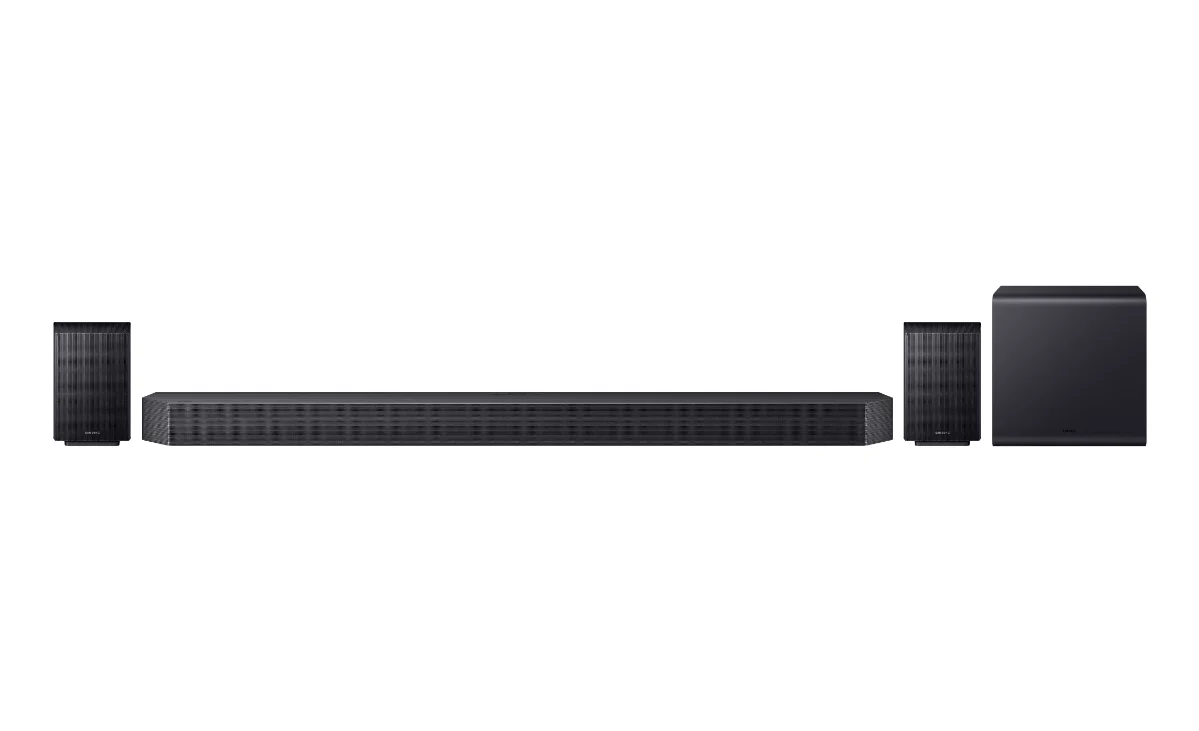
The Samsung HW-Q990F is, according to the What Hi-Fi? Awards 2025, the best Dolby Atmos soundbar of the year. It offers 11.1.4 channels in a closed package (soundbar, sub, and two surrounds) for USD 1,999 — significantly cheaper than the LG Immersive Suite 7 Pro and a thousand dollars less than the Quad Suite 7 Pro. It supports DTS:X, has HDMI 4K/120 passthrough (key for gamers with PS5/Xbox Series X), and its integration with Samsung TVs (Q-Symphony) adds the TV’s own audio as a center channel. The limitation: fixed setup, with no modularity or placement flexibility.
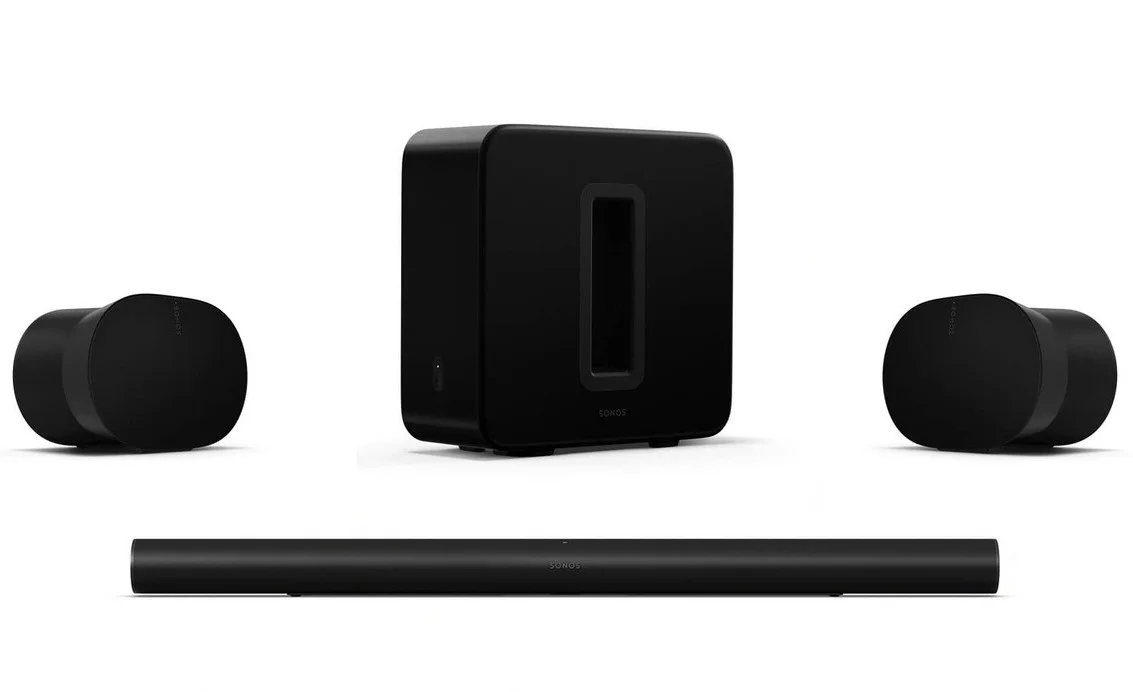
The Sonos Premium Immersive Set (Arc Ultra + Sub 4 + 2× Era 300) reaches USD 2,956 in a 7.1.4 configuration. What Sonos offers is a mature ecosystem, polished app, and true multi-room audio — but like the LG, it has no DTS:X or HDMI passthrough. What Hi-Fi? crowned it best of the year in a comparison of four flagships published in September 2025.
The three systems play different games. LG bets everything on placement flexibility; Samsung on pure performance with gaming compatibility; Sonos on ecosystem maturity. There is no absolute winner.
Conclusion: buy Sound Suite or wait
Sound Suite is the first serious answer to a real problem: building Dolby Atmos in living rooms that are not auditoriums. FlexConnect technology works, the quality of the Peerless drivers is consistent with the price, and the modularity offers something no competitor has today. But it is also a first generation with plenty of rough edges: early firmware that causes micro-dropouts, contentious WiFi connectivity, Sound Follow that does not fully work, significant dependence on the LG ecosystem to access all features, and pricing that includes no bundle discounts.
If you already have an OLED C5 or G5, or you are going to buy an 85" or larger 2026 LG OLED, Sound Suite is the most interesting option on the market right now. If your TV is from another brand or smaller, the Samsung Q990F remains the favorite for performance/price ratio and gaming compatibility. If you want mature modularity with a polished app, Sonos. If placement flexibility is non-negotiable, LG has done the hard part — now it is worth waiting for firmware updates to finish polishing the easy part.
LG Sound Suite H7
The central soundbar and the brain of the Sound Suite ecosystem. It uses 12 Peerless drivers and the Alpha 11 Gen 3 processor, and coordinates the system’s entire FlexConnect calibration.
Pros
- It is the only component that enables Dolby Atmos FlexConnect without depending on a specific LG OLED TV.
- Alpha 11 Gen 3 processor inherited from high-end OLED TVs, with real-time audio processing.
- Twelve Peerless drivers with excellent lateral directionality and clear dialogue.
- Full integrated streaming: AirPlay 2, Google Cast, Spotify, and Tidal Connect.
Cons
- No HDMI passthrough: everything goes into the TV and out via eARC, a limitation for multiple consoles.
- Does not support DTS:X, which is present on many UHD discs.
- Problematic WiFi connectivity: 2.4 GHz only and no DFS channels.
- The height channel depends on up-firing drivers, more diffuse than dedicated ceiling speakers.
LG Sound Suite W7
An 8-inch wireless subwoofer that provides the system’s bass. It pairs via FlexConnect and can be placed vertically or horizontally.
Pros
- Reaches down to 25.9 Hz, with real physical presence for medium-sized living rooms.
- Vertical or horizontal installation, useful for low furniture or corners.
- Fully wireless: it only needs power.
Cons
- Sold separately and adds USD 599 to the system cost.
- The system’s forceful bass depends on adding it: without it, the system loses body.
LG Sound Suite M7
Premium satellite speaker that works as a system surround or as a standalone multi-room speaker. 2.1.1 configuration with Peerless woofer and up-firing driver.
Pros
- Works as a system satellite or standalone, behaving like a Sonos-style stereo pair.
- 4-inch Peerless woofer and up-firing driver in a compact body.
- Rear USB-C input for direct sources.
Cons
- Purchased individually (USD 399 each): four units for the Quad Suite quickly raise the cost.
- The up-firing height effect is more diffuse than dedicated ceiling speakers.
Author
Alexis PaezAnálisis basado en specs oficiales de LG y reviews técnicas independientes de Engadget, Xataka, What Hi-Fi?, TechRadar y RTINGS. El autor no tuvo acceso físico al producto para este reporte.