M6 and M5 Ultra: Apple’s first 2 nm chip and its first four-die chip

Index
Apple introduced two chips on the same day, and neither is quite what the naming suggests. The M6 is the company’s first processor manufactured on a 2-nanometer process. The M5 Ultra is the most powerful chip it has ever made, and it belongs to the previous generation.
Both debuted by press release, with no event, inside the Mac mini and the Mac Studio. Together, they make the Apple Silicon lineup harder to read than it has ever been.
M6: 2 nanometers come to the Mac
The M6 debuts the 2-nanometer manufacturing process. Less distance between transistors means more transistors in the same area and less energy per operation, which is where the two things Apple promises come from: more speed and the same power consumption.
Its CPU has 12 cores split across three tiers: two super cores, four performance cores, and six efficiency cores. That is two more cores than the M5. Apple says the individual core is the fastest in the world, and claims 1.2x higher multithreaded performance than the M5 and 2.4x higher than the M1.
GPU and a Neural Engine that is now doubled
The GPU moves up to 12 cores, each with its own Neural Accelerator. The result is roughly 30% more peak AI compute than the M5 and more than eight times that of the M1. Geometry rates increase by 50%, while Dynamic Caching, hardware ray tracing, and an updated shader architecture remain in place.
The structural change is in the Neural Engine. Instead of one 16-core engine, the M6 has two. Apple talks about up to twice the peak compute, but what matters is how it is used: it can split a single model across both engines or run two different models at the same time. For a workflow where transcription, summarization, and generation coexist, that changes more than a speed percentage.
Memory reaches 32 GB with 170 GB/s of bandwidth, 10% more than the M5 and two and a half times the M1.

M5 Ultra: four dies linked by UltraFusion
The M5 Ultra is Apple’s first four-die architecture. Until now, an Ultra chip was the combination of two Max chips via UltraFusion, the interconnect Apple uses so the operating system sees a single processor instead of two chips glued together. This time, it is two dual-die M5 Max chips connected to each other.
The new generation of UltraFusion moves more than 4.4 TB/s between dies and increases connection density by more than sixfold. That number is what sustains the whole illusion: if the link between halves were slow, the system would have to manage two processors and the advantage would disappear.
The result is up to 36 CPU cores —12 super cores and 24 performance cores—, 80 GPU cores, and a 32-core Neural Engine. Compared with the M3 Ultra, Apple measures 1.25x higher single-threaded performance, 1.3x higher multithreaded performance, 40% better graphics, and 4.5x more AI compute.
Memory: 512 GB and 1.2 TB/s
The M5 Ultra reaches 512 GB of unified memory with 1.2 TB/s of bandwidth, 50% more than the M3 Ultra.
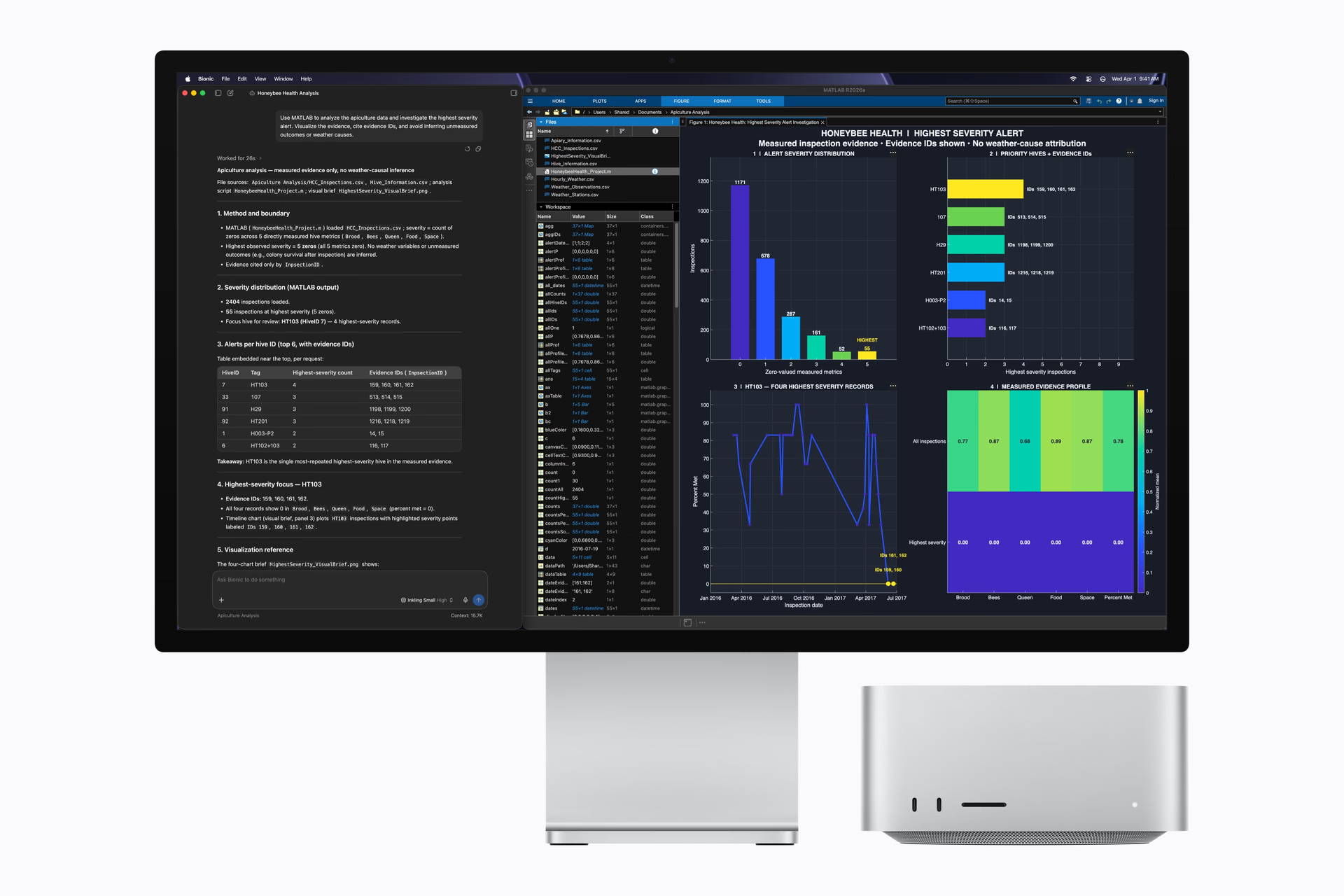
With unified memory, there is no copy between system RAM and video-card memory: the CPU, GPU, and Neural Engine all read from the same place. For a language model, that is decisive, because the limit stops being how much memory the GPU has and becomes how much memory the entire machine has. A model that would need to be split up or trimmed on a PC fits here in full.
Media engine: four ProRes engines
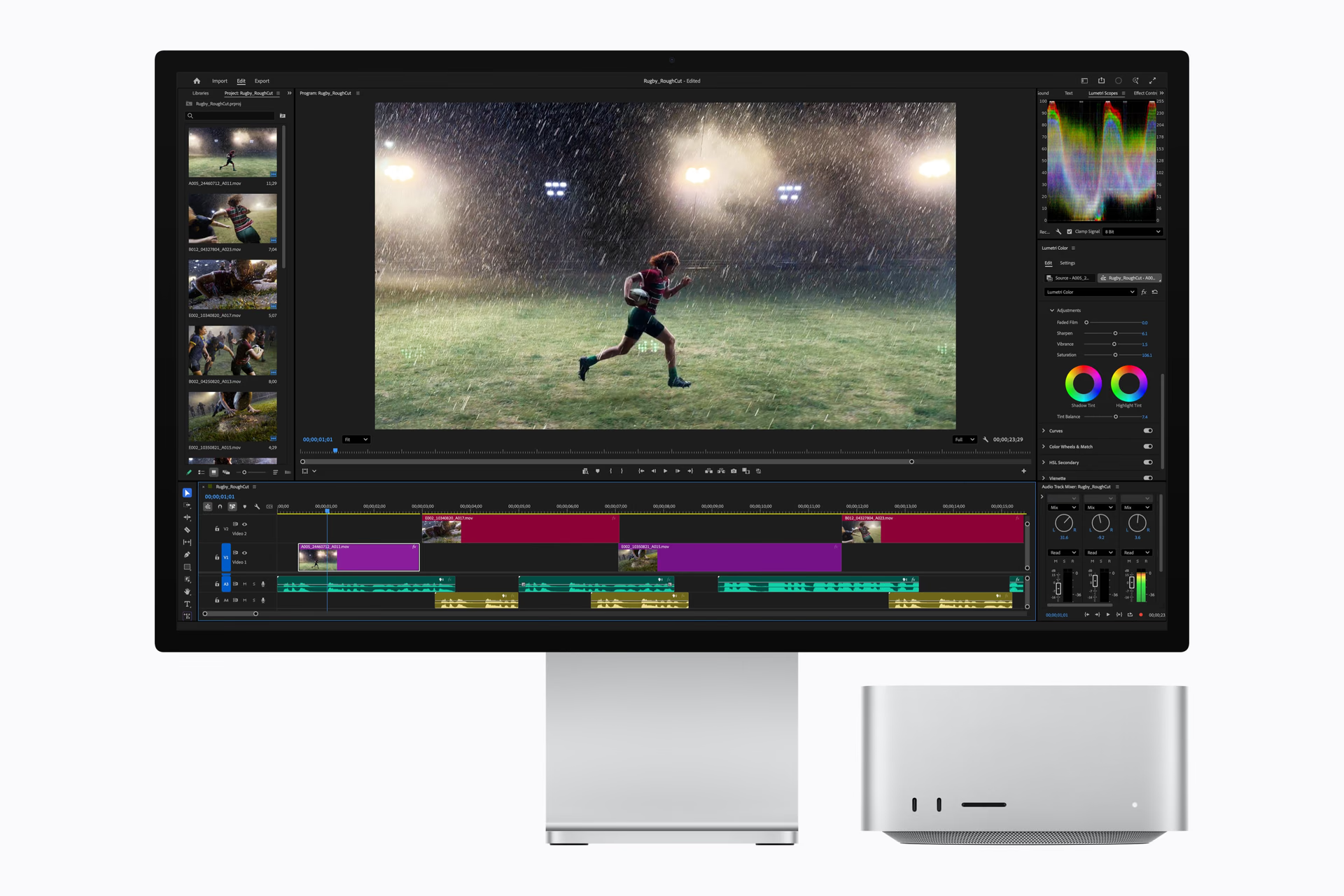
The M5 Ultra adds hardware acceleration for H.264 and HEVC, four ProRes encode and decode engines, and hardware AV1 decoding.
Four ProRes engines are not a brochure number: they are the reason several high-resolution video feeds can play back in a timeline without generating intermediate files or lowering playback quality.
Why an M5 sits above an M6
This is the part that gets confusing, and it is worth understanding before buying either machine.
Apple’s chips do not all come out at once. First comes the base model of a generation, and months later the Pro, Max, and Ultra variants, which are physically larger and take longer to manufacture. The M5 Pro and M5 Max arrived in March with the MacBook Pro. The M5 Ultra, which is built by joining two M5 Max chips, has only arrived now.
Meanwhile, the next generation has already started at the bottom. The M6 is more modern than any M5 chip, but it is the entry-level model in its family: 12 CPU cores versus the Ultra’s 36.
In other words, “M6” indicates generation and “Ultra” indicates size, and they are not directly comparable. An M6 wins in per-core performance and efficiency. An M5 Ultra wins in everything that depends on quantity: cores, memory, and bandwidth.
What remains is the rest of the M6 family, which does not exist yet. When the M6 Pro and M6 Max appear, the lineup will make sense again. Until then, Apple’s catalog mixes two generations in the same storefront.
Conclusion
The technical leap is present in both, but they target different places. The M6 moves the baseline forward: 2 nanometers, a dual Neural Engine, and an entry-level model that runs local AI without asking permission. It is the chip that will be inside most of the Macs sold next year.
The M5 Ultra is something else. Four dies, 4.4 TB/s of interconnect bandwidth, and 512 GB of unified memory are not there to make the computer fast: they are there so a model that does not fit elsewhere can fit. It is a niche machine solving a problem that did not exist three years ago.
What remains to be seen is whether Apple will sustain this coexistence of generations or whether it was a consequence of rushing the M6 to get to 2 nanometers before anyone else. The answer will come when the first M6 Pro appears.
Author
Alexis PaezReport based on official announcements and verified public sources at the time of publishing.