Pixel Tag: Google enters the tracker market with UWB, a one-year battery, and a button the AirTag does not have

Index
The Pixel Tag costs $29, or $99 for the four-pack, and arrives with the missing answer: it has UWB. Google has cleared up the uncertainty that had followed the product since the first leaks and that mattered when deciding whether it was worth waiting for.
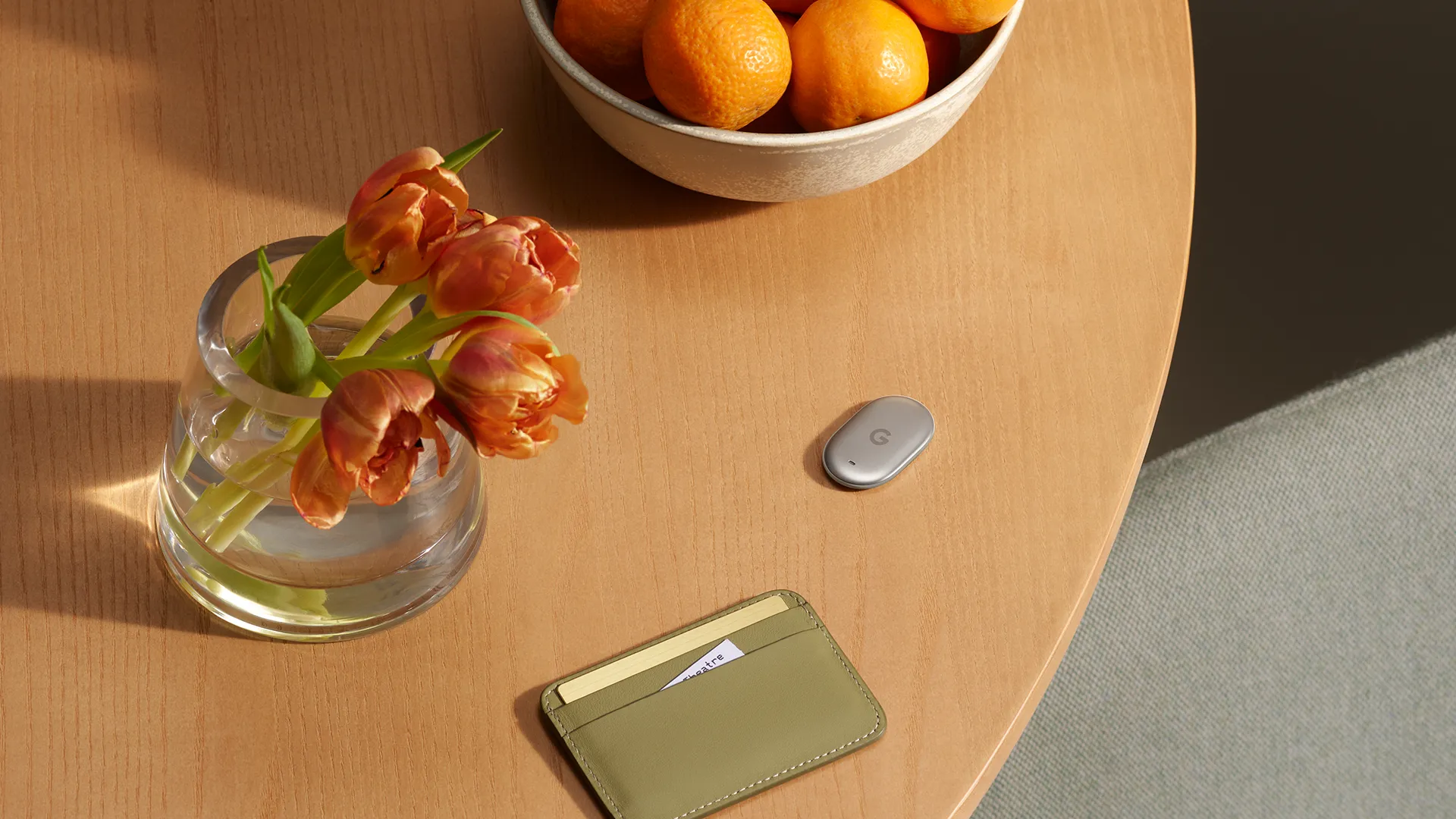
What did not change is the other point we had noted: it still has no key ring hole, and the ring is sold separately.
What it is and what it looks like
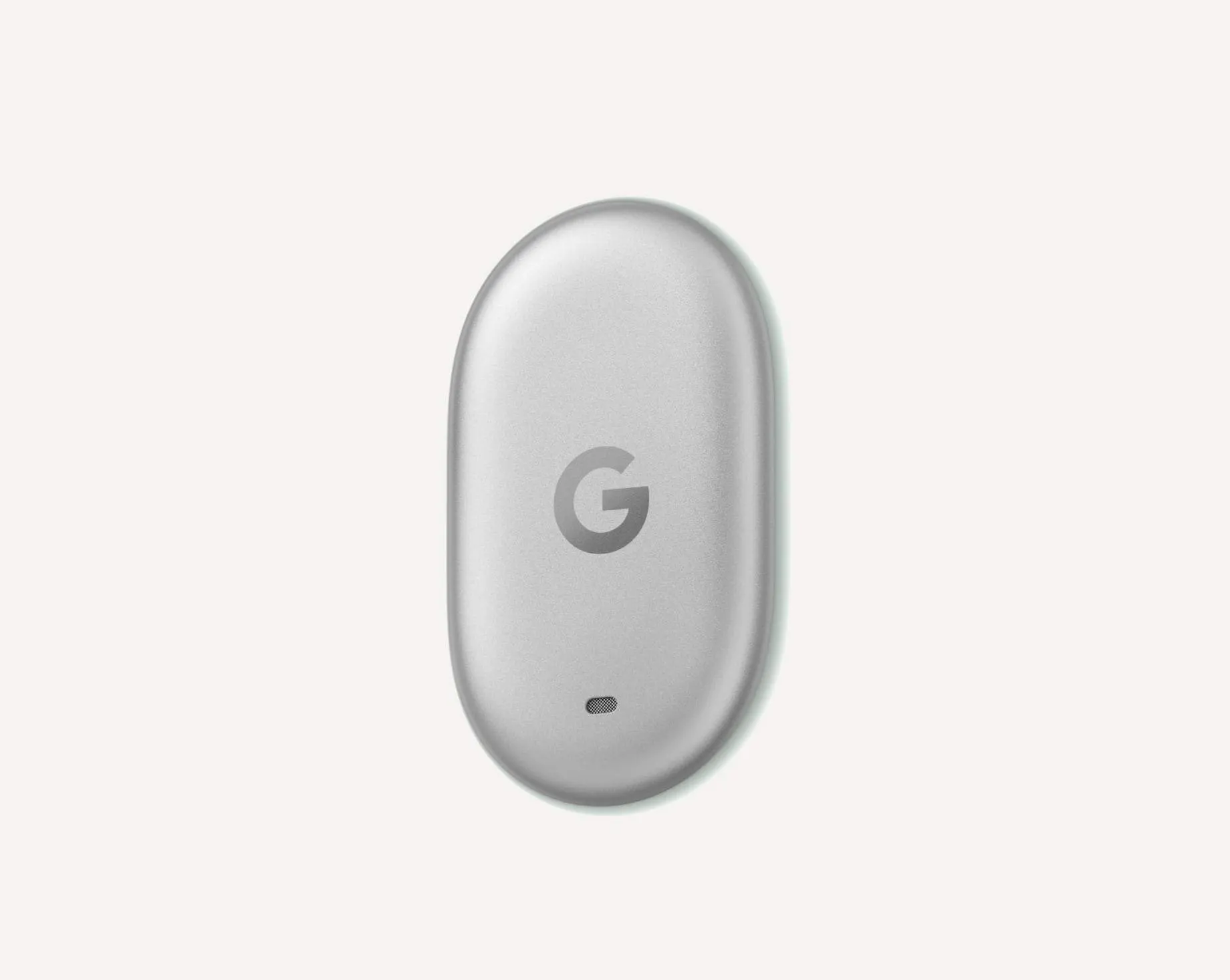
It is an elongated capsule, taller than it is wide, that moves away from the AirTag's disc shape and Samsung's and Motorola's round trackers. It measures 46.1 by 28 millimeters, is 5.4 millimeters thick, and weighs 11.8 grams with the battery installed.
The front is metal, with the Google logo and the speaker grille underneath; the rear half is polycarbonate. It comes in a single color, Fog. The rating is IP67: it can withstand one meter of water for half an hour.
UWB and Bluetooth Channel Sounding: two different ways to search
This is the part worth reading carefully, because the Pixel Tag uses two technologies and they are not interchangeable.
UWB provides centimeter-level precision and works up to fifty meters from the paired phone, with an arrow and distance on screen. Bluetooth Channel Sounding reaches accuracy between 30 and 50 centimeters while using less power, but it requires Android 16 and Bluetooth 6.0.
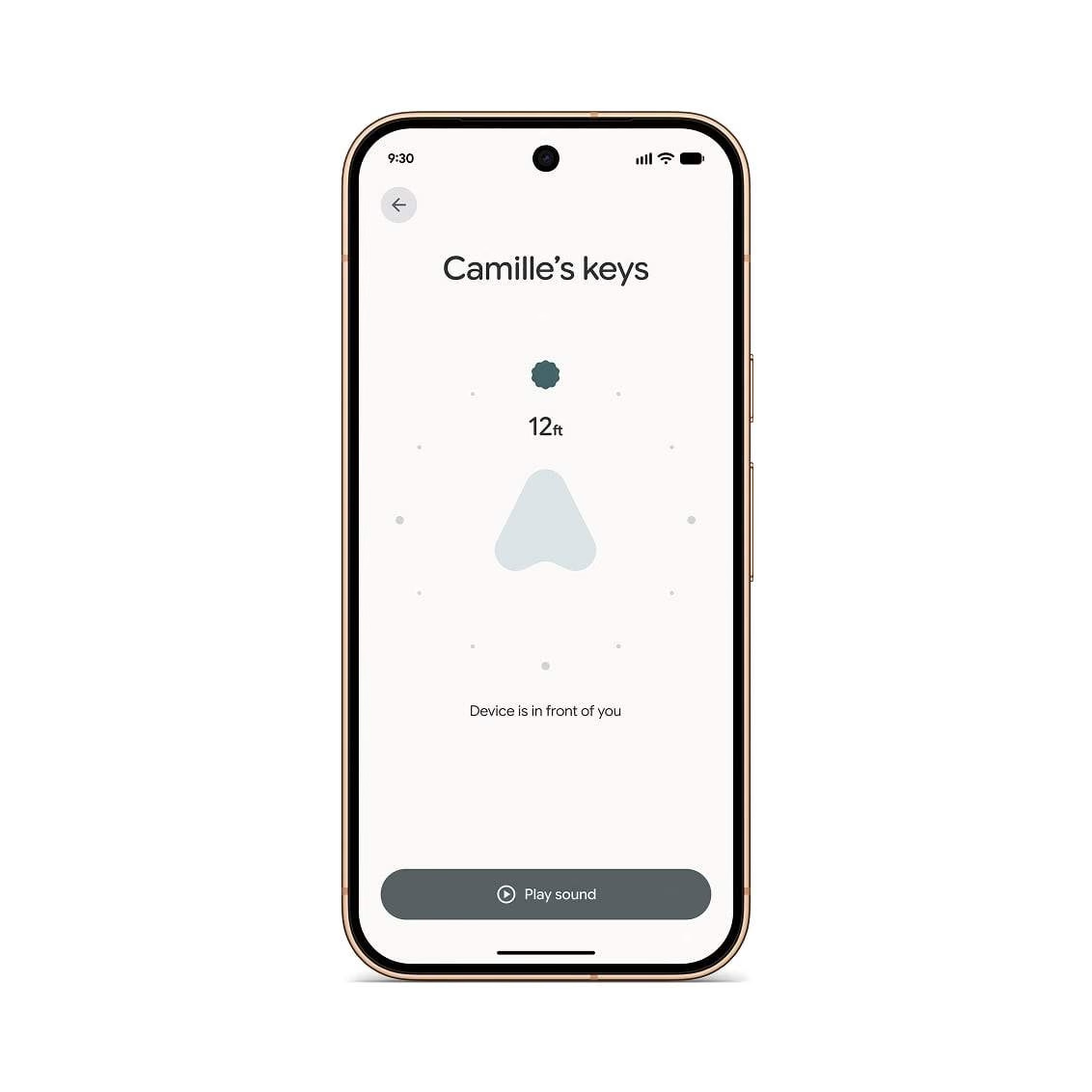
The practical consequence is that the flagship feature depends on the phone, not the tracker. You need an Android phone with a UWB radio, and much of the high-end segment still does not include one. It is the same problem that was already visible before the announcement: the chip in the tag is useless if the phone on the other end does not have it.
The button that makes your phone ring
It is the least discussed feature and probably the most useful one day to day. The Pixel Tag has a physical button that makes the paired phone ring. This is not finding your keys with your phone: it is finding your phone with your keys.
The AirTag does not offer it. And it is the kind of detail that reveals what the product was really designed for, because the everyday scenario — a phone lost between the couch cushions — is far more common than an item lost miles away.
Find Hub and shared features
The network is Google's structural advantage: Find Hub runs on more than a billion Android devices, with end-to-end encrypted location reporting. Pairing uses Fast Pair, so all you need to do is pull the battery tab and bring it close to the phone. It works with Android 9 and later.
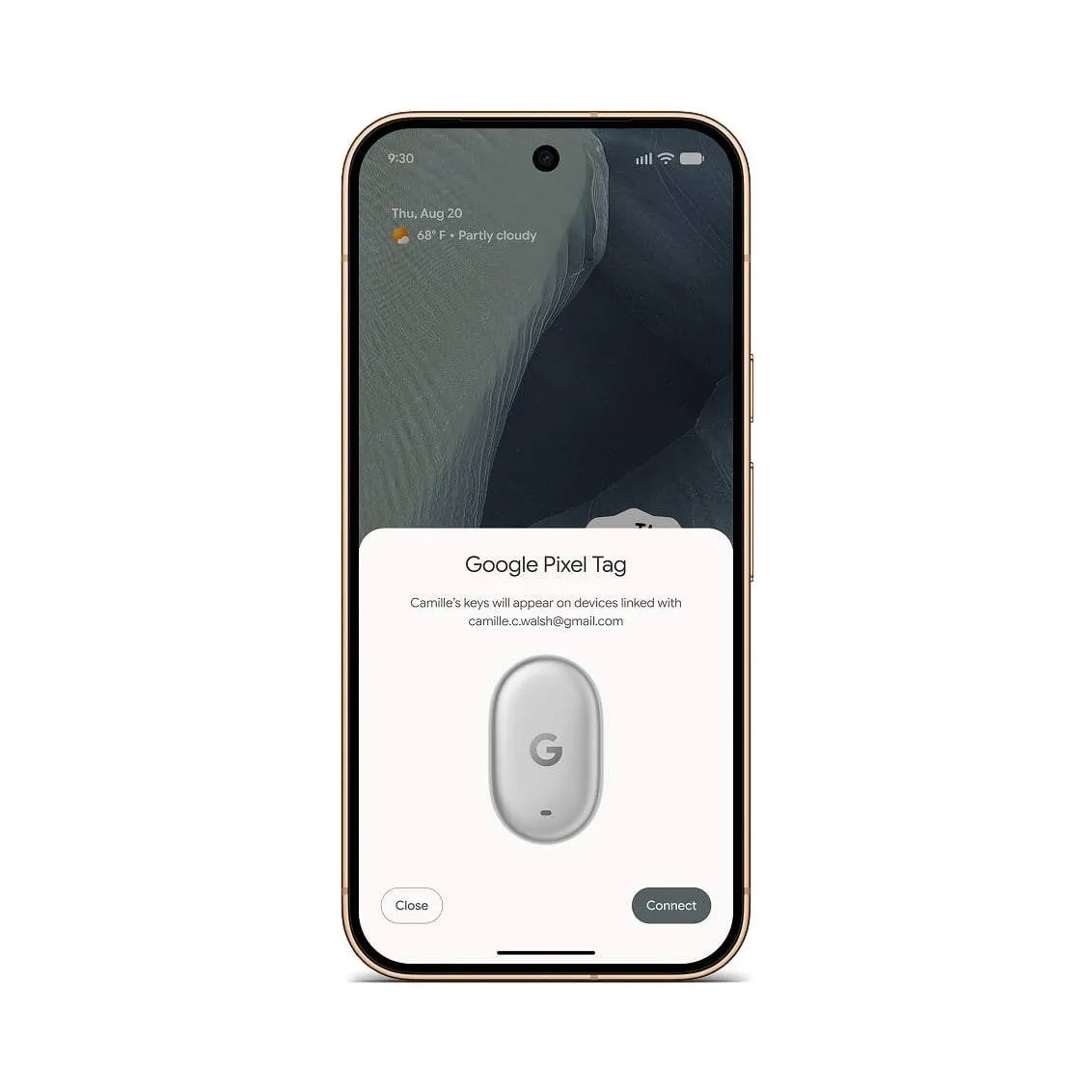
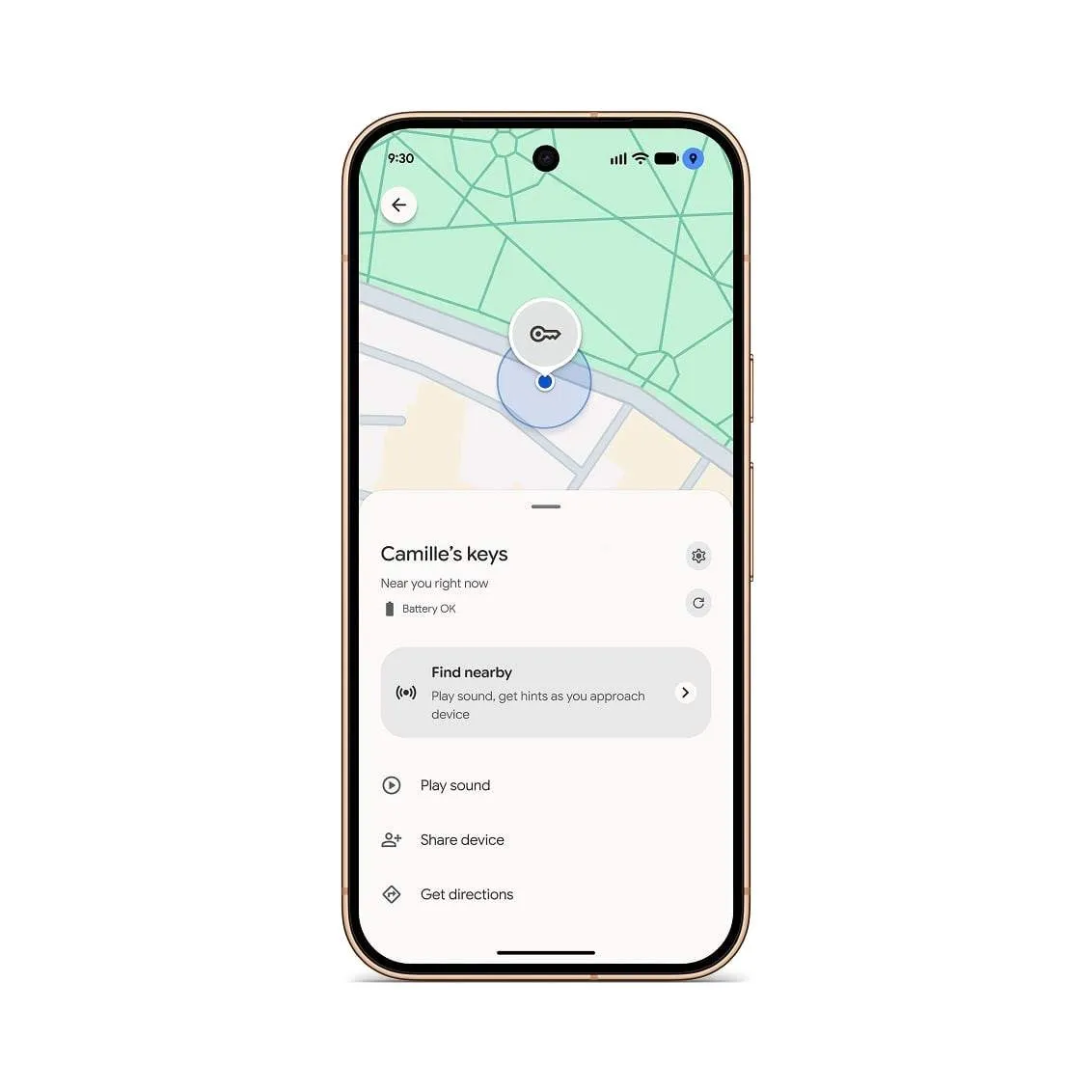
A tag can be shared with up to ten people, which is useful for family car keys or a suitcase traveling with someone else. There are also left-behind alerts, which notify you when you walk away without it. And because it integrates with the rest of the ecosystem, you can ask Gemini from the Pixel Buds to make it ring without taking the phone out of your pocket.
One-year battery and the key ring detail
It uses a standard CR2032 that can be replaced without tools and that Google rates for more than a year. It is the right choice: no proprietary charger, no subscription, and a replacement battery you can find in any store.
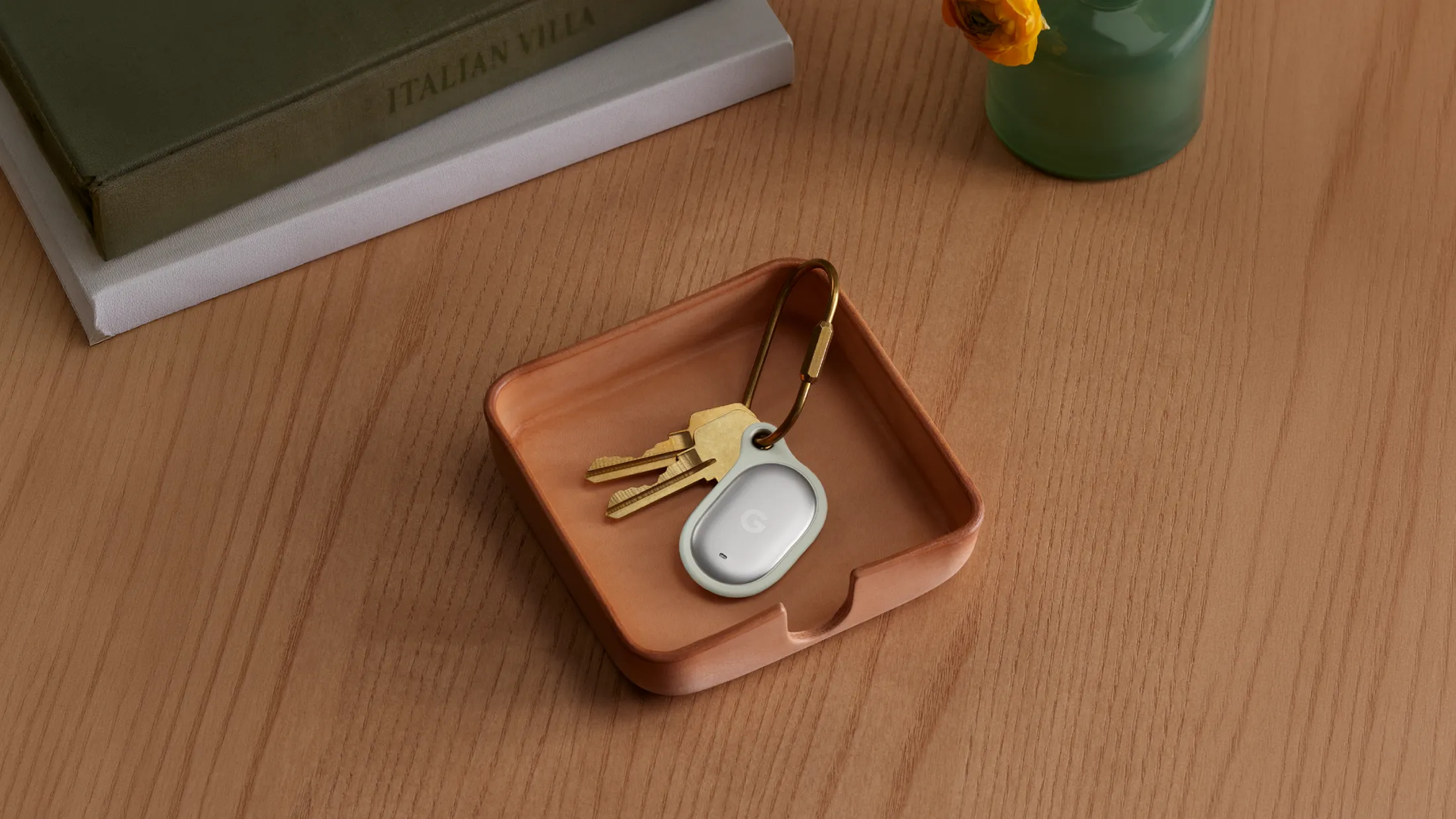
The weak point remains. The body has no hole, so attaching it to a keychain requires adding the ring that Google sells separately, the same setup that cost Apple years of criticism. Motorola and Samsung solved it with a hole in the plastic.
Price and availability: a three-month wait
It costs $29 for one unit and $99 for the four-pack, in line with the AirTag. In Europe, it is 34.99 euros and 109.99 for the pack. Preorders opened on August 12, but shipping does not start until November 11.
That three-month gap is the strangest part of the launch. The rest of the catalog reached stores on August 20; the tracker was announced in August to go on sale almost in December.
Conclusion
Google got the hard part right: it added the UWB the category demands, chose a standard battery that lasts a year, and included a button none of its rivals has. As a first attempt, the product is well resolved.
What still feels weak is execution, not design. The lack of a key ring hole forces an extra accessory from day one, and three months between announcement and sale is a long time in a category where everyone's price hovers around thirty dollars. If you are on Android and can wait until November, it is the most complete option on the Find Hub network. If you need something now, there are alternatives that run on the same network.
Frequently asked questions
Does the Pixel Tag have UWB?
Yes. Google confirmed it in the August 12, 2026 announcement. UWB enables precision finding with distance and direction up to fifty meters from the paired phone, but it requires an Android phone that also has that radio.
Does the Pixel Tag work with iPhone?
For tracking, no: it operates on Find Hub, which requires an Android device. An iPhone can detect it if someone uses it to follow you, because unwanted tracking alerts are a standard that Apple and Google implemented on both systems.
When can you buy the Pixel Tag?
Preorders opened on August 12, 2026, and shipments start on November 11. It costs $29 for one unit and $99 for the four-pack.
Pixel Tag
Google's first tracker with its own hardware: UWB, a one-year battery, and IP67 for $29, running on the Find Hub network.
Pros
- The CR2032 battery can be replaced without tools and lasts more than a year.
- It has a button that makes the phone ring, something the AirTag does not offer.
- It runs on Find Hub, Android's most widespread tracking network.
- It adds UWB for precision finding up to fifty meters.
- It can be shared with up to ten people.
Cons
- It has no key ring hole: the ring is sold separately.
- It does not go on sale until November 11, three months after the announcement.
- Precision finding depends on the phone having UWB.
- It cannot be used to track from an iPhone.
Author
Alexis PaezReport based on official announcements and verified public sources at the time of publishing.
Comments
Share article
You might also like

Pixel Tag: what we know about Google’s tracker before the event
Google will introduce its first tracker on August 12 alongside the Pixel 11. Leaked listings show the design and price, but none mention UWB.


Pixel 11: 30x zoom and fast wireless charging come to the base model, but it misses out on HiLight
The Pixel 11 inherits the Pro models’ 5x telephoto and 30x Super Zoom for $899. Full specs, price, sale date, and what it gives up versus the Pro models.