Anthropic launched Claude Opus 5: nearly as capable as Fable 5, at half the cost

Index
Anthropic introduced Claude Opus 5, the first fifth-generation model in its Opus line. The company positions it as a model for everyday use: it approaches the performance of Fable 5—its most powerful model—at half the cost, while keeping the same price as its predecessor, Opus 4.8. The other part of the news is a new feature: a control that lets users choose how much effort the model devotes to each task, balancing cost and capability. One detail to keep in mind: the performance comparisons come from Anthropic’s own benchmarks.
What is Claude Opus 5
Opus 5 is the top-end model in the Opus family and the first in that line to reach generation 5. Anthropic describes it as "thoughtful and proactive," and positions it as the new default model in the Claude Max plan and the most powerful option in Claude Pro. In coding and knowledge-work tasks—the evaluations the company uses as references, Frontier-Bench and GDPval-AA—it presents Opus 5 as the new state of the art, although it notes that the model remains behind Mythos 5 in cybersecurity.
The positioning is clear: it is not the most capable model in the catalog, but the most balanced one in terms of capability and cost. It is the fourth update Anthropic has launched in less than two months, after Mythos 5, Fable 5, and Sonnet 5. Only Haiku, the lightweight model, is still waiting for its jump to the 5 series.
Cost vs. capability: the new effort dial
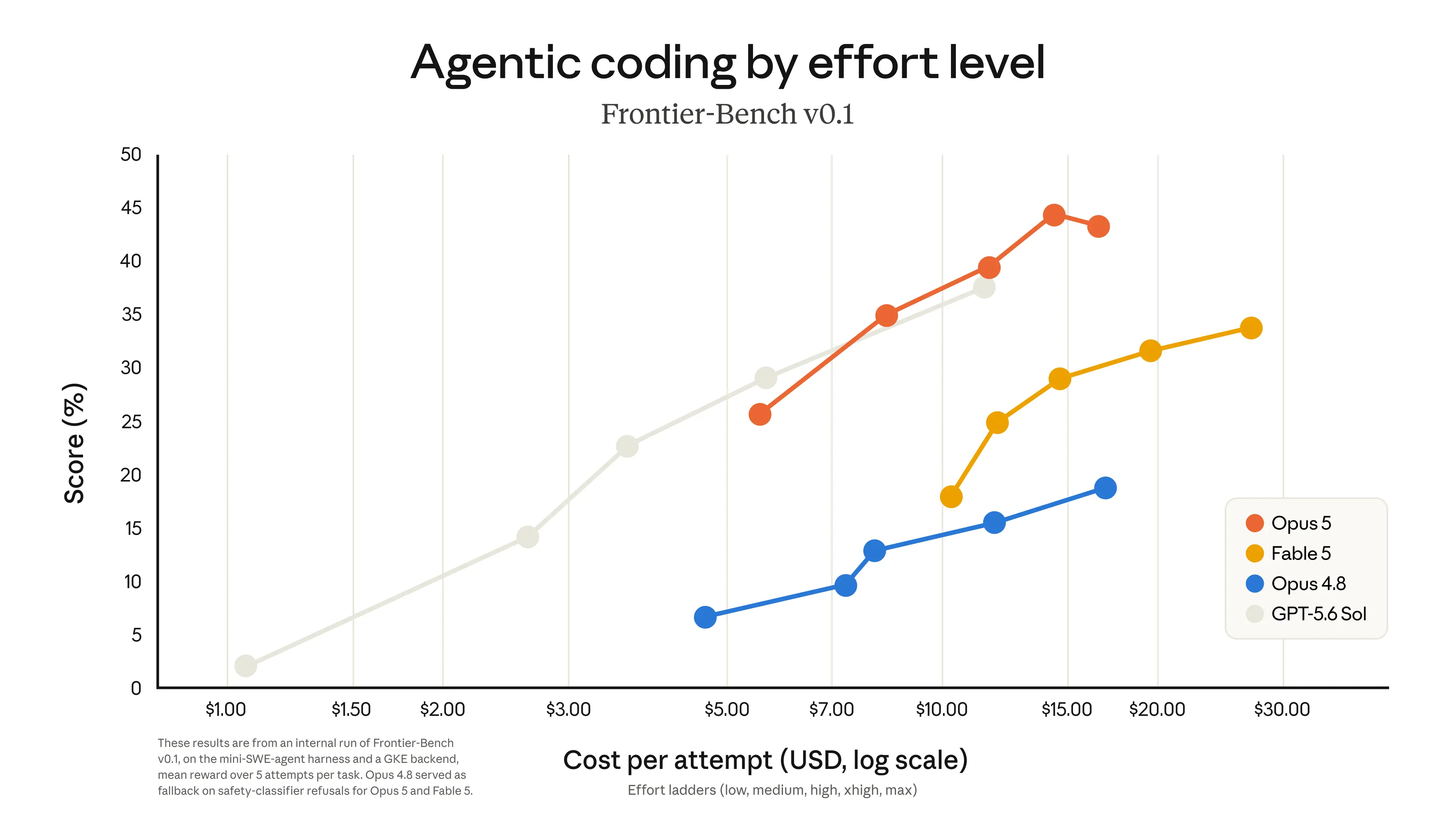
The feature that most clearly sets Opus 5 apart from earlier launches is an effort control. Instead of fixed performance, the model lets users choose how much compute capacity it devotes to solving each request, from a low level up to maximum. The logic is straightforward: at lower effort, it uses fewer tokens and responds faster and more cheaply; at higher effort, it extracts more capability in exchange for higher cost.
The point Anthropic emphasizes is that at lower levels, Opus 5 preserves much of its performance. You do not need to pay for maximum effort to get a solid result on tasks that do not require it. For companies and developers watching their AI bill, that is the central promise: tuning spend without switching models.
Two other cost-control options are also being added, both in beta: the ability to switch models mid-conversation and automatic fallbacks, which redirect requests that safety classifiers block to another model instead of stopping them.
Performance and benchmarks
In the evaluations that Anthropic published alongside the launch, Opus 5 improves significantly over Opus 4.8 and competes closely with Fable 5. In Frontier-Bench—an agentic coding test—it more than doubles Opus 4.8’s result at a lower cost per task. In ARC-AGI 3, a test of novel problems, its score triples that of the second-best model. And in CursorBench, at maximum effort, it lands less than half a percentage point below Fable 5’s peak, but at half the cost per task.
The improvement also shows up in scientific work: Opus 5 outperforms Opus 4.8 across all of the company’s life-sciences evaluations, with the biggest jumps in organic chemistry (10.2 percentage points higher) and protein-related tasks (7.7 points).
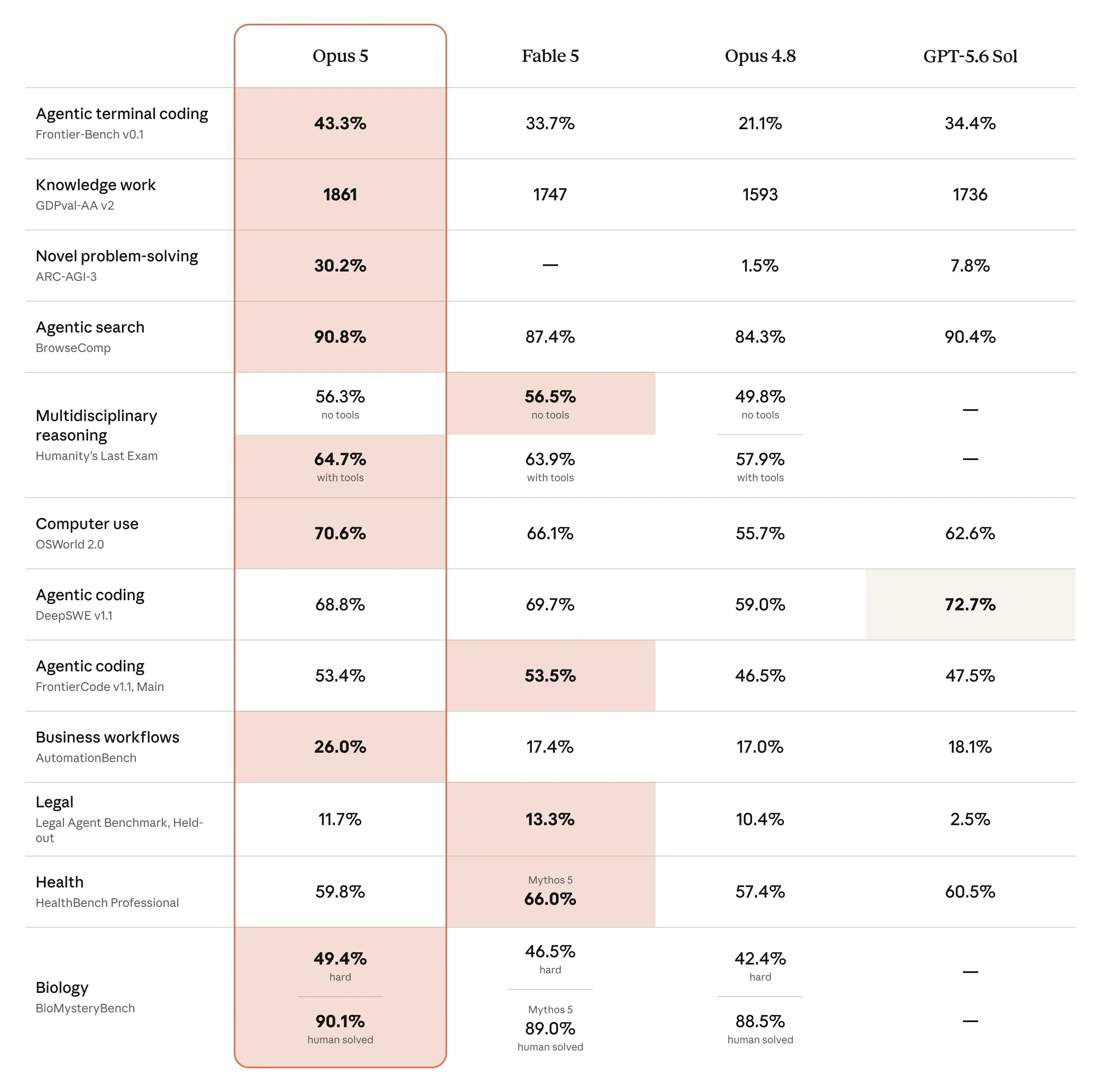
These numbers should be read with the right amount of distance. They are Anthropic’s own benchmarks, based on bounded tasks with measurable results. They are useful for placing Opus 5 relative to its siblings, but performance in real work—more ambiguous and messier than a test—is something that only becomes clear beyond the manufacturer’s charts.
Price and how to access it
Opus 5 costs $5 per million input tokens and $25 per million output tokens, the same price as Opus 4.8 and half the cost of Fable 5. It is available across all Anthropic platforms and in the API, with the identifier claude-opus-5.
It is also offered in a Fast mode that runs at about 2.5 times the standard speed, at double the base price. In subscription plans, it is the default model in Claude Max and the most powerful model available in Claude Pro.
Alignment and safety
Anthropic says Opus 5 is its most aligned model to date: the one least likely to engage in deceptive behavior and the hardest to manipulate for misuse, according to its internal behavior audit. The company also describes it as the most careful model when it comes to avoiding actions with consequences that are difficult to reverse.
On dual-use capabilities, the company is explicit that Opus 5 does not advance the frontier: it remains behind Mythos 5—its restricted model—in both biological research and offensive cybersecurity. Its cybersecurity classifiers allow vulnerability hunting in source code, but block scanning binaries, pentesting, and exploit generation. When one of those filters is triggered in Claude, the request is routed to Opus 4.8.
Conclusion
Opus 5 is not a model that rewrites the ceiling of what is possible; it is one that adjusts the price of what already works. For anyone already using Opus, it is an upgrade at no additional cost. For anyone looking at Fable 5 but held back by the price, Opus 5 is the sensible option for almost everything, except frontier tasks where Fable or Mythos still pull ahead. And for developers and companies, the effort control is a concrete tool for lowering the bill without giving up too much.
The backdrop is more interesting than the model itself. Four launches in less than two months, with price as the central argument, show where the competition has moved: it is no longer defined only by peak capability, but by the economics of everyday use. Opus 5 is Anthropic’s bet that this is the ground that matters.
Frequently asked questions
Is Claude Opus 5 free?
No. Opus 5 is available in Anthropic’s paid plans: it is the default model in Claude Max and the most powerful model in Claude Pro. In the API, it costs $5 per million input tokens and $25 per million output tokens.
Is Opus 5 better than Fable 5?
It depends on the task. In Anthropic’s benchmarks, Opus 5 comes close to Fable 5 and even surpasses it in several tests, at half the cost. But Fable 5 remains the most capable model for frontier tasks, and Mythos 5 outperforms it in cybersecurity and biology.
How do you access Claude Opus 5?
From any Anthropic platform, including the Claude app, and through the API with the identifier claude-opus-5. Claude Max subscribers have it as their default model.
Author
Alexis PaezReport based on official announcements and verified public sources at the time of publishing.
Comments
Share article
You might also like

Apple vs. ChatGPT, Claude, and Gemini: why Apple isn't playing the same game
Apple does not want to be ChatGPT, Claude, or Gemini. While OpenAI, Anthropic, and Google compete to build the best model, Apple is betting on being the platform where they all run. Why this is a different strategy.