Free ChatGPT moves to unlimited chats: what OpenAI gains by giving away messages

Index
OpenAI announced on August 6 that ChatGPT Free and Go accounts are moving to unlimited text chats. GPT-5.6 Luna replaces GPT-5.5 Instant as the default model during the week of August 6, and unlimited messages — along with a new button called Think — start the week of the 10th.
The question is not what free users get, but why they are getting it now. Serving unlimited text to a user base that OpenAI describes as one billion people per week only works if two things happened first: generating each token became much cheaper, and the free plan gained its own revenue stream. Both happened, and both are documented by the company.
What changes for Free and Go accounts
Luna is the smallest and fastest member of the GPT-5.6 family, which OpenAI introduced in July alongside Sol and Terra. According to an internal company evaluation, with Luna, responses containing at least one factual error are about 62% less frequent than with GPT-5.5 Instant. It is OpenAI’s own measurement, without independent verification.
The Think button is the second piece: it works per message and gives Luna more time when the prompt calls for it.
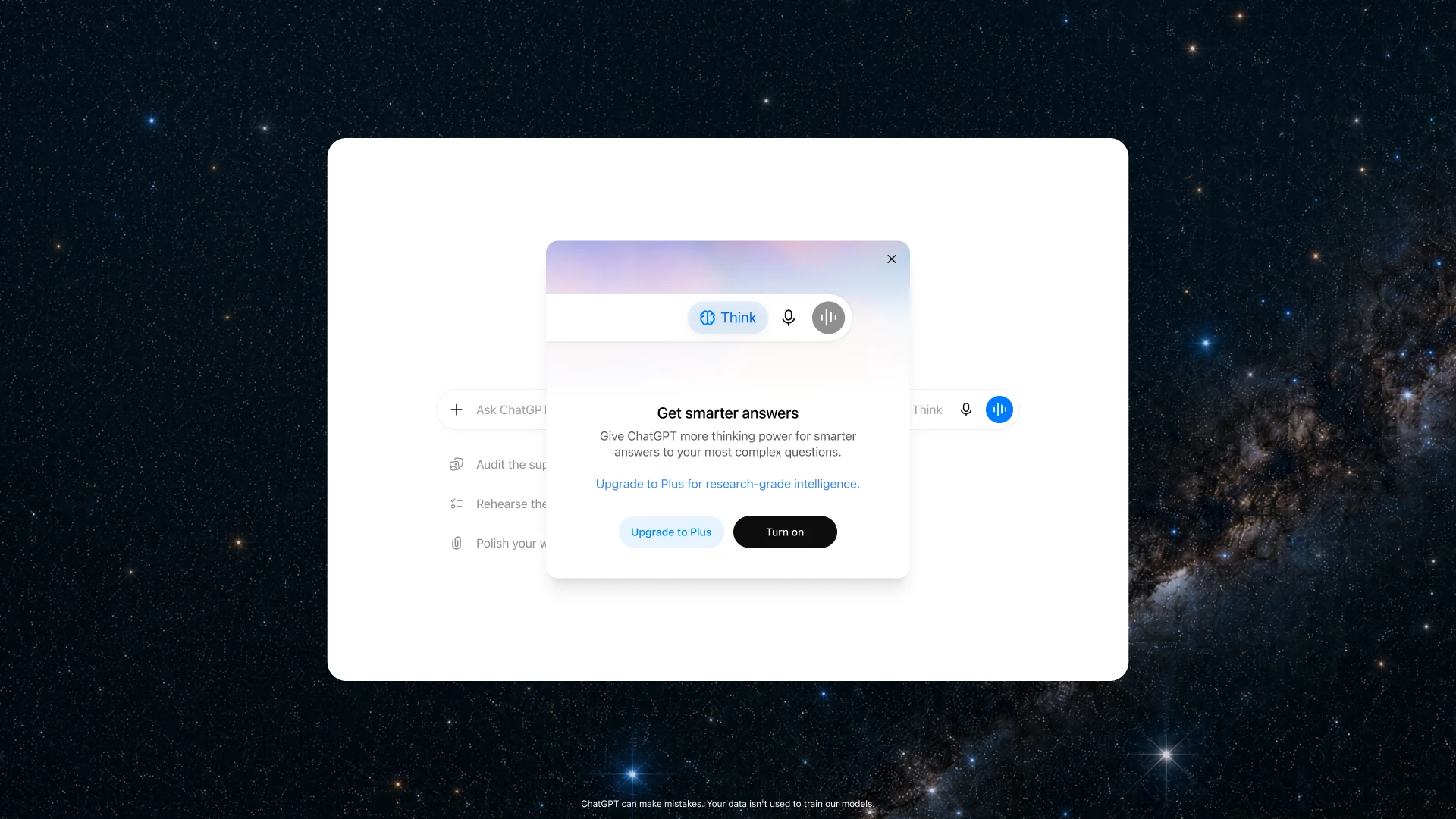
The dialog that introduces it says something on its own. Next to the button to enable it, there is an invitation to upgrade to Plus "for research-grade intelligence": the free plan’s new feature comes with the paid plan’s upsell built in.
What is actually unlimited?
Text chats, and nothing else. File uploads, image generation, and the rest of the tools keep their quotas, and access remains subject to anti-abuse mechanisms. The free plan still has ceilings: what changed is which one disappeared.
It is worth clarifying which cap was removed, because much of the coverage treated it as a given. OpenAI never published a fixed number for the free plan: its help center describes access as limited within a five-hour window, with dynamic caps that vary by market, system conditions, and individual usage. The figures circulating as official — ten messages every five hours is the most repeated one — never were.
Plus and Pro: one model and an effort control
On paid plans, instant answers and deep reasoning now run on the same model. Before, they were two experiences with different tones, and that was noticeable when jumping from one to the other; now, increasing effort should feel like the same model taking more time.
The slider is the interface for that change, on web, mobile, and desktop: from quick answers for everyday questions to maximum effort for planning, research, or code.
Why OpenAI can give away messages
The first reason has a date. On July 30, seven days before the announcement, OpenAI cut Luna’s API price by 80%, to $0.20 per million input tokens and $1.20 per million output tokens. In that same post, it describes Luna as performing on par with models that were at the frontier a year ago, at about six cents on the dollar per task. The math works because the input got cheaper, while the cost of AI hardware keeps pushing consumer product prices upward.
The second reason is on the other end. Unlimited chats are coming to Free and Go, which are exactly the two plans where ChatGPT shows ads; Plus, Pro, and enterprise accounts do not see them. Each additional message from a free user is another opportunity to show that user an ad. The region has already entered that map: on August 6, the same day as the announcement, Brazil appeared as an enabled market for advertisers, with Mexico on the way.
And there is a clause worth rereading. On its page about advertising, OpenAI offers three exits for anyone who does not want to see ads: upgrade to Plus, upgrade to Pro, or turn them off on the Free plan in exchange for fewer daily messages. Messages are the currency used to pay for not seeing advertising, and what happens to that clause now that the plan is unlimited is the question the announcement does not answer.
It is also where the strategies of the major assistants diverge: Anthropic has committed to keeping Claude ad-free, and Google funds Gemini with the machinery it already had running. Three different ways to pay the same compute bill.
The free plan is no longer a demo
For anyone using ChatGPT for free, the change is a pure benefit: a better model and no cap where it hurt most. For anyone paying for Plus, what remains on the other side is reasoning capability, uncapped tools, and the absence of advertising; the subscription is still justified for heavy work, but the argument of "don’t run out of messages" no longer exists.
In the background, unlimited messages, a cheap-to-serve model, and an advertising line tied to those same two plans are not three separate pieces of news: they are one. What remains to be seen is what happens to users who choose to disable ads.
Author
Alexis PaezReport based on official announcements and verified public sources at the time of publishing.
Comments
Share article
You might also like

Apple vs. ChatGPT, Claude, and Gemini: why Apple isn't playing the same game
Apple does not want to be ChatGPT, Claude, or Gemini. While OpenAI, Anthropic, and Google compete to build the best model, Apple is betting on being the platform where they all run. Why this is a different strategy.


Apple sues OpenAI for stealing trade secrets for its first device
Apple sued OpenAI and two former engineers for trade secret theft: an exploited bug, prototypes in interviews, and an unauthorized metal finish.