OPPO Find X10 Pro Max: one of the first with Dimensity 9600 Pro and a global release
Index
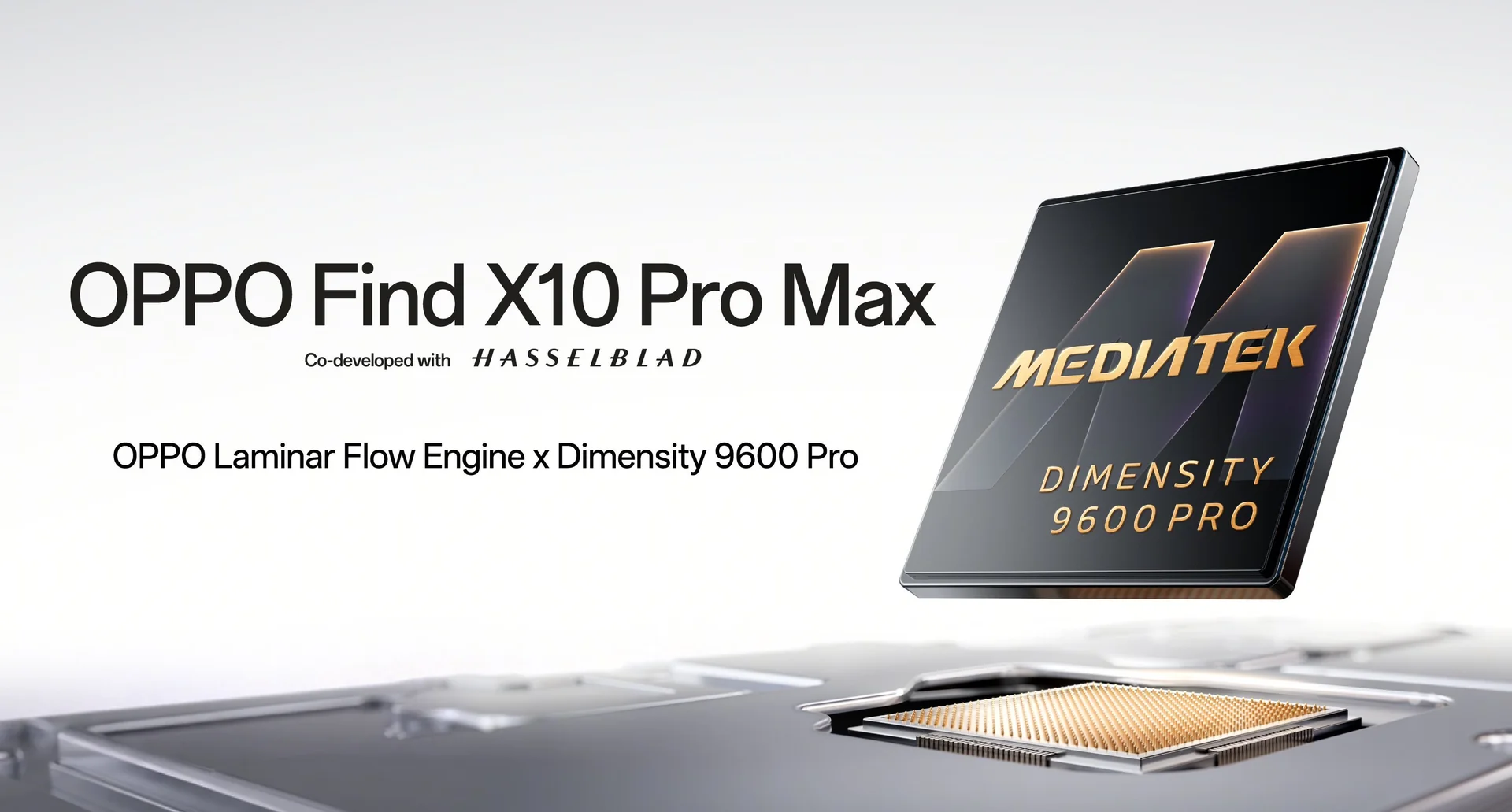
OPPO confirmed on September 15 that the Find X10 Pro Max will be one of the first phones with the Dimensity 9600 Pro, MediaTek's first chip manufactured on a 2-nanometer process. And it will not stay in China: after the local presentation on September 22, it is headed to international markets.
The chip leap is real, but it does not extend to the entire series: the standard Find X10 would use a processor with an almost identical name and specs from the previous generation.

Dimensity 9600 Pro: what changes with 2 nm
The Dimensity 9600 Pro is manufactured on TSMC's 2-nanometer node, the same one already used to manufacture Apple's A20 Pro, and OPPO's announcement specifies that it is the N2P process. The CPU still has no efficiency cores and moves to a 2+3+3 configuration: two C2-Ultra cores at 4.55 GHz, three C2-Pro cores at 4.35 GHz, and three C2-Pro cores at 3.1 GHz.
According to MediaTek, compared with the Dimensity 9500, it delivers up to 17% higher single-core performance and 15% higher multi-core performance, with 61% lower multi-core power consumption. The Mali-G2 Ultra NX GPU delivers 27% higher peak performance with 24% lower power consumption. It is also the first Dimensity compatible with LPDDR6 memory and UFS 5.0 storage.
According to MediaTek's official spec sheets, the first two columns match row by row.
Which chip does the base Find X10 use?
The base Find X10 would use the Dimensity 9600M, according to GSMArena, although OPPO does not mention it in its announcement. In MediaTek's spec sheets, the 9600M has the same CPU, the same GPU, and the same memory support as the Dimensity 9500. Within the series, the 2 nm chip is reserved for the Pro Max.
According to that same coverage, what is new in the 9600M is software: the agentic AI engine and task scheduler from the current generation, running on the same silicon as the 9500.
Laminar Flow Engine: peak vs sustained performance
OPPO and MediaTek jointly developed the Laminar Flow Engine, which debuts on the Find X10 Pro Max. According to OPPO, it coordinates rendering with the system scheduler to balance responsiveness and power consumption.
The figures in OPPO's announcement match MediaTek's, but they do not say the same thing. Where MediaTek talks about 27% higher peak GPU performance, OPPO says 27% higher performance under sustained loads. That is not the same: peak is measured in the first few seconds, while sustained performance depends on how much heat each phone can dissipate. Until there are long-duration load tests from third parties, that 27% applies to peak performance.
Find X10 Pro Max: three 200 MP cameras and 8,000 mAh
OPPO confirmed three 200 MP rear cameras with 8K recording: f/1.5 main, 124° f/2.2 ultra-wide, and f/2.1 periscope. It also adds an 8,000 mAh silicon-carbon battery, ColorOS 17 on Android 17, and configurations of up to 16 GB with 1 TB.
The cameras sit in a square module, and the flash shares a separate capsule with the color sensor. The colors are Light Titanium, Warm Orange, and Moon White.



Notebookcheck reports that this capsule leaves the color sensor unobstructed when the new teleconverter is mounted, something the previous accessory covered on the Find X9 Pro. OPPO does not explain it in its material, so this should be treated as a report.

When the Find X10 Pro Max arrives
The China presentation is on September 22, with preorders open. For the rest of the world, OPPO has not given a date or price, and GSMArena reports a global event in October. It is the same schedule as the Find X9 series, which OPPO announced for the global market with the Dimensity 9500 on September 22, 2025, and launched internationally in late October.
Conclusion
The Find X10 Pro Max is the most direct way to get MediaTek's first 2 nm chip outside China. If you want that chip, the model is the Pro Max, not the base Find X10. If you care about performance in long gaming sessions or heavy video exports, wait for independent testing: the 27% that MediaTek measures at peak is not yet the same as what OPPO promises under sustained loads.
Find X10 Pro Max
The top-end model in the Find X10 series and one of the first phones with the 2 nm Dimensity 9600 Pro. It adds three 200 MP cameras and an 8,000 mAh battery, and it is headed to international markets.
Pros
- It is one of the first phones with the 2 nm Dimensity 9600 Pro.
- Three 200 MP rear cameras, including the periscope.
- 8,000 mAh silicon-carbon battery.
- It is launching in international markets, not just China.
Cons
- OPPO has not yet announced global pricing or a launch date.
- The sustained-load improvement OPPO promises has no third-party testing yet.
Author
Alexis PaezReport based on official announcements and verified public sources at the time of publishing.
Comments
Share article
You might also like

OPPO Find X9 Pro: In-depth review and the madness of its optical teleconverter
In-depth review of the new OPPO Find X9 Pro. We tested its incredible 7500 mAh battery, the Dimensity 9500 chip, and Hasselblad’s wild optical teleconverter.

Pixel 10 and Gemini: the duo Google plans to dominate 2025 with
Everything we know about the Google Pixel 10 and 10 Pro ahead of the Made by Google event. Tensor G5 chip, 16 GB of RAM, and full Gemini integration.

Pixel 11 Pro XL, Galaxy S26 Ultra, and iPhone 17 Pro Max: the three have converged, and something else decides the winner
All three come with 12 GB of RAM, a vapor chamber, and 5,000 mAh. We compare zoom, charging, and display—and why timing in the sales cycle matters more than the spec sheet.