SK Hynix invests US$38 billion in two new fabs to counter the memory shortage

Index
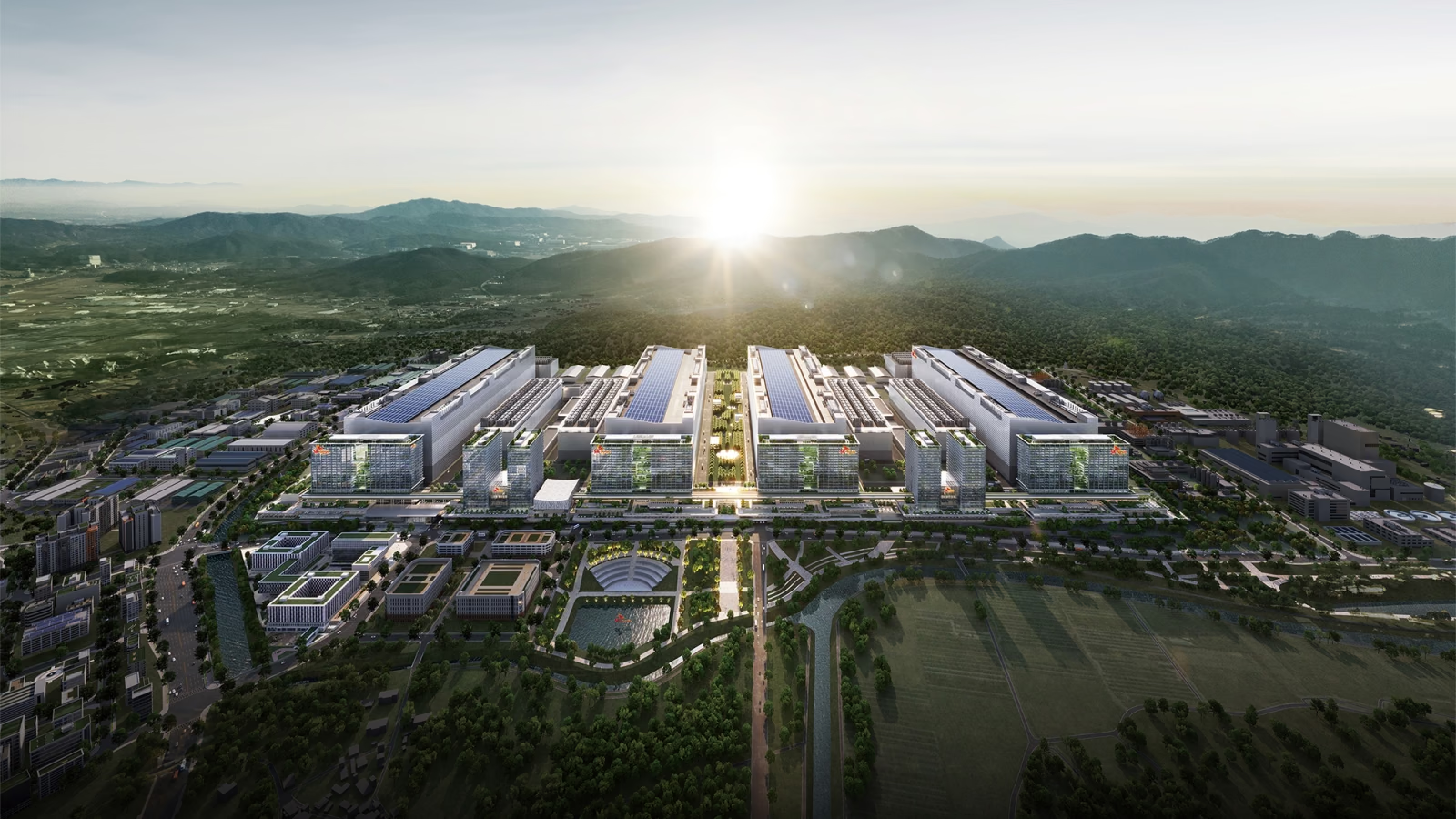
SK Hynix's board approved 54.3 trillion won — about 38.3 billion dollars — to build two memory fabs: Y2 in Yongin and M17 in Cheongju. It is the company's largest capital allocation and comes amid a sharp rise in RAM prices. The detail that barely appears in the coverage: neither facility starts construction before 2027, and the first cleanroom opens in December 2028.
What SK Hynix approved
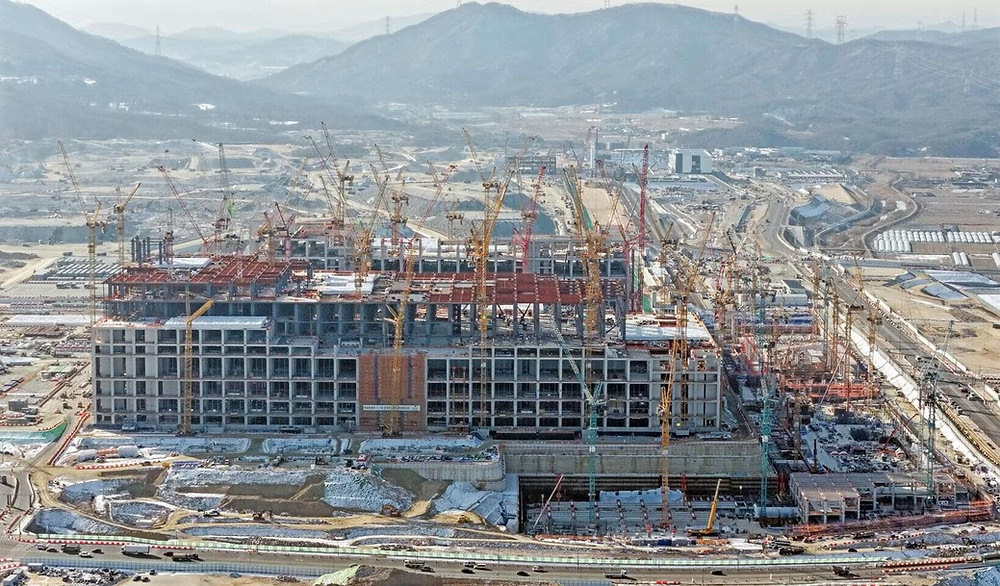
Y2 will be built in Wonsam-myeon, in Yongin's Cheoin district, with 35.2 trillion won across roughly 1,130,000 m². It will produce next-generation DRAM and HBM, the high-bandwidth memory stacked alongside AI accelerators.
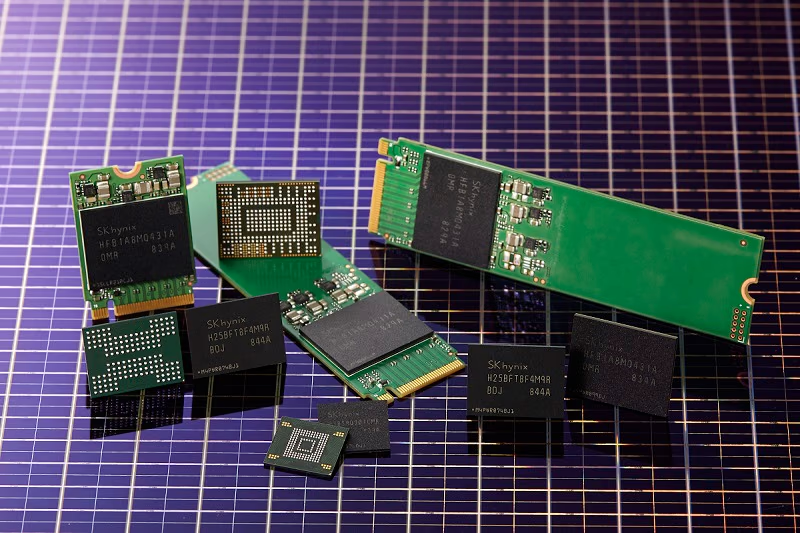
M17 goes to the Cheongju campus, where SK Hynix already operates the M11, M12, and M15 plants. It receives 19.1 trillion won over about 680,000 m² and is dedicated to NAND flash, the memory used in SSDs.
The company's rationale is about volume, not technology. "In the AI era, technological competitiveness alone is not enough: the ability to supply the necessary volume at the exact moment the customer needs it is itself a competitive advantage," a spokesperson said in the official announcement. Behind that is an Omdia projection: DRAM and NAND growing at a compound annual rate of 19% through 2030.
Y2 and the Yongin cluster
Y2 is the second of the four plants in the Yongin cluster, a 4.15-million-m² site that SK Hynix is developing as a long-term production base. The first, Y1, is already under construction and opens its initial cleanroom in February 2027.
What changed is the pace: the company moved up completion of the full cluster from 2045 to 2033, twelve years ahead of the original plan. That says more than any press release about how it reads AI demand. It is not treating it as a passing cycle, but as a new baseline.
M17 and the shift toward storage
The fact that 19.1 trillion won is going to NAND stands out in a market where the entire conversation is about HBM. The logic lies in how workloads have changed: agentic models do not just need bandwidth for inference; they also need to store context. M17 targets enterprise SSDs and key-value cache for inference, a use case that barely existed two years ago.
There is a nuance. NAND requires less new fab space than DRAM, because 3D stacking adds capacity on the same wafer without expanding the plant. The fact that SK Hynix still chose Cheongju is not about a technical requirement: it is the site with the fastest construction schedule.
When production begins
There is no construction in 2026. M17 starts construction in February 2027 and Y2 in July 2027. The cleanrooms open in December 2028 and June 2029, and spending extends through 2031.
There is one more condition, written into the announcement itself: the fabs are built according to the master schedule, but cleanroom expansions and equipment installation proceed sequentially based on demand, to maximize capital efficiency. The building follows the calendar; the machines do not. Raising the structure is the cheap part, and the lithography equipment — where most of those 54.3 trillion won will go — is released when there are orders to justify it.
June 2029 is not the date when Y2 floods the DRAM market. It is the date when the cleanroom exists.
Why this will not bring RAM prices down
According to TrendForce, DRAM and NAND contract prices rose by around 60% in the second quarter of 2026, and the projection for the third quarter is still upward: between 13% and 18% for DRAM, between 10% and 15% for NAND. The increase is slowing, but slowing is not the same as falling.
The market has also split in two. Data centers absorb everything produced for inference, cushioned by long-term contracts. On the other side, PC and smartphone makers are hitting the ceiling of what consumers can pay, and that cost ends up in retail prices.
Y2 will not fix that either once it produces: its stated priority is HBM and next-generation DRAM for AI, not the consumer DDR5 modules that are expensive today.
The CEO himself already warned about it
The most honest reading of the announcement came from the company itself before it was announced. CEO Kwak Noh-jung told Reuters that 2027 will be "the worst year in the industry's history from a supply perspective," and that demand will remain above supply capacity even beyond 2030. He said it on the day of SK Hynix's Nasdaq debut, as reported by Tom's Hardware.
Placed alongside the timeline, the message falls into place: the shortage worsens in 2027, the fabs meant to solve it open in 2029, and even the company itself does not believe that will be enough by 2030.
The risk on the other side
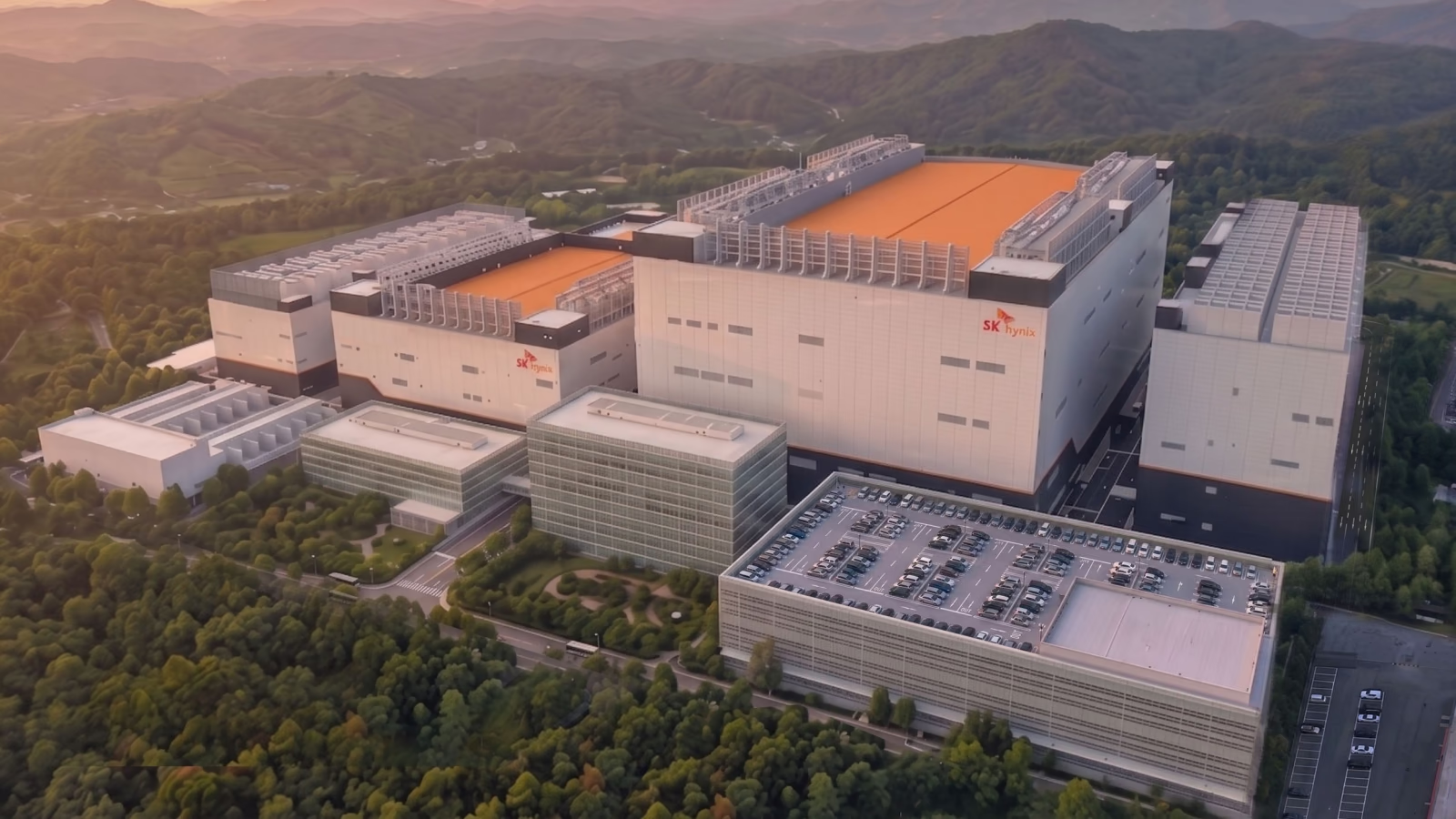
It is also worth keeping the opposite hypothesis in mind. SK Hynix is not alone: Samsung, Micron, CXMT, Kioxia-SanDisk, and YMTC have announced expansions in parallel, and Micron is already building 3D NAND capacity in Singapore. If all that supply lands at the same time around 2029 and enterprise AI adoption does not keep pace, Blocks & Files warns that the scenario shifts from shortage to oversupply, with the price collapse that implies in a market that has already gone through that cycle several times.
In that context, installing equipment based on demand stops being an accounting technicality: it is SK Hynix's insurance policy against its own forecast.
What to expect from memory prices
If you are building or upgrading a PC, this announcement does not change your decision. Prices remain tight through 2027, and the approved capacity does not reach the market until 2029 at best: buying now or waiting is a calculation about the current cycle, not about these fabs.
If you follow the industry, it matters for another reason. SK Hynix considers AI memory demand structural enough to bring a twelve-year infrastructure plan forward: it is an explicit bet that this is not a bubble.
And if your work depends on enterprise storage, M17 is the part worth following. It recognizes that AI is no longer just a bandwidth problem, but also a question of where to store context.
The real unknown is not whether the fabs will be built. It is whether they will arrive before the cycle turns.
Frequently asked questions
When will SK Hynix's new fabs start production?
The first cleanroom, M17 in Cheongju, opens in December 2028. Y2 in Yongin opens in June 2029. Construction of both begins during 2027, so production is not possible before 2029.
Will this investment lower RAM prices?
Not in the short term. DRAM and NAND contracts continue to rise during 2026, and SK Hynix itself projects that 2027 will be the industry's worst year for supply. Capacity from these fabs arrives in 2029, and their priority is HBM for AI rather than consumer memory.
What is the difference between Y2 and M17?
Y2, in Yongin, receives 35.2 trillion won and produces DRAM and HBM. M17, in Cheongju, receives 19.1 trillion won and produces NAND flash, the memory used in SSDs. Y2 is the larger facility and targets AI; M17 targets storage.
Why is SK Hynix investing in NAND if demand is for HBM?
Because agentic AI models need to store context as well as process it. M17 is aimed at enterprise SSDs and cache storage for inference, a demand segment that has grown quickly over the past two years.
Author
Alexis PaezReport based on official announcements and verified public sources at the time of publishing.