The Pixel 11 Pro drops to 12 GB of RAM: to get 16, you have to pay $120 more and get 512 GB

Index
Google introduced the Pixel 11 Pro as phones designed to run Gemini locally. In the same presentation, without saying it on stage, it lowered the memory in the entry-level configuration from 16 to 12 GB. To get those 4 GB back, you have to move up to the 512 GB version, which costs $120 more.
How much RAM does the Pixel 11 Pro have?
The 256 GB version comes with 12 GB of RAM. The 512 GB and 1 TB models come with 16 GB. It is a change from the previous generation, where 16 GB came in every Pro configuration, including the cheapest one. The same tiering applies to the Pro XL.
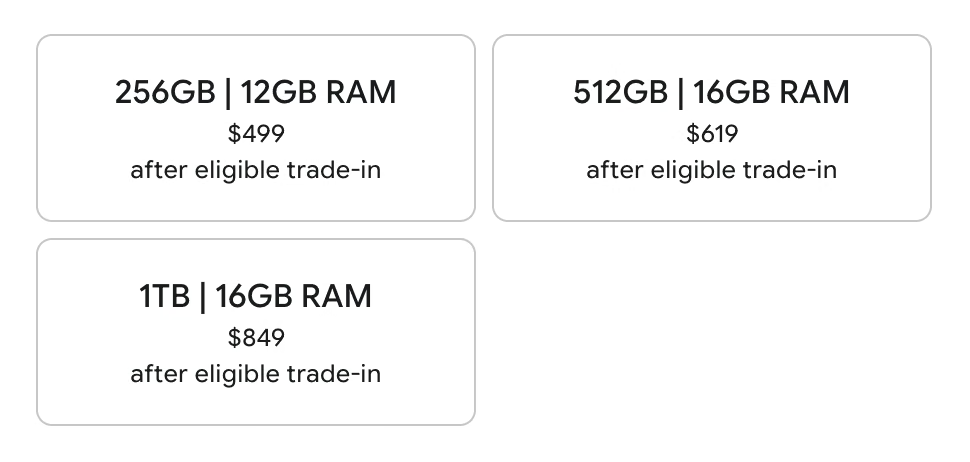
The detail that raises eyebrows is not the price itself, but what it forces you to buy. To get 4 GB more memory, you also have to take 256 GB more storage, whether you want it or not. There is no 256 GB version with 16 GB of RAM.
Why memory matters differently when AI runs on the phone
A model that runs locally has to be loaded into memory to respond quickly. That portion stays reserved while the system needs it, and it is not available for everything else.
That is the difference from RAM a few years ago, when its only job was to keep apps open in the background. With Gemini Nano running on the device, memory becomes a resource contested between the assistant and everything else. When it runs short, the system starts closing background apps: you lose your place in what you were doing, the camera takes longer to open, and browser tabs reload.
With 12 GB, that is not going to happen tomorrow. The point is different: Google promises seven years of updates, and AI models do not get smaller over time. The question is not whether 12 GB is enough today, but whether it will be enough in the future.
The contradiction is inside the lineup itself
The strangest part of the issue appears when you look at the rest of the catalog. The Pixel 11 Pro Fold has 16 GB in all of its versions, including the 256 GB model. The foldable costs more, yes, but it is not the model Google put at the center of the local AI pitch: that role belongs to the Pro models.
And the Pixel 11 never reaches 16 GB: it stays at 12 GB in both configurations, even if you pay $1,019 for the 512 GB version.
Google attributes the cut to software optimization, and that is a plausible explanation: a better-compressed model takes up less space. But if the optimization is enough, it is hard to understand why the foldable needs 16 GB in its cheapest version.
The second cut, the one you pay for every month
The purchase includes six months of Google AI Pro. The previous generation included twelve. That is half the subscription that gives access to cloud-dependent features, right in the year when AI is the center of the campaign.
Added to the $100 increase over the previous model, the real cost of having a Pixel 11 Pro with the full experience rises by more than the price tag suggests.
Which configuration should you buy?
If you are going to keep the phone for two or three years and then upgrade, the 256 GB model is fine: 12 GB will not be a problem in that timeframe, and you save $120.
If you plan to stretch it until updates run out, the 512 GB model is the sensible purchase. Not because of the storage, but because of the memory, and that is exactly the problem: you are paying for 256 GB you may not need to get 4 GB you do.
And if the budget does not cover the jump, look at the Pro Fold before ruling it out. It is more expensive, but it is the only one in the lineup that does not make you choose.
Conclusion
This is not a scandal or a broken phone: the Pixel 11 Pro is excellent, and 12 GB of RAM is more than enough for current use. What is frustrating is the way it is structured. Google raised the price, lowered the entry-level memory, cut the subscription in half, and built the configuration ladder so that the only way out is to spend more.
There is an optimistic reading, which is that software optimization really does make those 4 GB unnecessary. And there is a pessimistic one, which is that three years from now, the difference between the two versions will become noticeable precisely when there is nothing left to do about it. For now, all we know is that Google chose not to explain it on stage.
Author
Alexis PaezReport based on official announcements and verified public sources at the time of publishing.
Comments
Share article
You might also like

Which Pixel 11 to buy: which of the four is right for you and which configuration to choose
The Pixel 11, the Pro, the Pro XL, or the foldable: which one makes sense depending on your use, what really changes between them, and which RAM and storage configuration to choose.

Pixel 11 Pro and Pro XL: HiLight, 120x zoom, and the first vapor chamber in a Pixel
The Pixel 11 Pro and Pro XL add HiLight, 120x Pro Zoom, a vapor chamber, and 3,600 nits. Full specs, pricing, and the asterisk around 12 GB of RAM.

Pixel 11 Pro XL, Galaxy S26 Ultra, and iPhone 17 Pro Max: the three have converged, and something else decides the winner
All three come with 12 GB of RAM, a vapor chamber, and 5,000 mAh. We compare zoom, charging, and display—and why timing in the sales cycle matters more than the spec sheet.