Which Pixel 11 to buy: which of the four is right for you and which configuration to choose

Index
The four Pixel 11 models hit stores on August 20, and there is a thousand-dollar gap between the cheapest and the most expensive. Choosing the model is only half the job: Google built the configuration ladder so the decision continues afterward, when you have to decide how much memory and storage you are willing to pay for. The Pro Fold is the only model in the lineup that does not make you choose between the two.
The $899 Pixel 11 is the right buy for most people; the Pro models are justified by the camera and cooling, not by the AI Google uses to sell them.
If you are coming from a mid-range phone
The Pixel 11. For $899 you get the 5x telephoto lens with 30x Super Zoom that, until this generation, was exclusive to the Pro models, 256 GB of base storage, and a 4,985 mAh battery, the largest among the three non-foldables. Wireless charging increases from 15W to 25W with Qi2.2, 60% faster.
What it gives up is specific, and it is worth being clear about it: it does not have HiLight, it stays on Wi-Fi 6E while the Pro models move up to Wi-Fi 7, and it does not include a vapor chamber. That last omission matters most in a phone sold on its local AI, because cooling is what sustains performance when processing runs for longer.



All four share Tensor G6, the Titan M3 security chip, Android 17, and seven years of system updates. Buying the entry-level model does not leave you out of long-term support, which is where most brands cut back.
If you have a Pixel 10
Do not upgrade. HiLight is an LED ring around the flash, the 120x Pro Zoom is processing on top of a better sensor, and the vapor chamber is only noticeable under sustained use. None of that justifies $1,099 one year after paying for an equivalent phone.
If you have a base Pixel 10, the argument is not the lens either: the Pixel 11 ultra-wide and telephoto repeat the previous hardware, and what changed is the Tensor G6 processing. The real jump comes if you are coming from a Pixel 9 or earlier, where two generations of camera, chip, and display improvements add up.
If the camera matters to you
This is where the difference between the Pixel 11 and the Pro models begins and ends. The Pro models debut new sensors across all three lenses: 50 MP on the main camera, 48 MP on the ultra-wide, and 48 MP on the 5x telephoto, with 30% higher sensitivity. That enables 5x portraits, 120x Pro Zoom, and Night Sight that is 4.5 times faster. The front camera jumps to 42 MP with autofocus.
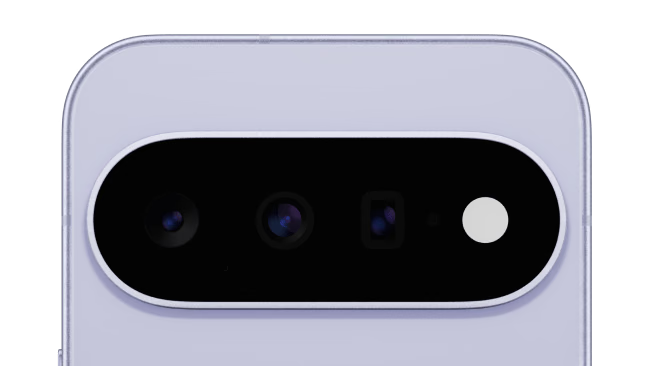
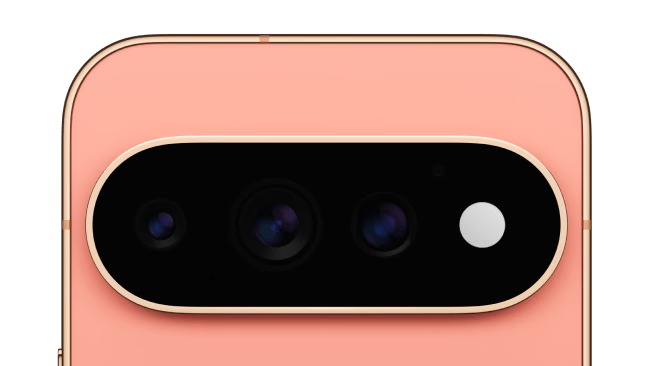
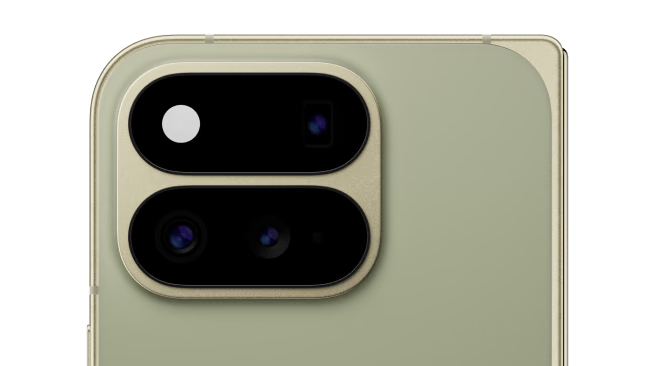
The Pro Fold sits in the middle, and there is no need to soften it: its cameras are from the previous generation of Pro models. A 48 MP main sensor, 10.5 MP ultra-wide, and 10.8 MP telephoto that reaches up to 30x. If you are paying for the foldable because of photography, you are spending $800 more than the Pro for a worse system.
If you want a large display
There are two paths, and they are not equivalent. The Pixel 11 Pro XL gives you 6.8 inches in a standard 226-gram phone, with 5,115 mAh and 45W charging, the fastest in the lineup. The Pro Fold gives you 8 inches that fold down to a 6.5-inch outer display, for $600 more and thirteen extra grams.

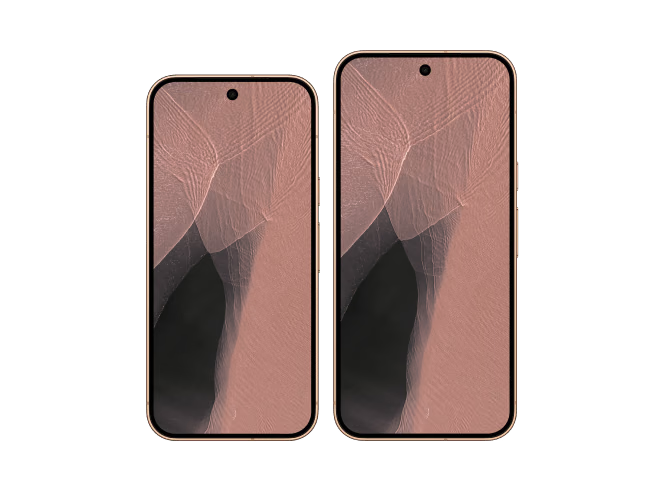

The honest comparison is not settled by inches. The Pro XL gives you the largest display that fits in a pocket without compromises: no crease, no hinge, and the largest battery of the generation. The Pro Fold gives you a tablet format in exchange for all of that. If you want to see more, get the XL; if you want to do two things at once, get the foldable.
If you want a foldable
The Pro Fold is the most sensible foldable on the market for a reason that barely appears in the coverage: it keeps IP68 certification, and no other mass-market foldable offers it. The enemy of this category is not drops but dust, which gets through the hinge, slips between the layers, and ruins the panel from the inside. A sealed foldable lasts years longer than one that is not sealed.
Add to that the fiberglass composite back cover, the gearless hinge, and the 239-gram weight, almost twenty grams less than the previous generation. Folded, it measures 10.1 millimeters; unfolded, it is 5.
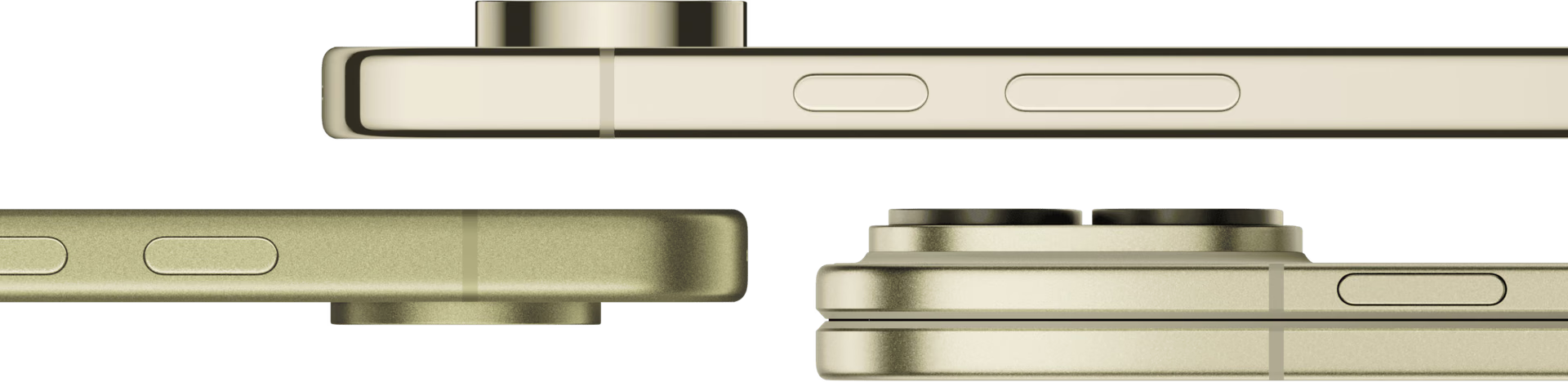
What Google did not solve is the crease on the internal display, which improves only slightly and remains behind what Samsung and Oppo have already achieved. The read is clear: the effort went into what breaks, not what you see every day.
The four Pixel 11 models, head to head
The table organizes what separates each model, not what they share. Chip, operating system, years of support, IP68, and 25W wireless charging are identical across all four.
Read by user profile, the table says three things. The Pixel 11 loses nothing used every day except in camera performance. The Pro XL buys size and charging speed, not new capabilities. And the Pro Fold is the best equipped in memory and the weakest in photography.
Which configuration to choose within each model
This is where most guides stop, and where the purchase is actually defined. The 256 GB Pixel 11 Pro models come with 12 GB of RAM; 16 GB is reserved for the 512 GB and 1 TB versions. To get four more gigabytes of memory, you are also forced to take 256 GB more storage, whether you need it or not.
The practical rule is simple. If you are going to keep the phone for two or three years and then upgrade, the 256 GB version is more than enough and saves you $120. If you plan to stretch it until the seven years of updates run out, the 512 GB model is the sensible buy, because local AI models will not get smaller over time, and those 4 GB will matter more later than they do today. On the base Pixel 11, there is no dilemma: both configurations come with 12 GB, so you choose only based on storage.

Preorders opened on August 12, and general sales begin on the 20th for all four models. Any of them includes six months of Google AI Pro, half of the twelve months offered with the previous generation.
Which one to buy, by profile
For most people, the $899 Pixel 11 in its 256 GB version. It has the zoom that matters, the largest battery among the non-foldables, and seven years of support; what it gives up is barely noticeable outside demanding photography.
For serious photography, the 512 GB Pixel 11 Pro. The new sensors and vapor chamber are the real difference this generation, and the 512 GB configuration is the only one that does not leave you tied to 12 GB of memory in a device built to last.
For those who want a large display without compromises, the Pro XL. For those who will truly take advantage of the format, the Pro Fold, knowing that you are paying for durability and not the camera.
And if you have a Pixel 10, none of them. This generation is a year of refinement with a bill attached: better camera, better display, higher price, and less entry-level memory. Wait for the 12.
Frequently asked questions
Which Pixel 11 should you buy?
For most people, the $899 Pixel 11: it inherits the 5x telephoto with 30x zoom, starts at 256 GB, and has the largest battery among the non-foldables. The Pro models are justified if photography is a priority, because they debut new sensors and a vapor chamber.
Is it worth paying $200 more for the Pixel 11 Pro XL?
Only if you want the 6.8-inch display or 45W charging. They share the chip, cameras, HiLight, and memory: the XL does not add capabilities; it adds size, battery life, and charging speed in exchange for twenty-two extra grams.
Which Pixel 11 has the most RAM?
The Pixel 11 Pro Fold, with 16 GB in all versions. The Pro and Pro XL start at 12 GB and only reach 16 GB in the 512 GB and 1 TB configurations. The base Pixel 11 stays at 12 GB in both versions.
Does the base Pixel 11 have the same zoom as the Pro models?
No. It shares the 5x optical telephoto and reaches 30x, but the Pro models debut a 48 MP sensor with 30% higher sensitivity and reach 120x with Pro Zoom. The difference is most noticeable at long range and in low light.
Pixel 11
The entry-level model of the 2026 generation and the most sensible buy in the lineup for most people.
Pros
- It is the cheapest model in the lineup and the one that gives up the least in everyday use.
- It inherits the 5x telephoto with 30x Super Zoom from the Pro models.
- The 4,985 mAh battery is the largest among the three non-foldables.
Cons
- It does not have a vapor chamber, and cooling is what sustains performance.
- It stays on Wi-Fi 6E and has no HiLight.
- It never reaches 16 GB of RAM, not even if you pay for the 512 GB version.
Pixel 11 Pro
The compact Pro: the best sensors of the generation and active cooling in 6.3 inches.
Pros
- All three sensors are new and increase sensitivity by 30%.
- The vapor chamber sustains performance during extended use.
- It is the most compact flagship on the market, at 6.3 inches.
Cons
- The 256 GB version drops from 16 to 12 GB of RAM.
- To get 16 GB, you have to pay $120 more and take 512 GB.
- The battery is the smallest of the three non-foldables.
Pixel 11 Pro XL
The large Pro: the same spec sheet as the Pro with 6.8 inches, more battery, and the fastest charging in the lineup.
Pros
- 45W charging is the fastest in the entire lineup.
- It adds display size and battery without giving up anything from the Pro.
- The largest display of the generation without a crease or hinge.
Cons
- It costs $200 more than the Pro for differences in size and charging.
- It weighs twenty-two grams more than the Pro.
- It carries the same RAM cutback in the 256 GB version.
Pixel 11 Pro Fold
Google's foldable for 2026: the best equipped in memory and durability, the weakest in photography.
Pros
- It is the only mass-market foldable with IP68 certification.
- It includes 16 GB of RAM in all versions, including the cheapest one.
- It weighs 239 grams, almost twenty less than the previous generation.
Cons
- The cameras are from the previous generation of Pro models.
- The internal display crease improves only slightly.
- Google did not publish the battery capacity, which is lower than the previous model.
Author
Alexis PaezAnalysis based on the manufacturer's official specifications. The author did not physically test the product.
Comments
Share article
You might also like

Pixel 11: 30x zoom and fast wireless charging come to the base model, but it misses out on HiLight
The Pixel 11 inherits the Pro models’ 5x telephoto and 30x Super Zoom for $899. Full specs, price, sale date, and what it gives up versus the Pro models.

Pixel 11 Pro and Pro XL: HiLight, 120x zoom, and the first vapor chamber in a Pixel
The Pixel 11 Pro and Pro XL add HiLight, 120x Pro Zoom, a vapor chamber, and 3,600 nits. Full specs, pricing, and the asterisk around 12 GB of RAM.

The Pixel 11 Pro drops to 12 GB of RAM: to get 16, you have to pay $120 more and get 512 GB
The 256 GB Pixel 11 Pro drops from 16 to 12 GB of RAM: 16 GB is reserved for the 512 GB and 1 TB models. What that means for local AI and which version makes sense.

Pixel 11 Pro XL, Galaxy S26 Ultra, and iPhone 17 Pro Max: the three have converged, and something else decides the winner
All three come with 12 GB of RAM, a vapor chamber, and 5,000 mAh. We compare zoom, charging, and display—and why timing in the sales cycle matters more than the spec sheet.